In crypto derivatives markets, liquidation is determined not by the price of the last trade on the chart, but by a calculated risk price — Mark Price (sometimes shown in the interface as Fair Price). Mark Price is built on the basis of Index Price — the averaged price of the underlying asset across several spot sources, so that a single trade in a thin order book — an order book with low order depth — does not trigger forced closure. A short price “spike” in Last Price does not lead to liquidation if Mark Price has not crossed the risk level.
📖 Which prices the risk model uses during liquidation
The chart most often shows Last Price (the price of the latest trade), while the risk model compares margin with the threshold using Mark Price. Index Price serves as the base for the calculated price because it aggregates spot sources and reduces the impact of a local imbalance on one venue.
- Last Price can move because of one large execution or a sparse order book, so a candle may sometimes show a “touch” that is not confirmed by the calculated risk price.
- Index Price is the averaged price of the underlying asset across several spot sources with outlier filtering, so a single anomaly on one venue has a weaker impact on the reference price.
- Mark Price is used to calculate unrealized PnL — the floating result of a position before closure — and to check liquidation conditions: a position enters the risk zone when Mark Price reaches the liquidation price, not when a candle briefly touches the level by Last Price.
A detailed breakdown of formulas and differences between exchanges: Mark Price, Index Price, and liquidation: calculation mechanics.
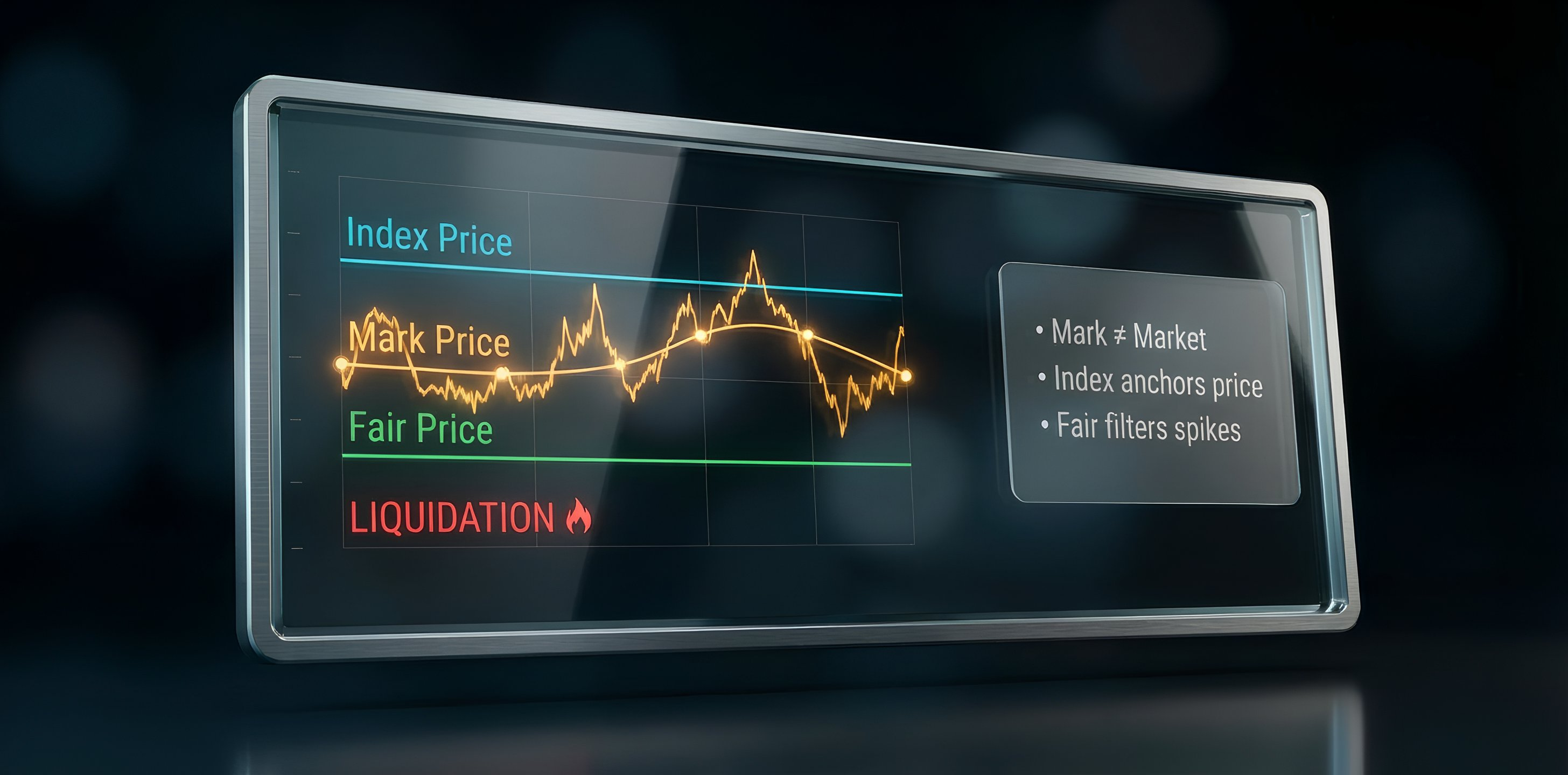
🧩 How an exchange separates the calculated risk price from Last Price
- The role of Index Price
- Index Price aggregates spot sources and provides a reference point that depends less on one venue and one trade.
- Index Price is needed as the base for the calculated price, but by itself it is usually not the liquidation trigger.
- What Fair Price means
- Fair Price is a common label for the calculated risk price in some exchange interfaces, and in a typical implementation it matches Mark Price.
- If an exchange shows Fair Price, the relevant contract specification determines which exact price is used to calculate margin and the liquidation price.
- Why Mark Price is needed
- Mark Price sets the calculated price at which the exchange calculates unrealized PnL and checks whether there is enough margin before the liquidation threshold.
- Mark Price can differ noticeably from the candle during thin order book conditions and a widened spread because the calculated price does not have to repeat every individual trade by Last Price.
- The Mark Price formula includes adjustments to Index Price, and the parameters of these adjustments are published in the specification of each contract on each exchange; a detailed breakdown of the calculation structure is provided in the main material.
If Mark Price differs noticeably from the candle, order book depth and the spread near the closing price explain why Last Price may become noisy; practical signs are collected in the market liquidity checklist.
⚡ Why liquidation is not triggered by the market price
Liquidation is tied to the calculated price, not to the latest trade:
- Liquidation is triggered when Mark Price reaches the level that the exchange shows as the liquidation price for the position.
- Last Price records the fact of the latest trade, but it can briefly move in a thin order book and is not suitable as a margin sufficiency criterion.
- A candle may cross the level by the latest price, but liquidation will not begin without a Mark Price crossing because the risk model checks margin using the calculated price.
If Mark Price has not crossed the liquidation level, a single trade by Last Price does not change the position status in the risk model.
🧭 Criteria for liquidation diverging from candles
Price source and closeout trigger
The divergence is almost always linked to the fact that the chart shows Last Price, while risk and margin are calculated using Mark Price (or Fair Price). For analyzing a mismatch between the level and the candle, the prices used by the specific contract matter.
- Mark Price and Index Price display: the calculated price and index lines show which price crossed the risk level at the moment of closure.
- Stop-order trigger source: the specification of the specific market determines which price triggers stops — Last Price or Mark Price, so the stop may come second after the liquidation trigger.
- Order book state near the level: a wide spread and low depth increase the chance that Last Price becomes noisy and the divergence from Mark Price becomes visible.
When risk is calculated using Mark Price, there may be no visual “candle touch” by Last Price even if the calculated price has already crossed the liquidation threshold.
⚠️ Interpretation limits of calculated prices
Index Price, Fair Price, and Mark Price are used as risk and margin reference points, not as trade execution prices.
- Mark Price does not cancel liquidation: during a sustained market move, the calculated price reaches the threshold together with the market, but it does not have to react to individual trades.
- Index Price is not a buy or sell price: it is a reference benchmark from external quotes that is needed as a base for calculations.
- Fair Price in an interface often means the calculated risk price rather than the “market price” of the candle, so the composition of the margin calculation depends on the specification of the specific contract.
❓ FAQ on price sources in derivatives
How does Index Price differ from the latest trade price?
Index Price aggregates spot quotes from several venues with outlier filtering, while Last Price is the price of one specific trade on one venue at a specific moment.
What exactly does Mark Price check during liquidation?
Mark Price is used to calculate unrealized PnL and check whether there is enough margin before the threshold: liquidation is triggered when the level is crossed by Mark Price, not by a brief candle touch through Last Price.
Why does one exchange show Fair Price?
Fair Price is often the interface name for the calculated risk price and in a typical implementation matches Mark Price; Fair Price participation in margin and liquidation price depends on the specification of the selected contract.
🧾 Why the liquidation threshold does not match the candle
Candles are built from Last Price — the price of the latest trade, so a single execution in a thin order book can briefly move the chart without confirmation from the calculated price.
The risk model uses Mark Price (sometimes labeled as Fair Price), which is built on the basis of Index Price and is intended for margin calculation and liquidation threshold checks.
If the stop and expectations are tied to Last Price while the liquidation threshold is calculated by Mark Price, the position may be forcibly closed without a visual “candle touch”.