In crypto derivatives markets, liquidation is determined not by the last trade price but by calculated benchmarks—Index Price and Mark Price. They are built from spot quotes and order book data so a single random trade can’t trigger liquidation. Mark Price is used to calculate unrealized PnL and to check the liquidation threshold. A brief price “spike” won’t liquidate a position unless the reference price crosses it.
📖 Why Index Price and Mark Price are used for liquidation
Index Price and Mark Price are calculated prices in the liquidation risk model. The risk model uses the aggregated market state rather than a single trade or a local price outlier.
- The last trade price can move because of one large order or a thin order book. If it were used as the trigger, one outlier could start a chain of liquidations.
- Index Price is the asset’s weighted average price across multiple spot sources. A deviation on one venue has less impact on the index and doesn’t become a market-wide liquidation signal.
- Mark Price is used to check margin conditions. A position enters the liquidation zone when Mark Price reaches the liquidation price, not when the last trade briefly touches that level.
A detailed breakdown of how these prices are calculated and used: Mark Price, Index Price, and liquidation: how the calculation works.
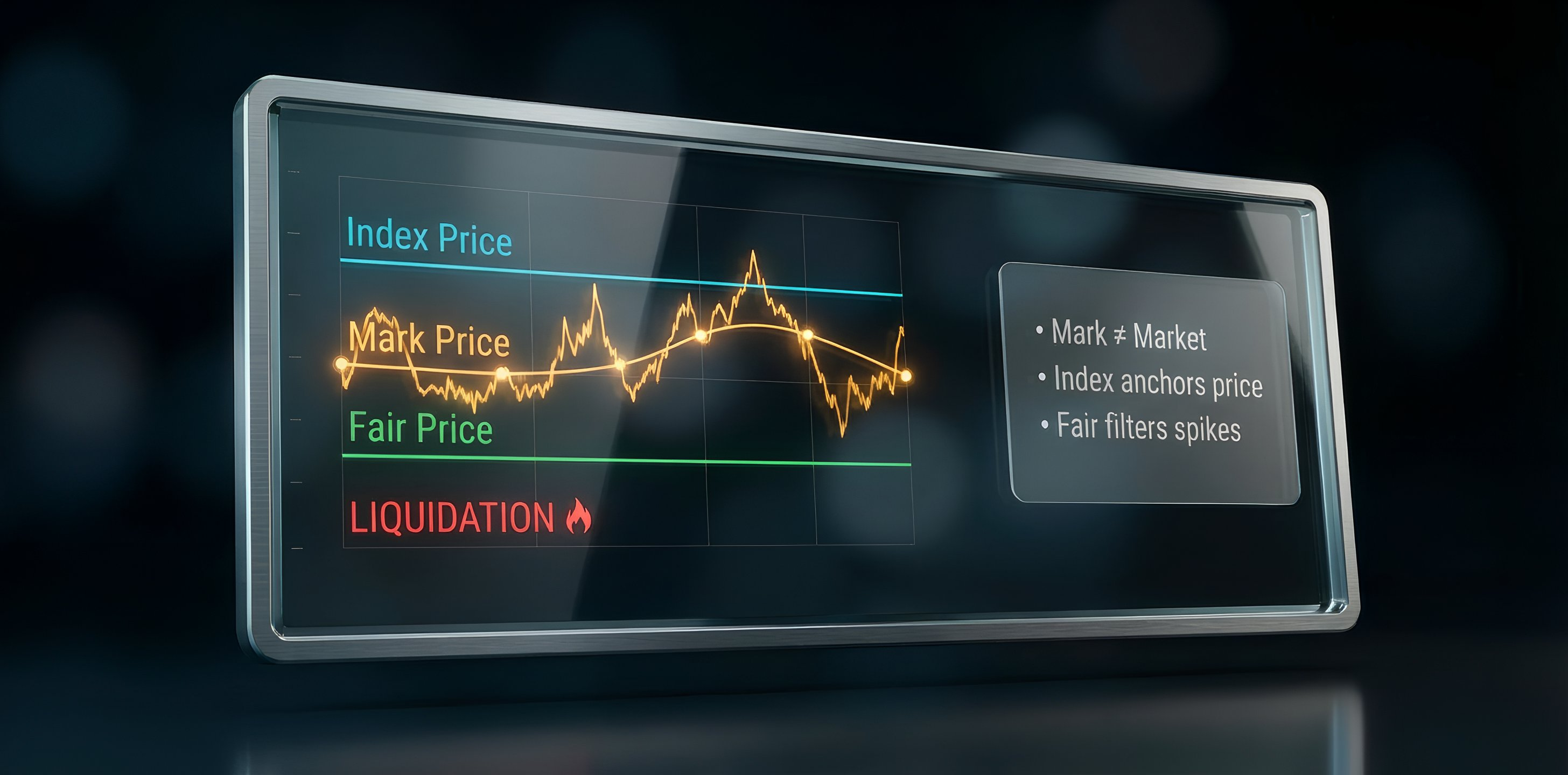
🛠 How Index Price, Fair Price, and Mark Price are calculated
- Index Price calculation
- Index Price is defined as the weighted average price of an asset across multiple spot sources.
- Extreme outliers are excluded so a single anomalous quote doesn’t shift the index.
- Fair Price formation
- Fair Price is calculated as the midpoint between the best bid and best ask from the order book at a specified liquidity depth.
- The calculation uses bid and ask quotes from the order book, not the last trade price.
- Mark Price construction
- Mark Price is built from Index Price and the contract price’s deviation from the index.
- This deviation is called the basis—the difference between the contract price and the index price.
- An EMA (exponential moving average) is applied to the deviation to smooth it, so a one-off price spike doesn’t change Mark Price instantly.
Fair Price and the stability of Index Price depend on the depth and distribution of orders in the order book. Practical signals are collected in the market liquidity checklist.
⚡ Why liquidation doesn’t trigger at the market price
Liquidation is tied to Mark Price, not the last trade:
- Liquidation triggers when Mark Price reaches the liquidation price derived from the position’s margin parameters.
- The last trade price records an execution, but it is not used as the condition for margin insufficiency in calculations.
- A short-lived outlier can push the last price through the liquidation level, but it won’t trigger liquidation without Mark Price crossing it.
Because liquidation uses Mark Price, a single trade does not change a position’s status until Mark Price moves to the liquidation level.
🧨 Typical triggers of divergence between Mark Price and the last trade price
Scenarios that distort the last trade price locally
A gap between Mark Price and the last trade price appears when individual executions do not match the aggregated state of the market.
- Thin order book: one market order moves the last price a noticeable distance when depth is low.
- Short volatility burst: liquidity on one side of the book temporarily disappears, and a series of trades prints at worse prices.
- Source anomaly on one venue: a brief deviation on a single exchange affects the last trade there but barely changes the aggregated index.
Mark Price follows the index and a smoothed basis, while the last price changes with individual executions without filtering outliers.
⚠️ Limits of interpreting reference prices
Index Price, Fair Price, and Mark Price are risk benchmarks, not execution prices.
- Mark Price does not prevent liquidation. In a sustained market move, Mark Price reaches the liquidation level along with the market, but it does not react to one-off spikes.
- Index Price is not a buy or sell price. It is a reference benchmark built from external quotes.
- Fair Price reflects an order-book-based price at a specified depth. When liquidity compresses, the calculated price shifts with the actual quotes.
❓ FAQ on Mark Price, Index Price, and Fair Price
How is Index Price different from the last trade price?
Index Price is a weighted aggregate price across multiple spot sources with outlier filtering. The last trade price is the price of one specific trade on one venue at one moment.
What exactly does Mark Price check during liquidation?
Mark Price is used to check whether the liquidation price is reached in margin calculations. If Mark Price crosses the liquidation level, the risk model initiates liquidation. The last trade price is not the trigger condition.
Are Fair Price and Mark Price the same?
Fair Price is a calculated order-book price at a specified depth. Mark Price is a contract reference price based on the index and a smoothed deviation of the contract from the index. Fair Price can be an input into Mark Price, but it does not replace it.
🧾 Why Mark Price matters more than the last trade price for liquidation
The last trade price is the result of a single execution. It depends on order book depth and local liquidity at the moment of the trade. Because of that, the last price can briefly deviate from an aggregated market estimate and not match the position’s margin-risk calculation.
Mark Price is used to check the liquidation price and is calculated from Index Price. A one-off trade does not trigger liquidation until Mark Price crosses the liquidation level.
Trigger condition: liquidation is driven by a calculated risk price, not by a local outlier in the last trade.