Why VWAP and TWAP matter when trading large size
A large order is rarely filled as one trade at one price: aggressive slices pay the spread and consume levels, limit slices join the queue, and slicing shifts price, so the average execution price usually differs from the initial expectation.
The goal is to explain VWAP (volume-weighted average price) and TWAP (time-weighted average price) as execution tools, show the key parameters, common mistakes, and ways to evaluate entry and exit quality across different markets.
When order size is noticeable, entry quality is defined by the spread, depth at the best levels, and the share of one-minute turnover consumed by execution; trade direction stops offsetting costs if slices regularly move to worse levels and worsen the average execution price.
VWAP and TWAP turn execution into a slicing plan: the interval, slice size, and stop rules for deteriorating conditions are defined; the limits tie execution speed to available liquidity rather than to a single large order submission.
With sufficient liquidity and correct parameters, VWAP/TWAP can reduce total spread and market impact costs (price deterioration caused by consuming depth with your own volume) and reduce the dispersion of the average execution price across comparable runs.
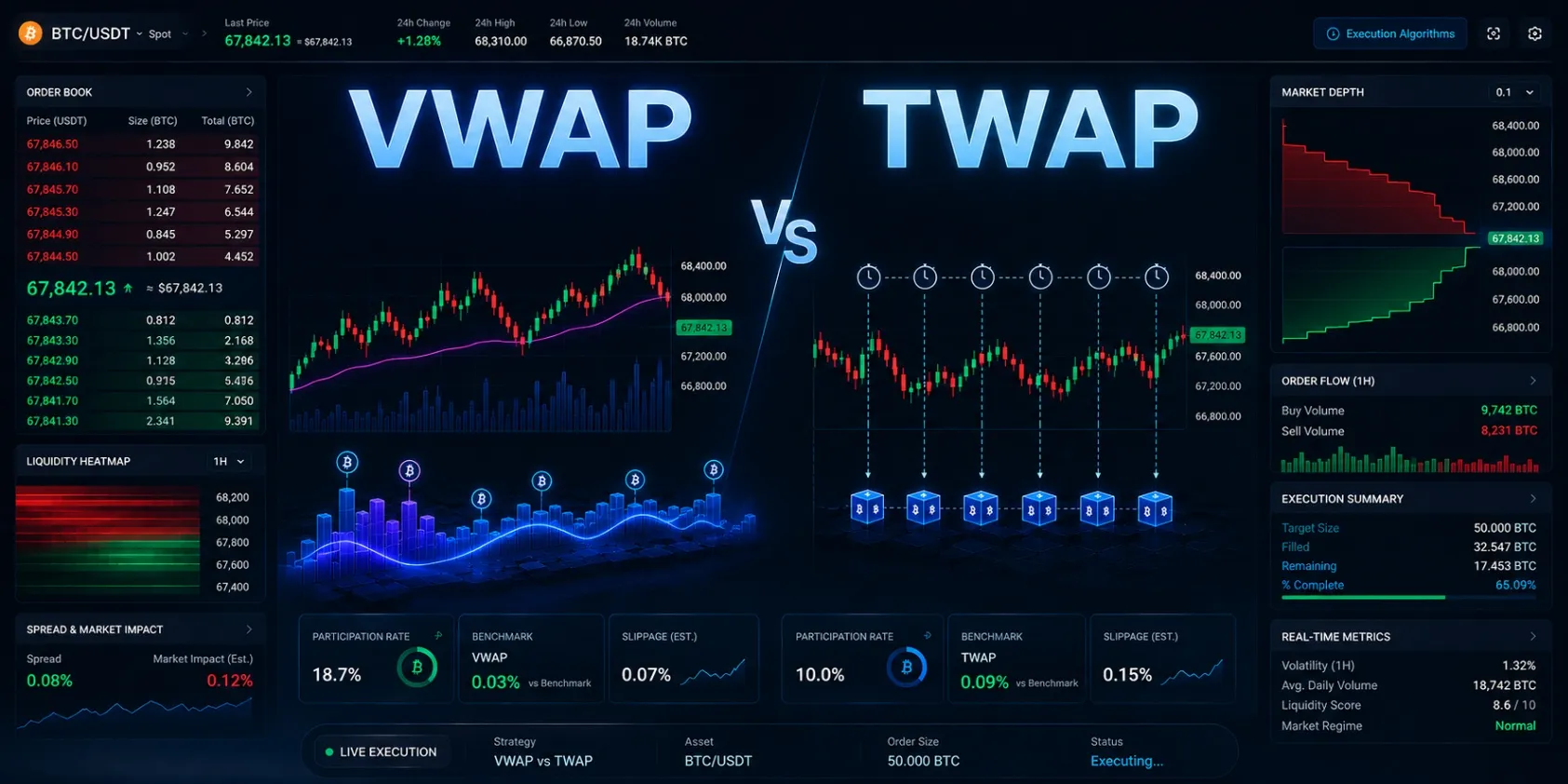
How VWAP and TWAP calculation affects the average execution price
An incorrectly selected calculation window distorts the benchmark (the average price used to compare the trade result) and worsens execution even when the trading decision is correct.
The deviation of the average trade price from the benchmark depends on which trades are included in the calculation and over what period. A horizon error changes the reference point during execution and reduces control over the average price.
- VWAP: the average price where each trade is weighted in proportion to its volume — larger trades affect the result more than smaller ones.
- TWAP: an average price calculated by time — each time interval has equal weight regardless of the trade volume inside it.
- Period: in equities, the calculation is usually tied to the trading session; in crypto, the period is defined by the execution task because trading runs continuously.
- Calculation reset: VWAP is recalculated from the start when the period changes, so the value at the beginning of the interval relies on a small amount of volume, while near the end it reflects the accumulated trade flow.
Mini VWAP example: three trades are executed during a period: buying 0.002 BTC at 50,000, then 0.006 BTC at 50,020, and 0.012 BTC at 49,980. Because the largest BTC volume was bought at the lower price, the final VWAP shifts downward and lands closer to 49,980 rather than to the simple average of the prices.
The key practical task is choosing the correct window. A period that is too short makes the benchmark sensitive to individual prints (executed trades in the tape) and one-off spread expansions. A period that is too long increases timing risk and creates lag against the current market.
Terms: Market impact — price deterioration caused by consuming depth with your own volume; Benchmark — the average price used to compare the trade result; Execution quality — the deviation of the average trade price from the selected benchmark; Spread — the difference between the best bid and the best ask in the order book.
The calculation window is tied to the execution task and stop rules: for entries, the critical limit is deterioration of the average price against the reference point; for exits, the focus is impact control and protection from depth gaps.
A separate variation is Anchored VWAP, where the calculation starts from a selected event, such as a local extreme or listing moment. This approach fixes the starting point and allows execution to be compared against the same market event.
An incorrectly selected execution benchmark can quietly turn a correct trade into systematic overpayment to the market.
VWAP and TWAP as execution benchmarks
VWAP and TWAP answer a practical execution question: how to enter or exit with large size without worsening price through your own trading activity.
Slippage is the difference between the price at which the order was intended to execute and the actual average trade price; slippage is formed by the spread, the order book queue, market impact, and price movement while the order is being sliced.
VWAP weights prices by volume: larger trades move the average more strongly; TWAP averages by time by splitting the order into equal intervals, so the schedule for sending slices is driven by time rather than by volume windows.
| Criterion | VWAP | TWAP |
|---|---|---|
| Principle | Following actual market volume | Even distribution over time |
| Optimal conditions | Clear liquidity peaks | Stable market without urgency |
| Key risk | Excessive activity in volume windows with a wider spread and sharp prints | Lag during directional movement |
| Market visibility | Medium, volume can be detected | Low due to evenly distributed slices |
Example: buying 2,000,000 USDT worth of BTC with one market order instantly consumes the best levels and worsens the average price; VWAP distributes volume during periods of dense liquidity, while TWAP stretches the purchase over time and reduces pressure on the order book.
In practice, VWAP and TWAP are used as execution references: the average trade price is compared with the market VWAP or TWAP over the same interval.
Execution quality changes with the spread, depth, and trade speed, even when the algorithm formula does not change.
VWAP/TWAP and market regimes: where the algorithm has an edge
The same parameters produce different results when market microstructure changes: order book depth, print speed, and the share of aggressive trades; choosing VWAP or TWAP makes sense only after these conditions are assessed.
Range conditions more often produce a more stable TWAP because even slices are distributed across price fluctuations without the need to chase movement; in this regime, the result more often depends on the spread and place in the limit order queue.
- Trend: a fixed TWAP lags and executes increasingly close to worse levels, so a price corridor and acceleration during periods of rising market volume are required.
- High volume window: VWAP is usually more effective because participation is distributed across higher turnover and less often creates price “steps”.
- News impulse: timing risk dominates, and depth can disappear at the best levels, so pauses are needed when the spread widens and depth falls.
- Thin liquidity: both modes require smaller slices and longer intervals between submissions; otherwise, each slice moves execution to the next level.
Example: an instrument moves into an impulse, volume rises, but the spread widens; VWAP with a participation limit executes more actively in volume windows, while TWAP without adaptation turns into a series of purchases during acceleration.
Signs of a regime shift:
- Depth at the best levels falls at the same time as the spread widens.
- The share of aggressive prints rises, and price starts jumping across levels.
- Deviation from the benchmark grows faster than executed volume increases.
VWAP/TWAP reduce the deviation of the average execution price from the benchmark when slice size, participation, and pauses change together with the spread and depth instead of staying fixed.
The final price deteriorates when the spread, order book queue, and impact simultaneously move order slices to worse levels.
What slippage and hidden execution costs consist of
Slippage consists of microstructure effects, and the share of each effect changes with liquidity, market regime, and the selected execution method.
- Spread: aggressive execution locks in the difference between bid and ask even when price does not move.
- Queue: limit orders are executed by price-time priority, so part of the volume may wait or remain unfilled.
- Timing risk: while the order is sliced, price moves against the position due to a trend, impulse, or news.
- Liquidity fragmentation: in stress regimes, the best levels “empty out”, and market orders jump across several levels.
Separate accounting for fees, spread, and slippage shows which part of the loss came from paying the taker role (a participant who removes liquidity with an aggressive order), which part came from waiting for limit orders in the queue, and which part came from depth impact.
VWAP and TWAP do not remove costs, but they shift the submission of order slices toward more liquid areas of time and volume, reducing the share of aggressive prints that regularly “eat” the best levels.
Execution quality is more often defined by order book depth, fees, and matching rules than by the difference between VWAP and TWAP as formulas.
Why venue choice and execution mode matter more than the formula
The execution algorithm runs inside the venue infrastructure; order book depth, order types, API (application programming interface for programmatic order submission) speed, limits, and matching logic often affect the result more than the VWAP or TWAP calculation.
For the same order size, the average execution price is usually better where depth at the best levels can absorb the flow of aggressive trades and does not turn into “gaps”; in crypto, this is visible in altcoins and impulse moves, when depth disappears faster than quotes update.
Mechanics: excessively frequent small submissions increase the number of aggressive executions and more often move slices to worse levels; in some regimes, less frequent but larger slices reduce the total number of “hits” on the best levels.
For large size, subaccounts, rate limit restrictions (limits on API request frequency), and quote stream stability matter; these constraints determine whether the strategy can adjust participation and pauses when depth falls or whether it executes the schedule without adaptation.
Comparing venues by depth and order book stability reduces impact and slippage risk under the same volume plan.
Venue choice and execution mode become part of the strategy because the venue and execution mode define the spread, depth, and cost of the taker and maker role (a participant who adds liquidity with a limit order).
The fee and the order role often change the final average price more than the choice between VWAP and TWAP.
Order types and fees: where VWAP and TWAP lose the most
When executing large size, the order type and fee model are often more important than the algorithm formula; the main losses arise when the strategy pays the spread where the market allows liquidity to be added with limit orders.
- Market: provides immediate execution but almost always pays the spread and increases price impact.
- Limit: allows price control and maker participation, but adds waiting risk and partial underfill risk.
- IOC/FOK (immediate-or-cancel / fill-or-kill): limit execution time and volume, reducing orders stuck in the queue.
- Post-only: fixes the maker role and a lower fee, but increases timing risk when the market moves.
- Iceberg: reduces visible limit volume, requiring precise sizing and refresh frequency settings.
Practice: VWAP is often implemented through a dominance of limit orders in volume windows to pay the spread less often; TWAP more often runs in a mixed mode where limit slices are supplemented by aggressive ones if the execution schedule falls behind.
Fee logic: on most venues, the maker fee is lower than the taker fee, and at VIP tiers the difference becomes material.
- Dominant taker execution means paying the spread and a higher fee at the same time.
- Maker orientation reduces fees but increases underfill risk when the market accelerates.
- The role ratio is defined by the task: a planned entry allows more maker slices, while an exit in a risk regime more often requires taker slices.
To evaluate the result, the average trade price is decomposed into fees, spread, and benchmark deviation; slicing loses value if the strategy systematically executes as taker and pays the spread on most slices.
A lower fee sometimes comes with higher underfill; during market acceleration, timing risk can be more expensive than the taker fee on part of the volume.
The choice between VWAP and TWAP directly affects slippage and how predictably the rhythm and slice size can be read in the trade tape.
When to choose VWAP and when to choose TWAP
The decision is defined by the liquidity profile and acceptable urgency; VWAP follows the price formed by volume over a period, while TWAP follows time-based execution with equal intervals.
Signs of a high-slippage regime:
- The trade takes a meaningful share of one-minute volume and quickly consumes the best order book levels.
- Depth is limited, and the spread widens even under moderate aggression.
- The flow is dominated by fast participants who react to the repeated rhythm of aggressive slices.
- Timing risk becomes more expensive than the benefit of even slicing during directional movement.
VWAP provides a more stable average price when volume is unevenly distributed and recurring liquidity windows exist; in these windows, the market absorbs larger volume without a sharp spread expansion or depth gaps.
TWAP is more convenient when there are no volume peaks and the execution schedule must stay less visible; evenly distributed slices reduce the probability that the trade side will be recognized from a series of similar aggressive prints.
Practice: in a trending market, a fixed TWAP often executes at a worsening price; in this regime, a hybrid is common, where the base TWAP accelerates when liquidity rises and slows down when the spread widens.
Choosing VWAP or TWAP makes sense only after assessing the spread, depth, and acceptable timing risk in the current market.
The final average price is more often shaped by the size and frequency of order slices, the price corridor, and participation than by choosing VWAP or TWAP as a formula.
VWAP/TWAP settings: parameters that actually matter
Interfaces often reduce VWAP and TWAP to one button, but settings define the result; the calculation horizon, slice frequency, price limits, and participation control determine how many times the strategy pays the spread and how deeply it “eats” the order book.
- Time horizon: the period over which the benchmark is calculated and the order is distributed — from minutes to several hours.
- Slice frequency: the interval and size of slices relative to current depth and trade speed.
- Deviation limit: a price corridor that restricts execution during adverse movement.
- Participation: the maximum share of current market volume that the strategy takes as part of the total trade flow.
- Pause rules: stopping execution when the spread widens, depth falls, or volatility rises.
A common mistake is using slices that are too small in an active market while expecting minimal slippage: the share of aggressive executions rises, and the strategy regularly pays the spread on every micro-move.
On centralized venues, execution through an API is often implemented with a custom bot; this option adds control over pause and participation rules, but transfers error handling and protection from duplicate submissions to the strategy.
Microstructure determines exactly how slices are executed: the order queue, tick size, and matching engine rules change the probability of limit execution and the price of aggressive slices.
In advanced configurations, the urgency parameter defines how often the strategy pays the spread for speed; higher urgency usually increases the share of taker execution and worsens the average price.
Without predefined limits, an algorithm can easily complete the volume plan at the cost of systematic overpayment through spread and impact.
Execution risk management: limits, pauses, and acceptable price deterioration
VWAP and TWAP are controllable only with defined constraints; without boundaries, the algorithm may execute the volume while regularly moving to worse levels because of a wider spread and declining depth.
Execution risk is the probability of receiving an average execution price worse than the strategy’s acceptable threshold due to spread, queue, and impact; in practice, execution risk is defined as a number: the maximum deviation from the benchmark, including fees and acceptable urgency.
What should stop or slow the execution algorithm:
- Deviation from the benchmark exceeds the threshold while executed volume remains low.
- The spread widens to a level where aggressive execution becomes more expensive than expected.
- Depth at the best levels falls, and each slice moves execution to the next level.
- The market accelerates, and price moves faster than the execution schedule.
- Quote or order submission failures appear, causing the strategy to lose participation control.
For entries, limits on the spread and the share of taker execution are usually sufficient; for exits, the framework is stricter because aggressive slices deplete depth faster and move following slices to worse levels.
Working parameter framework:
- A limit on the taker execution share so fees and spread do not consume the benefit of slicing.
- A price corridor relative to the reference price (the selected benchmark or decision price) that limits mechanical price chasing.
- Pause and restart rules for waiting until the spread narrows and depth recovers.
Execution risk management works when constraints set the acceptable loss limit in advance and stop execution when the spread widens and depth falls.
An operational execution plan reduces impact and errors more reliably than trying to “tune” one parameter in the moment.
Step-by-step plan for entering and exiting with large size
The process connects liquidity assessment, benchmark selection, and quality control into one sequence of actions; this order applies to crypto markets and traditional venues.
- Define the execution task and benchmark.
- Set the priority: speed, discretion, or minimizing deviation from the reference.
- Select the comparison metric: VWAP, TWAP, or implementation shortfall.
- Define acceptable price deterioration in percentages or points.
- Assess liquidity and market regime.
- Analyze order book depth and gaps that cause market slices to jump levels.
- Compare conditions across several venues when parallel markets exist.
- Check whether the order size is proportionate to the instrument’s one-minute turnover.
- Configure slicing and adaptation rules.
- For VWAP — a participation profile with increased activity during dense liquidity periods.
- For TWAP — a slice schedule and pauses when the spread widens.
- A price corridor and limits on chasing market slices.
- Monitor execution in progress.
- Track the average price and deviation from the benchmark in real time.
- Monitor the taker execution share and impact growth as the plan is completed.
- Pause when the order book deteriorates, API failures occur, or volatility rises.
- Review after execution.
- Compare the result with VWAP/TWAP and the decision price.
- Break losses down by source: spread, impact, or timing risk.
- Adjust slice size, participation, and the price corridor to current liquidity.
Practice: when exiting a position, reducing speed sometimes produces a more stable average price than accelerating execution; in a thin market, aggression quickly depletes the best levels and moves following slices to worse prices.
A fixed sequence of steps makes execution reproducible: each run has the same checks, the same limits, and the same quality control.
The execution scenario determines the final average price more strongly than small changes to individual settings.
Scenarios where VWAP and TWAP have the strongest effect
Execution algorithms are most useful where manual entry becomes a choice between an aggressive market hit and waiting for limit orders; scenario selection fixes the regime, benchmark, and limits before launch.
✅ Where algorithms help
- Planned portfolio rebalancing with priority on a stable average price.
- Exiting a position in a thin market where impact control is critical.
- Accumulating a liquid asset with clear volume windows.
- Execution within a risk budget with a defined price corridor.
❌ Where algorithms can underperform
- A strong trend with high urgency, where timing risk becomes dominant.
- Low liquidity and a wide spread that make slicing economically inefficient.
- Markets with decorative liquidity, where depth disappears as price approaches.
- Insufficient error control, including API failures and duplicate order submissions.
Accumulation scenario: a large entry into a liquid asset is often executed through VWAP with a participation limit so the strategy does not take too large a share of current volume; exiting a position is often compared with TWAP because an even schedule reduces the risk of a price drop from a series of large aggressive slices.
Scenarios are easier to connect with the state of the order book: with dense depth, VWAP more easily keeps the average price close to the market, while with fragile depth, pauses and impact limits matter more regardless of the selected benchmark.
Connecting the execution mode with the market phase helps choose speed and slice size through spread and depth rather than through a subjective assessment.
Scenario-based selection turns VWAP and TWAP into working modes with a predefined schedule, limits, and stop rules.
The execution profile simplifies choosing VWAP or TWAP through specific parameters: volume participation, slice size, and pause rules.
Two basic execution profiles: VWAP and TWAP
VWAP and TWAP differ in how they interact with liquidity; the focus is on how the average trade price is formed and which slices create costs.
VWAP execution as volume-following
A VWAP algorithm adapts the execution schedule to market volume by increasing slice submission during periods of higher activity and greater depth.
- Effective for instruments with recurring volume windows and stable order book depth.
- Used as a reference: the average trade price is compared with the market VWAP over the same period.
- Handles short-term impulses better when pauses are used during spread expansion.
- Requires participation control because a high participation share makes the source of volume visible and increases impact.
VWAP is appropriate when the goal is to receive an average price close to the market price over the execution period without taking too large a share of current volume.
TWAP execution as even order release
A TWAP algorithm divides the order into equal time intervals and sends slices according to a schedule, reducing the probability of a one-time hit to depth.
- Suitable for long entries and exits where duration matters more than precise alignment with volume windows.
- Reduces visibility if slice size and intervals do not form a repeatable aggressive pattern.
- Provides a predictable volume schedule and is convenient for planned rebalancing.
- During directional movement, worsens price if the market moves faster than the execution schedule.
Pure TWAP is stable in calm regimes; during market acceleration, TWAP is supplemented with spread-based pauses and acceleration when liquidity rises so execution does not become “chasing”.
Separating VWAP and TWAP into execution profiles helps select the mode through measurable parameters: spread, depth, participation, and timing risk.
Algorithm combinations help preserve discretion and price control where base modes no longer cope.
Advanced combinations: POV, icebergs, and dynamic corridors
VWAP and TWAP are often used as base execution modes, but in real trading they are strengthened with additional mechanisms. Combinations reduce predictability, limit impact, and improve average price stability.
- POV (percentage of volume): the algorithm executes the order as a fixed share of current market volume, automatically increasing activity during periods of high liquidity and reducing it when turnover falls; execution pace is defined by the market, not by a predefined schedule.
- Iceberg: only part of the limit order is displayed in the order book, while the remaining volume is released in portions, reducing visual visibility.
- Limit corridor: a rule that prohibits execution beyond the acceptable deviation from the reference price.
- Randomization: controlled randomness in intervals and slice sizes that reduces pattern detectability.
- Maker-bias: a shift toward limit orders to add liquidity more often and save on the spread.
Example: exiting a 500,000 USDT position in a low-liquidity pair is implemented through TWAP with iceberg limits inside a price corridor. If the market accelerates, part of the volume moves into a more aggressive mode with pauses when the spread widens.
In crypto, the additional risk is a sharp “drying up” of the order book in stress regimes. In these moments, limit orders are pulled faster than they are updated, so the algorithm must detect deteriorating conditions and automatically reduce aggression.
Without metrics, average price deterioration appears gradually: spread and impact growth is “spread out” across slices and is not visible in the moment.
How to measure execution quality: VWAP, TWAP, and implementation shortfall
Execution quality is evaluated with numbers, not impressions; metrics allow algorithms, venues, and parameters to be compared under the same volume plan and a comparable market.
Implementation shortfall compares the decision price with the final average trade price; the difference includes timing, impact, and spread costs during execution.
VWAP and TWAP are convenient reference points over the execution period, but they do not fix the decision price; implementation shortfall is used when the final entry or exit price must be measured relative to the decision moment.
- VWAP deviation: the difference between the average trade price and VWAP over the execution period.
- TWAP deviation: the difference between the average trade price and the time average over the same interval.
- Taker execution share: the ratio of aggressive trades to volume that adds liquidity.
- Time distribution: moments when losses occur and the connection between losses, spread, and depth.
- Result stability: changes in deviations in calm regimes and during impulses.
What to record in the execution journal:
- The decision reference price and defined execution period.
- The average trade price and median executed print.
- Fees separately from spread and slippage.
- The number of partial fills, cancellations, and resubmissions.
- The spread and order book depth dynamics during execution.
When the spread widens and depth falls, deviation from VWAP/TWAP grows even with the same slice schedule; under these conditions, slicing parameters and pause rules need revision.
Differences in market microstructure determine how often the strategy pays the spread and how deeply it “eats” the order book under the same volume plan.
How VWAP/TWAP behave in equities, futures, crypto, and FX markets
The same parameters in different markets produce different execution quality; the reason is differences in trading hours, recurrence of volume windows, and liquidity structure.
Stocks and ETFs (exchange-traded funds): sessions, auctions, and stable volumes
In stocks and ETFs, the volume profile often repeats: activity is concentrated at the open and close of the session, while the middle of trading usually has moderate liquidity.
- VWAP is widely used as a reference for evaluating execution quality within the trading session.
- TWAP is suitable for planned trades and rebalancing without strict speed requirements.
- Opening and closing auctions change depth and require a separate execution mode.
- Queue position and tick size affect the probability of limit execution under maker-bias.
A repeatable volume profile simplifies calibration: the execution window and participation can be tied to the open, middle, and close of the session.
Cryptocurrencies and perpetuals: 24/7 trading and liquidity gaps
The crypto market runs 24/7, and depth can change sharply across time and venues, especially in altcoins and derivatives.
- VWAP is more stable on highly liquid pairs where depth can absorb slicing without sharp steps.
- TWAP helps stretch execution and reduce impact when there is no urgency.
- In derivatives, liquidation cascades quickly deplete depth and worsen the average price.
- Different exchanges provide different depth and fees, so venue choice affects the execution result.
During impulses, a strategy without pauses executes at worsening levels: the spread widens, depth falls, and slices jump levels.
In cross-exchange strategies, execution quality depends on spread and depth no less than on latency and fees.
In the FX (foreign exchange) market and CFDs (contracts for difference), the result depends on liquidity providers and execution mode; during news impulses, slippage rises when quotes update faster than orders are matched.
Stop conditions define the moment when execution stops because of spread, falling depth, or market acceleration.
Algorithm stop conditions: how not to “push” the market with your own order
Even a correctly configured VWAP or TWAP worsens the result if it continues running during liquidity deterioration; stop conditions define the boundaries within which execution remains economically comparable with the task.
- Spread trigger: a pause when the spread widens to a level where aggression becomes more expensive than expected.
- Depth trigger: a stop if volume at the best levels falls and slices start moving execution to the next level.
- Volatility trigger: lower aggression during market acceleration to avoid executing in chase mode.
- Impact limit: a pause if deviation from the benchmark grows faster than executed volume.
- API trigger: a stop when submission errors, duplicate orders, and order book data desynchronization appear.
Condition example: if the average price has worsened by 0.35% relative to the reference price after only 20% of the plan is completed, the algorithm reduces volume participation and switches to limit mode; repeated deterioration triggers a pause until depth recovers.
In practice, total volume is sometimes split into mandatory and optional parts: the mandatory part is executed even if costs rise when position risk is higher than execution cost, while the optional part is active only under normal spread and depth.
Stop conditions protect against execution into order book gaps, where each slice jumps levels and accelerates average price deterioration.
What is usually reviewed after a pause:
- The reference price, if the market has shifted and the previous corridor is no longer relevant.
- Slice size and intervals to reduce pressure on the best levels.
- Depth on alternative venues and volume distribution.
- The presence of a chase mode if speed has become more expensive than average price control.
When exiting a position, stop conditions are especially important: aggression depletes the best levels faster and moves each following slice to a worse price.
Most overpayment comes from slice size, participation, and missing pauses, not from the VWAP or TWAP formula itself.
VWAP/TWAP mistakes that quietly turn execution into overpayment
VWAP and TWAP problems are more often linked to how the strategy interacts with the order book, spread, and market regime; the mistakes look harmless but regularly move slices to worse levels and worsen the average price.
- Excessive urgency: execution turns into a chain of market orders with constant spread payment.
- Slices not proportionate to depth: each slice “eats” a level and shifts price against the trade.
- Identical parameters for different regimes: range conditions and impulses require different frequency and different limits.
- No price corridor: the strategy starts chasing the move and increases timing risk.
- Excessively small slices: the taker execution share rises, while noise and spread worsen the average price.
- No spread and depth pauses: execution continues at the moment liquidity deteriorates.
Example: TWAP in a directional market keeps buying at higher prices because of a rigid schedule; the deterioration is created by execution schedule lag, not by “the market itself”.
Parameter check before launching VWAP/TWAP:
- Slice size is aligned with volume at the best levels without price steps.
- A deviation limit from the reference price and a reaction to leaving the corridor are defined.
- Spread and depth pauses are defined to protect against order book gaps.
- The acceptable taker execution share is fixed.
- The execution window matches the task, and speed is not purchased unnecessarily.
Model limitation: when depth falls sharply, planned execution can become more expensive than pausing, reducing volume, or changing the venue.
The answers fix practical criteria: what to compare with the benchmark, when to pause, and how to identify rising impact.
FAQ on order execution with VWAP and TWAP
Are VWAP and TWAP indicators or order types?
VWAP and TWAP are used in two roles: as indicators, they display the average price on the chart; as execution algorithms, they slice an order and form the average trade price that is compared with the benchmark.
Can VWAP/TWAP fully remove slippage?
Slippage cannot be fully removed because of the spread and changing depth; VWAP and TWAP reduce impact and distribute slices, but in stress regimes depth can disappear faster than the schedule executes.
What matters more: slice size or order submission frequency?
The result is defined by the combination of slice size and submission frequency: large slices increase impact, while overly frequent small slices increase spread payment and raise the taker execution share; a workable balance ties slice size to depth and accounts for pauses when the spread widens.
How can you tell that an algorithm has become visible to the market?
Signs include rising impact under the same parameters, worsening average price under comparable volatility, and stronger movement against the position after a series of similar aggressive slices; randomizing intervals and shifting toward maker execution reduce pattern repeatability.
Are VWAP and TWAP suitable for derivatives and futures?
They are suitable with stronger risk control: in derivatives, liquidation cascades quickly deplete depth, so the price corridor and spread/depth stop conditions are critical.
Which metric is more informative: VWAP deviation or implementation shortfall?
VWAP deviation is convenient for comparison with the market over the execution period; implementation shortfall measures the difference against the decision price and more accurately reflects timing impact; for quality control, it is useful to track both metrics.
Does it make sense to use VWAP/TWAP for small positions?
If the volume is small relative to depth, the price effect may be limited; at the same time, VWAP/TWAP define a verifiable execution schedule and compare the result with a benchmark rather than with a subjective assessment of a “good entry”.
As indicators, VWAP/TWAP show the average price on the chart, while as execution algorithms they slice the order; quality control relies on the spread, depth, taker share, and deviation from the reference price.
VWAP and TWAP are used to keep the average execution price within defined boundaries when the strategy limits participation, slice size, and stops execution when the spread widens.
✅ Practical use of VWAP and TWAP when executing volume
VWAP and TWAP work as execution modes for large orders, allowing impact, spread, and timing risks to be controlled: VWAP ties participation to market volume, while TWAP distributes slices over time according to a defined schedule.
The final average price depends not only on the averaging formula: order book depth, liquidity stability, order types, and fee structure determine how often the strategy pays the spread and how deeply it moves into the order book.
- VWAP is more stable during recurring volume windows and dense depth.
- TWAP is convenient for planned entries and exits without speed priority.
- Slice size mistakes and the absence of a price corridor worsen the result more than the choice of algorithm.
- Spread and depth pauses reduce the risk of chasing execution at worsening levels.