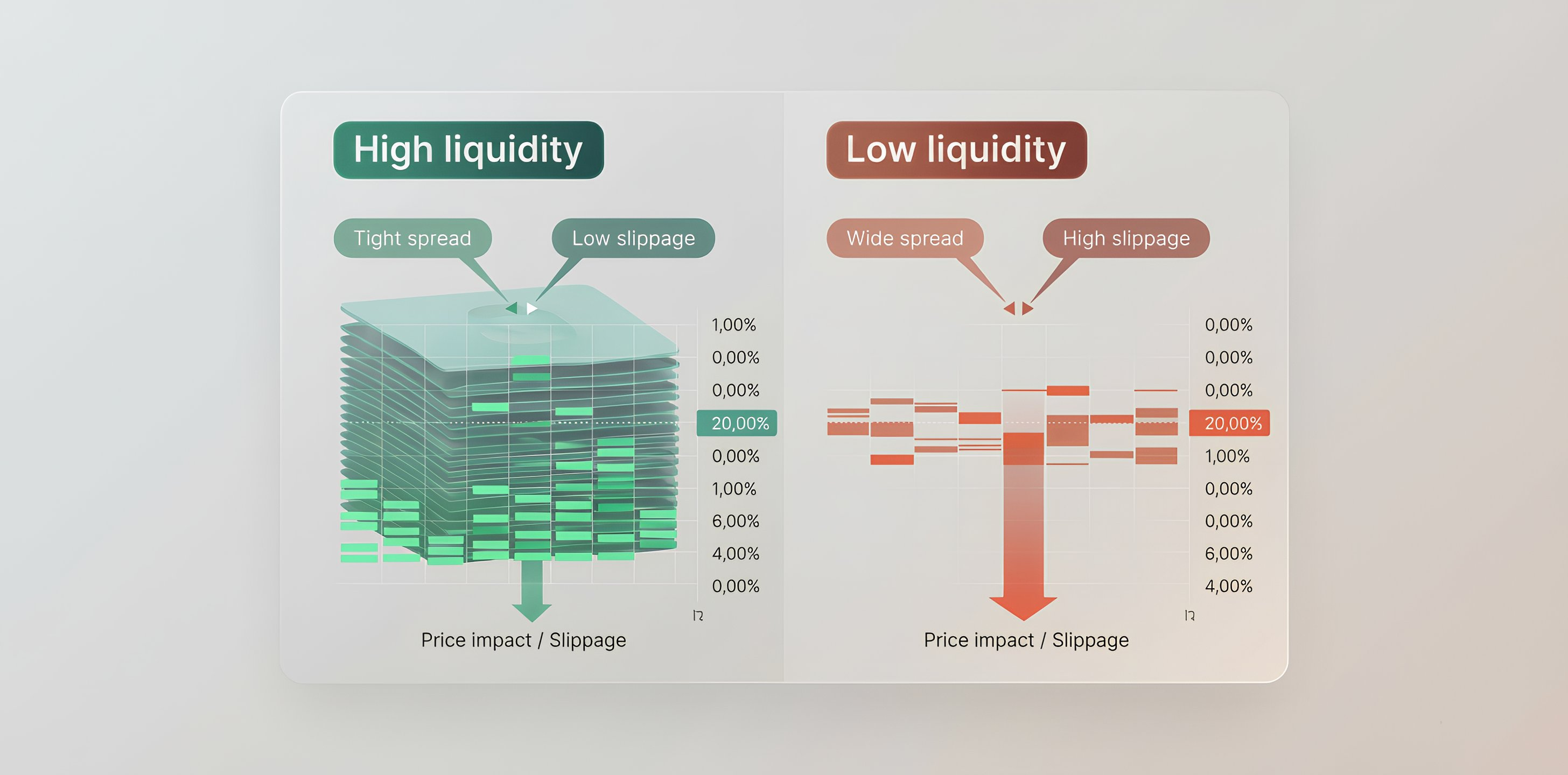
Liquidity is the amount of opposing orders or reserves sitting near the current price that can absorb your trade without requiring a large price concession. When there isn’t enough opposing volume close to the price, part of the order gets filled at worse, farther levels, and your average execution price shifts.
Goal of this article: to explain what “liquidity” means on an exchange and in DeFi, and why it describes execution costs—not the quality of the asset.
⚙️ Where liquidity comes from
Liquidity exists wherever there is opposing volume ready to take the other side at prices close to the current quote.
On a centralized exchange, liquidity is provided by limit orders in the order book (the list of buy and sell orders). The denser those orders are around the current price, the less your trade pushes your average execution price.
In DeFi, liquidity is typically held in a liquidity pool (a reserve of two tokens used for swaps). A smart contract (a program on the blockchain) executes the swap, and the price changes as the trade alters the token balances in the pool.
🧱 What liquidity does not tell you
Liquidity describes how “expensive” execution will be due to limited opposing volume, but it does not describe asset quality or venue reliability.
High liquidity does not make the price stable. It means trades clear faster and large sizes can move through the market more easily—so price can still change quickly if participants collectively shift direction.
Liquidity does not protect you from asset-specific problems. A stablecoin can lose its $1 peg (depeg—a stablecoin trading away from $1) due to collateral issues, and in that case liquidity only means you can exchange the asset at the current market price.
High daily trading volume does not guarantee a good price for a large order. For size, what matters more is how much opposing volume is posted near the current price in the order book, or how much capital sits in the pool—because that’s what determines the shift in your average execution price.
Liquidity answers “what execution price will I get for this size,” but it does not answer “where will price go” or “how reliable is the asset.”
🧾 Liquidity recap
Liquidity shows how much opposing volume sits near the current price and how strongly a trade moves the average execution price. On a centralized exchange, liquidity lives in the order book; in DeFi, it lives in the pool’s reserves.
Liquidity is not a guarantee of price direction and not a sign that an asset or venue is “safe.” It describes execution quality for a given size, not the instrument’s “promise” or prospects.
Liquidity is opposing volume near the current price in the order book, or reserves in a pool, that limit how far a trade pushes your average execution price.