ADL and forced deleveraging risk in futures
ADL (Auto-Deleveraging) is a futures exchange clearing mode in which the risk engine reduces a position with positive Unrealized PnL (unrealized profit) without sending a market order into the order book.
Why can ADL close a profitable position? Because that profit is used to cover a deficit in obligations after liquidations.
The ADL queue ranking criteria are Unrealized PnL and effective leverage (the ratio of position notional to available margin); market signs of an obligations deficit include spread widening, declining order book depth, a series of liquidations, and divergence between Mark Price (the futures reference price) and Index Price (the aggregated spot price).
ADL is activated when a negative balance remains on contract obligations after liquidations, and the insurance fund — the exchange reserve used to cover negative balances — does not fully cover it.
The risk engine moves a position higher in the ADL queue when the position’s Unrealized PnL and effective leverage rise at the same time; spread widening and falling order book depth are market signs of a deficit, not individual ranking parameters.
ADL is more common during a series of liquidations, when liquidation market orders sweep through order book levels and the divergence between mark price and index price increases.
A position moves toward the front of the ADL queue faster when high Unrealized PnL, high effective leverage, and large position notional combine; spread and order book depth show the probability of an obligations deficit for the contract.
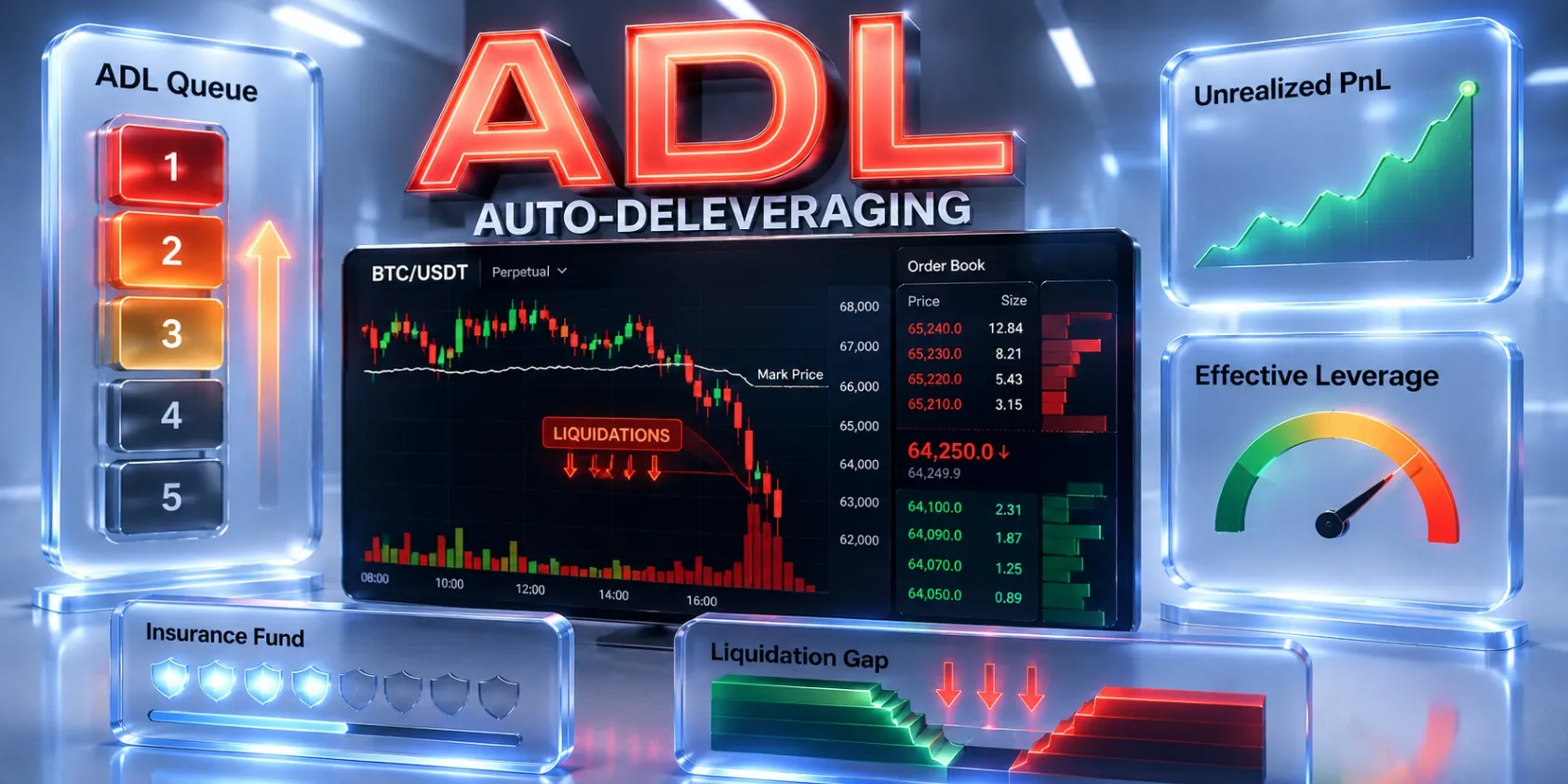
ADL is triggered after a negative balance appears on futures contract obligations when the insurance fund balance does not cover that balance.
What ADL is and why it exists in derivatives
ADL (Auto-Deleveraging) is a settlement mechanism for forced reduction of profitable positions that activates when losing positions cannot be closed without leaving a negative balance on contract obligations.
The derivatives market works as a system of mutual obligations: if a liquidation closes worse than the bankruptcy price, the account leaves a negative balance that the exchange settlement system must cover.
Risk mode: ADL is more likely during a series of liquidations, spread widening, and falling order book depth, when liquidation taker orders (orders that immediately take available liquidity from the order book) execute with slippage and close positions below the bankruptcy price.
Under normal conditions, the insurance fund covers the negative balance; if the negative balance exceeds the available insurance fund balance, the risk engine reduces profitable position size to cover obligations directly.
| Mechanism | Process logic | Who it affects | Typical trigger |
|---|---|---|---|
| Liquidation | Forced closure of a losing position | Positions with insufficient margin | Drop below maintenance margin |
| Insurance fund | Coverage of negative balances | Exchange settlement system | Liquidations executing below bankruptcy price |
| ADL | Targeted reduction of profitable positions | Positions with high Unrealized PnL and effective leverage | Negative balance above the insurance fund balance |
| Socialized loss | Proportional profit adjustment | A group of profitable accounts | The deficit is covered by adjusting group PnL without reducing specific positions |
On the account, ADL is recorded as a partial or full reduction of position size at the risk engine’s settlement price, which makes ADL critical for hedges and exit scenarios tied to a specific price.
A negative balance on obligations appears when a liquidation order executes below the bankruptcy price; the reason this balance can lead to ADL is explained in “What ADL is and why it exists in derivatives”.
How an exchange liquidates positions before ADL
Margin is collateral for a futures position: initial margin allows a trader to open a contract, while maintenance margin sets the level at which the risk engine starts forced closure.
How margin mode affects liquidation risk:
- Isolated margin limits the loss to the collateral of a specific position.
- Cross margin distributes margin requirements across the account balance and links positions through shared collateral.
- Risk limits (notional-based risk tiers) increase margin requirements as position notional grows and move the contract into stricter tiers.
Liquidations are calculated using Mark Price — a reference price that does not react to a single last-trade print; Index Price is the aggregated spot price to which mark price is anchored.
Example: a 1 BTC-PERP position with 20× leverage and $5,000 in collateral. A 5% price move against the position lowers the margin level; if it falls below maintenance, liquidation is triggered by mark price, not the last trade.
The risk engine tries to close the position near the bankruptcy price; execution below the bankruptcy price creates a negative balance that is covered by the insurance fund or by a settlement mechanism for covering an obligations deficit.
If a series of liquidations executes below the bankruptcy price, the negative balance grows faster than the insurance fund can cover it; when the insurance fund is insufficient, the exchange applies ADL or socialized loss depending on the settlement model.
See also: a breakdown of mark/index pricing and margin tiers is covered in Lighter DEX — overview of a perp exchange and mark price calculation.
The same negative balance after liquidations can be covered through ADL or socialized loss; these modes record the result differently for the position and for the account.
ADL and socialized loss: how the mechanisms differ
ADL and socialized loss cover the negative balance on obligations after liquidations; the difference depends on whether specific position size is reduced or the final PnL of an account group is adjusted.
| Approach | Who it affects | How the result is fixed | How it is recorded in the system |
|---|---|---|---|
| ADL (Auto-Deleveraging) | Selectively: positions with high Unrealized PnL and effective leverage | Full or partial reduction of position size | Position reduction event, ADL queue indicator |
| Socialized loss | A group of profitable participants | Proportional profit adjustment | PnL recalculation without changing position size |
| Insurance fund | Exchange settlement infrastructure | Coverage of the negative balance using reserves | The process does not affect positions when the fund is sufficient |
Result accounting: ADL changes position size and the average price of the remaining part; socialized loss changes final PnL without a position reduction event.
The probability of ADL and socialized loss rises when the spread widens, order book depth falls, and a series of liquidations executes below the bankruptcy price.
The ADL queue ranks positions by Unrealized PnL, effective leverage, and notional, so positions with the highest settlement burden are reduced first when an obligations deficit appears.
How the ADL queue is formed and why high-priority positions are reduced
The ADL queue ranks profitable positions by their ability to cover the negative balance on obligations: the risk engine accounts for unrealized profit, effective leverage, and position notional.
- High Unrealized PnL provides a larger amount of profit that can be realized when the position is reduced.
- High effective leverage increases the margin level’s sensitivity to a sharp price move.
- Large notional allows obligations to be reduced with fewer position reductions.
Position parameters that increase the probability of entering the ADL queue:
- High Unrealized PnL during a series of liquidations
- High effective leverage with a narrow buffer to the liquidation price
- Position notional close to the upper levels of risk limits
- Large position notional during an obligations deficit
- Increasing a profitable position without reducing effective leverage
Spread widening, declining order book depth, and rising OI do not determine a specific position’s place in the ADL queue, but they increase the probability of an obligations deficit for the contract.
In a futures interface, ADL risk is usually shown with a queue indicator that displays the position’s relative rank among profitable accounts.
Practical observation: a position with moderate Unrealized PnL and extreme effective leverage can rank higher in the ADL queue than a more profitable position with low leverage.
The exchange reduces the position whose reduction can cover the negative balance on contract obligations faster through the combination of Unrealized PnL, leverage, and notional.
A rising ADL queue indicator, increasing mark/index divergence, and shrinking distance to liquidation price can appear in the terminal before a liquidation cascade and ADL risk.
ADL risk metrics in an exchange terminal interface
Before ADL, the contract order book usually shows a wider spread and lower depth at the nearest levels, while mark price begins to deviate from recent trades more than usual.
- ADL indicator: a rising scale means the position is moving higher in the forced reduction queue.
- Mark Price and Index Price: a widening gap means the perp price is deviating noticeably from the index, and arbitrage alignment is weaker.
- Liquidation price: a shrinking distance means the margin buffer is falling or maintenance margin requirements are increasing.
- Risk limit and margin tiers: moving to a stricter tier increases maintenance margin as notional grows.
- Fees and execution mode: taker execution increases costs during a series of liquidations and forced reductions.
Interface scenario: the ADL indicator rises for several consecutive updates, the spread widens, mark price lags recent trades, and liquidation price shifts after the position moves to a stricter margin tier.
Obligations overload can be read through open interest (OI) — the amount of open positions — and funding rate — the periodic payment between longs and shorts that rises when demand for leverage becomes imbalanced.
See also: joint analysis of OI and funding is covered in Funding rate in cryptocurrencies: why it does not work without context.
Rising liquidation volume alongside rising OI means obligations are being closed by force while order book liquidity is insufficient, which increases the probability that the negative balance will not be covered by the insurance fund.
ADL appears at the end of the chain: spread widening and depth decline → series of liquidations → liquidations executing below bankruptcy price → reduction of profitable positions.
Step-by-step scenario: how the market reaches ADL
ADL appears after a sequence of events in which liquidation orders begin executing below the bankruptcy price and create a negative balance on obligations.
- Impulse and order book degradation
- A sharp price move widens the spread and reduces order book depth at the nearest levels.
- Mark Price diverges from recent trades more than usual because the order book is thin and arbitrage is delayed.
- Stop orders and market orders execute with slippage because order book levels are swept through.
- Series of liquidations and move acceleration
- The margin level of highly leveraged positions falls below maintenance margin, and the risk engine starts forced closure.
- Liquidation orders add taker pressure and amplify the price move.
- Volatility increases because of forced order flow, not because of a news impulse.
- Negative balance on obligations
- Liquidations close below the bankruptcy price because order book liquidity gaps appear.
- A negative balance forms on the contract and must be covered by the settlement system.
- The insurance fund balance declines as the series of liquidations continues.
- ADL as a deficit coverage mode
- The exchange reduces profitable positions according to the ADL queue.
- The reduction is recorded at the risk engine’s settlement price, not through a limit order in the order book.
- Priority is determined by Unrealized PnL, effective leverage, and position notional.
In ADL mode, the position result is determined by its place in the ADL queue and the state of the order book, not by the exit point selected in the strategy.
ADL realizes part of the profit at the risk engine’s settlement price and changes position size without sending an order into the order book.
How ADL affects closing price, PnL, and position structure
In normal mode, the exit depends on the selected order and order book liquidity; in ADL mode, the risk engine reduces the position at the settlement price to cover the negative balance on obligations (the mechanism is explained in “What ADL is and why it exists in derivatives”).
- Unrealized PnL on the reduced part of the position becomes realized PnL at the risk engine’s settlement price.
- The remaining position size receives a new average price and a new margin profile after recalculation.
- Fees and funding continue to accrue on the remaining size if ADL was partial.
Partial ADL example: a profitable 5 BTC-PERP position is reduced by 2 BTC. The result on 2 BTC is fixed through settlement, while the remaining 3 BTC continue to be accounted for at mark price and retain market risk.
Margin levels, liquidations, and ADL use mark price and index price, so profit based on the last trade may not match the settlement profit calculated by the risk engine.
See also: the link between obligations, liquidity, and price behavior across market phases is covered in Crypto market phases: accumulation, growth, and distribution.
After an ADL event, position size, average price, and liquidation price change, so previously placed take-profits and stops may no longer match the new size and new margin buffer.
Partial ADL leaves the position open, but changes size, average price, and distance to liquidation price in a single event.
Partial ADL: why a position is not always fully reduced
Partial ADL is applied when the negative balance on obligations can be covered by reducing part of the position without fully removing the exposure.
What changes in a position during partial ADL:
- Position size decreases, while the exposure direction may remain.
- Part of Unrealized PnL is fixed as realized PnL at the risk engine’s settlement price.
- Maintenance margin and liquidation price are recalculated for the remaining size.
- Average price and sensitivity to price movement change when the position was built through several entries.
Example: a profitable position of 10 contracts is reduced by ADL by 3 contracts. The result on 3 contracts is fixed through settlement, while the remaining 7 continue to be accounted for at mark price and carry market risk.
Practical effect: after partial ADL, current position size, maintenance margin, and liquidation price change, and the interpretation of active stops and take-profits changes with them.
Partial ADL changes position size and margin parameters, so orders placed for the previous size may no longer match the new exposure.
A position’s priority in the ADL queue rises with high effective leverage and high Unrealized PnL; cross margin and a move to stricter risk limit tiers change the position’s margin profile.
Margin mode, risk limits, and hidden ADL amplifiers
The same position notional can create different ADL risk because of margin mode, risk limit tiers, taker costs, and order book depth at the nearest contract levels.
✅ Factors that lower the probability of ADL
- Isolated margin limits the loss to the collateral of one position.
- Gradual profit realization reduces Unrealized PnL and lowers priority in the ADL queue.
- Limit orders reduce order book impact compared with a taker exit.
❌ Factors that increase ADL risk
- Maximum leverage increases the margin level’s sensitivity to a sharp price move.
- Cross margin links positions through shared collateral and increases the scale of obligations during a sharp price move.
- A thin contract with low order book depth increases the probability that liquidations will execute below the bankruptcy price.
Risk limits increase maintenance margin as notional grows, so increasing a position can move the contract to a stricter tier and bring liquidation price closer.
Common mistake: increasing a profitable position without reducing leverage simultaneously increases notional, raises maintenance margin, and moves the position higher in the ADL queue because Unrealized PnL grows.
On low-liquidity contracts, a negative balance appears more often at the same volatility level because liquidation orders sweep through order book levels and execute below the bankruptcy price.
On altcoin perps, ADL occurs more often because of lower order book size, weaker mark/index anchoring, and liquidation gaps across levels.
Why ADL triggers more often on altcoins
The frequency of ADL on altcoins is linked to the order book and arbitrage: when depth is thin, the spread widens faster, and liquidation orders more often execute below the bankruptcy price (the deficit mechanism is explained in “What ADL is and why it exists in derivatives”).
- Limited order book depth: moderate taker volume quickly removes the nearest levels.
- Wide spread during a series of liquidations: slippage rises as the order book becomes thinner.
- Weak arbitrage between perp and spot: the mark/index divergence increases.
- High leverage concentration: a series of liquidations develops more densely across margin levels.
- Sparse order book levels: a small taker order moves the price across several levels.
Strategic conclusion: the same idea with moderate leverage on a more liquid contract usually creates less slippage than the same idea on a thin altcoin perp.
A rising ADL indicator on an altcoin often coincides with spread widening and falling order book depth; reducing leverage and realizing part of Unrealized PnL lower the position’s priority in the ADL queue.
A position’s priority in the ADL queue decreases when effective leverage and Unrealized PnL fall; a tight spread and high order book depth reduce the probability of an obligations deficit for the contract.
What lowers the probability of entering the ADL queue
ADL cannot be disabled at the position level; queue priority changes through effective leverage and Unrealized PnL, which the risk engine uses to rank profitable positions.
Effective leverage and partial realization of Unrealized PnL
Reducing leverage and realizing profit gradually reduce effective leverage and Unrealized PnL — two ADL queue ranking parameters.
- Reducing leverage lowers the margin level’s sensitivity to gaps.
- Partial profit realization reduces Unrealized PnL and lowers the position’s queue priority.
- Distributing take-profits across levels spreads the exit across several prices.
- Partially moving exposure into spot or a hedge lowers futures margin requirements.
Risk calculation: reducing leverage and realizing part of Unrealized PnL lowers the probability of forced position reduction through the ADL queue.
Position notional and risk limit tiers
Splitting a position reduces the probability of moving into stricter risk limit tiers, while notional control prevents maintenance margin from jumping as the position grows.
- Dividing exposure reduces the probability of reaching upper risk limit tiers with one contract.
- Reduce-Only mode prevents accidental notional increase while closing part of the position.
- Monitoring maintenance margin shows when a notional increase moves the position to a stricter tier.
- Reducing size before major events lowers the risk of being caught in a liquidation cascade.
Risk calculation: controlling notional and risk limit tiers reduces the probability that the position will move higher in the ADL queue because of margin requirements.
Order book depth, spread, and execution mode
A tight spread and high depth lower the probability that liquidations will execute below the bankruptcy price and create a negative balance.
- Liquid contracts absorb liquidation orders with less slippage.
- Limit exits reduce taker pressure compared with market orders.
- Short-term reductions before thin trading periods lower execution risk.
- Monitoring mark/index divergence shows when arbitrage alignment is weakening.
Risk calculation: order book depth and spread do not rank a specific position, but they affect the probability of an obligations deficit for the contract.
Reducing effective leverage and realizing part of Unrealized PnL directly lower ADL queue priority, while order book depth and spread affect the probability that a deficit will appear on the contract.
Common ADL myths that distort risk understanding
ADL is often mistaken for an exchange failure, but ADL is a settlement mode that reduces profitable positions when a negative balance appears on obligations.
- Myth: ADL is triggered by any high volatility
- Volatility is not an ADL trigger without a series of liquidations and execution below the bankruptcy price.
- The trigger is a negative balance on obligations that is not covered by the insurance fund.
- Myth: ADL affects only large positions
- Account size does not determine queue priority.
- Priority is determined by the combination of Unrealized PnL, effective leverage, and position notional.
- Myth: stop orders eliminate ADL risk
- A stop limits the position’s loss, but it does not prevent a negative balance during a series of liquidations.
- With a wide spread and thin order book, a stop executes with slippage and does not guarantee an exit price.
- Myth: cross margin always improves position resilience
- Cross margin links positions through shared collateral and increases the scale of obligations during a sharp price move.
- Rising notional and leverage move a position higher in the ADL queue even with positive PnL.
Core source of the mismatch: forced position reduction through ADL and slippage on stops and liquidations are more often linked to spread widening, falling order book depth, and a series of liquidations than to an error in price direction.
If a strategy does not account for spread widening and falling order book depth, actual stop and liquidation execution begins to deviate from the calculation precisely when market stress increases.
Market overload signals that correlate with ADL risk
ADL appears after obligations grow and a series of liquidations begins; rising open interest, funding imbalance, volatility compression, and lower order book depth point to dense margin levels where liquidation orders sweep more deeply through the order book.
- Rising open interest (OI) during a price move: the notional of open positions increases and raises the volume of forced closures during a sharp pullback.
- Extreme funding and a persistent imbalance: the perp price deviates from spot, and holding positions becomes more expensive for one side.
- Volatility compression before an impulse: margin levels move closer together and increase the density of liquidation zones.
- Declining order book depth while turnover rises: activity remains high, but the nearest order book levels empty out and amplify slippage.
Example: OI rises for several sessions, funding remains positive, and the price holds on shallow pullbacks; a sharp move triggers liquidations, the order book thins, liquidation orders close below the bankruptcy price, and a negative balance appears on obligations.
Reducing leverage, using isolated margin, and realizing part of Unrealized PnL lower the position’s priority in the ADL queue.
FAQ about ADL (Auto-Deleveraging)
Is ADL a form of liquidation or a separate settlement mechanism?
ADL is a separate settlement mechanism for forced reduction of profitable positions; the activation reason is tied to a negative balance on obligations after liquidations execute below the bankruptcy price.
Why can the system reduce a profitable position without an order?
When an obligations deficit appears, the risk engine reduces profitable positions with high Unrealized PnL and high effective leverage to cover the negative balance without sending a market order into the order book.
Which signs point to a higher probability of ADL?
A rising ADL queue indicator, wider spread, falling order book depth, rising mark/index divergence, and higher liquidation volume alongside rising OI increase the probability of an obligations deficit.
How effective is reducing leverage against ADL risk?
Reducing leverage lowers effective leverage — one of the ADL queue ranking parameters — and, all else equal, moves the position lower in the queue.
How is ADL fundamentally different from socialized loss?
ADL reduces the size of a specific position, while socialized loss adjusts profit proportionally across a group of accounts without changing position size.
Can ADL risk be fully eliminated in futures?
Full elimination is impossible because ADL depends on the state of the order book and the size of the negative balance; the probability decreases with lower effective leverage and lower Unrealized PnL.
How does a position change after partial ADL?
After partial ADL, position size, average price, and liquidation price change, so position parameters and active orders are interpreted relative to the new size and new margin buffer.
Does the choice of margin mode matter?
Isolated margin limits risk to the position’s collateral, while cross margin links the position to the overall account balance and increases the scale of obligations during a sharp price move.
A rising ADL queue indicator together with spread widening, falling depth, and accelerating liquidations increases the probability of forced position reduction.
ADL (Auto-Deleveraging) takeaways
Terminal metrics and position parameters that rise before forced reduction through ADL.
ADL reduces profitable positions according to the ADL queue; activation is tied to a negative balance on obligations and the insurance fund balance.
A position’s priority in the ADL queue decreases when effective leverage and Unrealized PnL fall; a tight spread and high order book depth reduce the probability of an obligations deficit for the contract.
- ADL indicator: a rising scale means the position is moving higher in the forced reduction queue.
- Spread and order book depth: spread widening and falling depth increase liquidation slippage.
- Mark Price and Index Price gap: a widening gap means the perp price is deviating from the index and arbitrage alignment is worsening.
- Distance to liquidation price: a shrinking distance means the margin buffer is falling or maintenance margin is rising.
- Funding and open interest: funding imbalance and rising OI increase the volume of obligations that are closed by force during a sharp price move.