Price does not react to news because the market prices in the surprise component of the event, not the fact of publication itself, and its effect on order flow. If expectations were priced in beforehand or opposing buy and sell orders absorb each other, the quote remains without sustained movement.
Purpose of this article: explain why price can stay range-bound after news and which market regimes most often neutralize momentum.
The core issue lies in the gap between the headline and the real order imbalance that moves price.
Why price reactions to news often look illogical
Traders expect price movement after hacks, court rulings, regulatory statements, and macroeconomic releases such as CPI (Consumer Price Index — a measure of consumer price changes). Reality often looks different: even a major exploit or a loud headline may produce a short impulse without continuation or no visible move at all.
The lack of movement disrupts expectations because the news is perceived as an obvious “bullish” signal for price growth or a “bearish” signal for price decline, while the market shows neutral dynamics — a typical perception trap explored in detail in the article on trader psychology.
A flat price after news does not mean there is no trading activity, and it cannot be reduced to “important” or “unimportant” without understanding how price formation works.
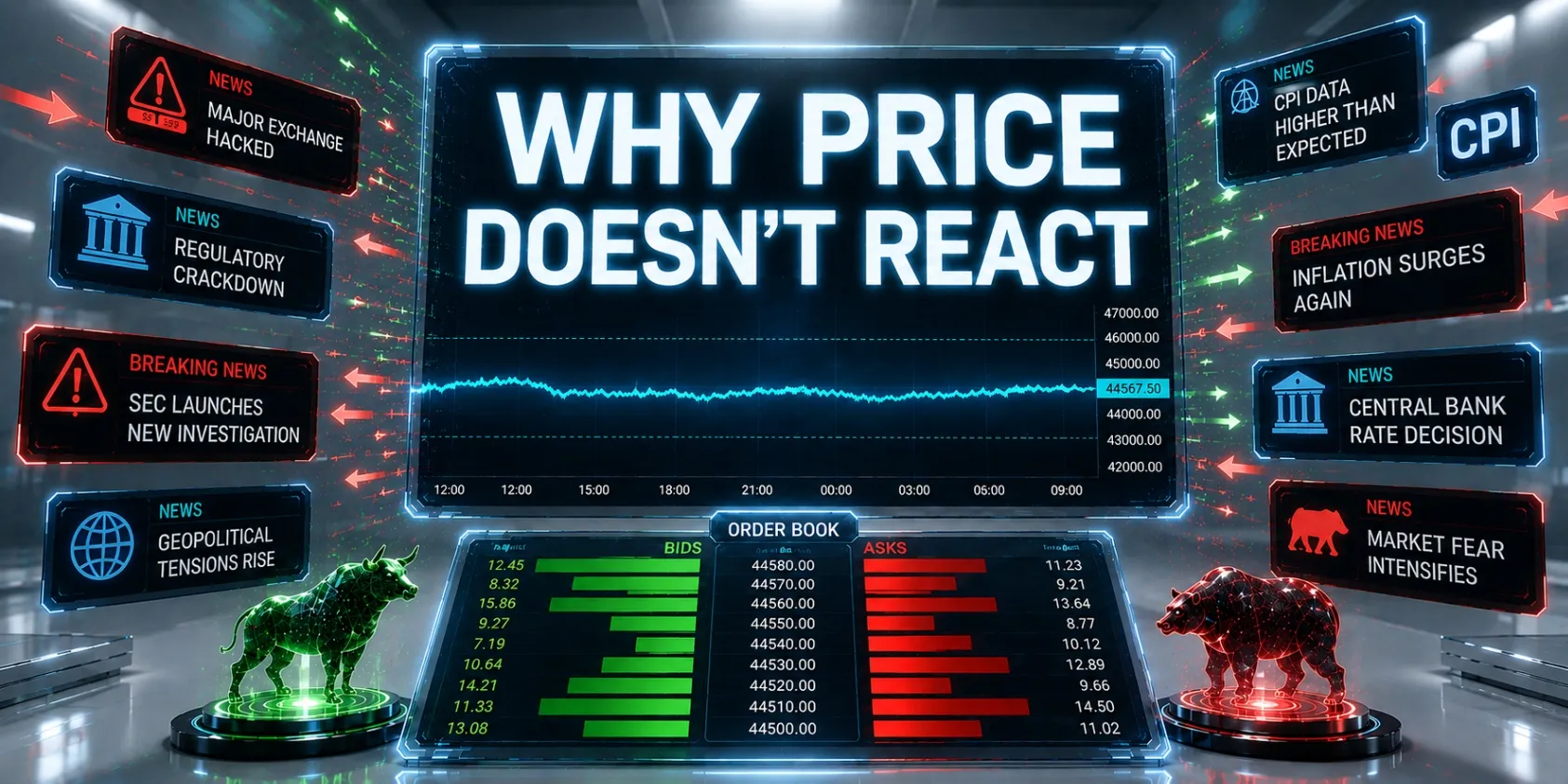
Price moves only when news creates a sustained demand or supply imbalance in the order book (a list of limit buy and sell orders) and in volume.
Mechanics: why news does not have to move the quote
How price reaction forms
An asset’s price forms through the balance between buyers and sellers. News moves price only when it changes expectations enough for one side to dominate orders and volume.
- Price does not move if the event was expected and participants had already positioned before the news release.
- Price stays range-bound when the news matches what the market already expected and does not create a new order imbalance.
Price changes not because news was published, but because the news does or does not create a new imbalance in orders and capital flows, which is directly linked to the probabilistic nature of markets rather than isolated events or trades, as explained in the article on probabilities in trading.
The reasons for a lack of movement are specific market regimes in which price receives no sustained impulse after news.
Reasons: why price may not move on news
- The news is already priced in
- Positions are built before publication when the event outcome is expected.
- At the moment the news is released, the market shifts to taking profit rather than opening new exposure.
- The event does not change demand for the asset
- The news does not affect network usage, capital flow, or demand structure.
- There is no reason for repricing even when the headline sounds dramatic.
- The broader market regime dominates
- The risk backdrop and direction of capital are stronger than a single news trigger.
- Local news does not change an already established market regime.
- Opposing trades absorb the impulse
- Buying and selling appear at the same time in comparable volumes.
- Price holds steady while the structure of positions changes.
- The level is defended by large participants
- Large holders buy into selling near the level to protect an existing position.
- This opposing order flow smooths the move and keeps price inside the range.
Price does not react to news if none of these regimes creates a sustained supply-demand imbalance.
A flat candle after news often leads to wrong conclusions because the chart does not show the distribution of opposing order flows.
Common misreads when price does not move after news
Common mistake: seeing a flat reaction and assuming the event does not matter. A zero reaction in the publication minute is not the same as no effect on capital allocation or on a horizon of weeks and months.
What cannot be concluded from a lack of price movement:
- If price did not move, the event is irrelevant.
- The market ignored the news.
- No reaction means there will be no movement later.
- A zero reaction by itself proves that price is being deliberately held through opposing orders.
A zero price reaction is not proof of “empty news” and is not proof of manipulation without data on opposing flows and liquidity (the available order volume for executing a trade without a sharp price shift).
The FAQ explains how to interpret the lack of an immediate price reaction to news.
FAQ on price reactions to news
Can price react later if there was no movement right after the news?
Yes. A delayed reaction appears when an event changes expectations, but the market waits for confirmation, a related factor, or an inflow of liquidity. In that case, price may remain range-bound until one side begins to dominate orders and volume.
What does “news is already priced in” mean in practice?
“Priced in” means that participants placed orders and took positions before the publication based on the expected outcome, so the fact of publication itself does not create a new imbalance. Signs of this regime include no surprise relative to the expected result and position-taking being closed into the event.
Why is a headline not a guaranteed signal for price movement?
A headline is not a signal because price reacts to the surprise component of the event, the change in demand, and the ability of capital to create a sustained order imbalance. If the outcome was expected or opposing flows offset each other, price may stay unchanged.
Lack of price reaction as a sign of order balance
Flat dynamics after publication more often describe a balance of opposing order flows and liquidity than the “emptiness” of the event.
A lack of price movement on news means the market did not receive a new demand-supply imbalance. Expectations may have been priced in beforehand, opposing order flows may have absorbed the reaction, and the liquidity regime may have prevented price from leaving the range.
At such moments, the chart reflects equilibrium, not indifference. News stops being a driver by itself and becomes either confirmation or noise inside the existing market structure.
Price reacts not to the wording of an event, but to surprise, the scale of capital redistribution, and participants’ ability to change the order balance.