Liquidity is a market condition where there are enough buyers and sellers ready to trade immediately, so a buy or sell order is executed quickly and close to the expected price. If there are few matching orders, the order moves through several nearby price levels and executes worse than the expected price.
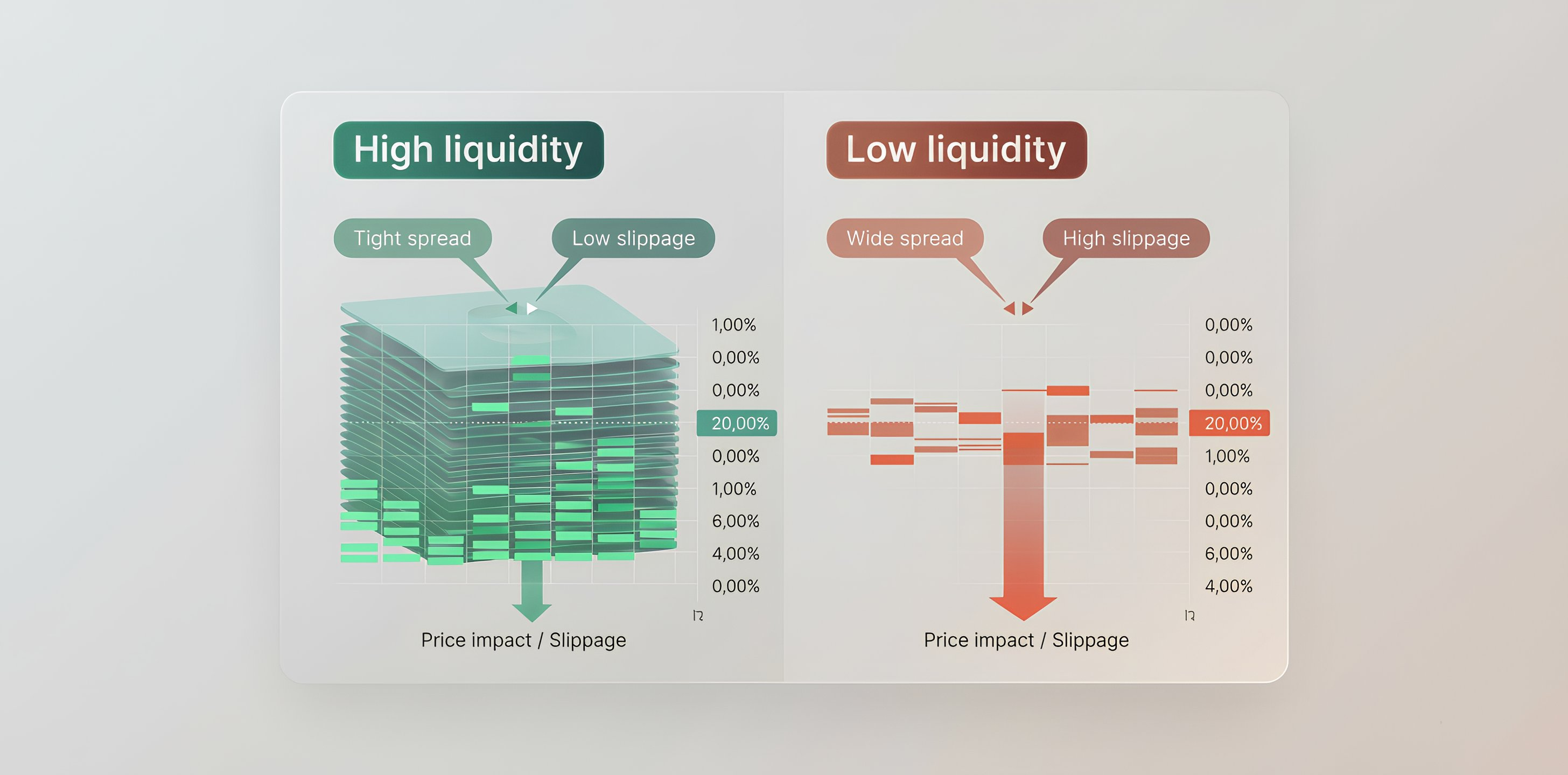
Low liquidity is visible through two things: the spread (the difference between the buy price and the sell price) and slippage (when a trade executes at a worse price than the one visible when the order was sent). The lower the liquidity, the wider the spread and the more noticeable the slippage.
✅ Checklist: how liquidity appears during a trade
Signs of high liquidity at the moment of a trade:
- The buy price and the sell price are close to each other (a narrow spread).
- After the order is sent, the trade executes almost at the price visible before the order was submitted.
- A meaningful trade size can be executed without a sharp price jump.
- There are many orders near the current price in the order book (the list of buy and sell orders) or enough funds in the liquidity pool.
🔄 How liquidity affects a trade step by step
Liquidity affects a trade in stages — from order submission to the final execution price.
- An order (a buy or sell request) enters the trading system;
- a market order executes immediately at the available prices;
- a limit order waits until a counterparty agrees to the specified price.
- The exchange matches the order with opposing orders;
- when liquidity is high, many orders sit nearby, so the price barely changes;
- when liquidity is low, there are few orders, and part of the trade moves to worse prices.
- The result of the trade appears in the execution price;
- the spread shows the difference between the buy price and the sell price at the moment of the trade;
- slippage shows how much worse the final price was than expected.
The less liquidity there is near the current price, the higher the risk of receiving a worse price than the one visible before the trade.
🎯 Why liquidity matters and what role it plays
Liquidity shows how close the trade execution price will be to the price visible before the order is sent.
- Liquidity allows the market to absorb trades without sharp price jumps because there are enough buyers and sellers nearby.
- With high liquidity, one trade has little impact on the price because there is enough volume in opposing orders.
- For beginners, liquidity is especially important when entering and exiting a position because the real trade price depends on how many orders are available nearby at that moment.
- If there are few nearby orders, the trade executes worse even when the chart does not show a sharp move.
- On large centralized exchanges, liquidity is usually higher for popular coins because many participants trade the same pairs, and some orders are supported by market makers (participants or algorithms that continuously place buy and sell orders to support trading activity).
The difference between trading through an exchange and swapping directly on-chain can be viewed in the article about DEX and CEX.
⚙️ How liquidity works on exchanges and in DeFi
Liquidity comes from two sources: orders in the order book or funds in a liquidity pool.
On an exchange with standard trading, liquidity sits in the order book (the list of buy and sell orders). The more orders there are near the current price, the easier it is to execute a trade without a noticeable deterioration in price.
In DeFi (decentralized finance), liquidity is often stored in a liquidity pool: a “basket” with two tokens used for swaps. The swap is executed by a smart contract (a program on the blockchain), and the price changes according to an AMM rule (automated market maker — an algorithm that calculates the swap price in a pool according to a preset rule), so the fewer funds there are in the pool, the more strongly a large trade moves the price. The basic mechanics can be viewed in the article about liquidity pools.
Which parameters worsen when liquidity is low
- The spread becomes wide: buying costs noticeably more than selling.
- Slippage increases: the final trade price differs from the expected price.
- A large order moves the price by itself, even without news.
On an exchange, the trade price depends on order density in the order book, while in DeFi it depends on the amount of funds in the pool.
📉 When liquidity disappears and what happens
Liquidity disappears when there are too few opposing orders or funds near the price.
- Trading activity falls, orders are removed, and little volume remains near the price.
- During news events, participants remove orders, reducing the volume of orders near the current price.
- In DeFi, liquidity contracts when funds are withdrawn from a pool or when the token balance becomes heavily skewed.
In all these cases, a trade begins to affect the price more strongly: the spread widens, and the final execution price differs from the expected price. Universal signs of declining liquidity — spread, volume near the price, and slippage — are collected in the liquidity checklist.
🧱 Boundaries of the concept: what liquidity does not show
Liquidity shows how a trade will execute, but it does not show whether an asset is “good” or how reliable a platform is.
High liquidity does not make the price stable. A liquid market simply allows many people to buy or sell quickly; if market sentiment changes, the price can also move quickly because trades pass through easily.
Liquidity does not protect against problems with an asset or a platform. For example, a stablecoin can lose its peg to $1 (depeg, when the stablecoin price deviates from $1) because of collateral issues, and liquidity at that moment only means the ability to swap it quickly at a falling price.
Large daily trading volume does not guarantee that a large trade will execute at a good price. What matters more is how much real volume sits near the current price in the order book or how many funds are held in the pool; if there is little nearby volume, a large order will still worsen the execution price.
Liquidity answers the question “how easy it is to enter and exit,” but it does not answer “where the price will go” or “how reliable the platform is.”
🧾 Liquidity review summary
Liquidity shows how easily a buy or sell can be executed at a price close to the current one without the trade itself noticeably worsening the price. In a liquid market, there are many opposing orders in the order book or enough funds in the pool near the current price, so the spread and slippage are usually lower.
Liquidity is not a guarantee of price direction and does not protect against problems with an asset or a platform. It describes trade execution quality, not “reliability” or “profitability.”
Liquidity is the presence of enough volume near the current price to buy or sell without a noticeable deterioration in price caused by the trade itself.