📖 Weex: Promoted Strengths and Real User Experience
Weex is a centralized crypto exchange (CEX). It is marketed as a platform for spot trading, futures, copy trading, and high-leverage strategies. In its promotional materials, the exchange highlights market depth, low fees, Proof-of-Reserves, meaning proof of reserves, and an insurance fund.
This article brings together recurring assessments and complaints from Trustpilot reviews and the wider trading community, including TradingView. The goal is to separate Weex’s stated advantages from actual user experience and identify areas of elevated operational risk.
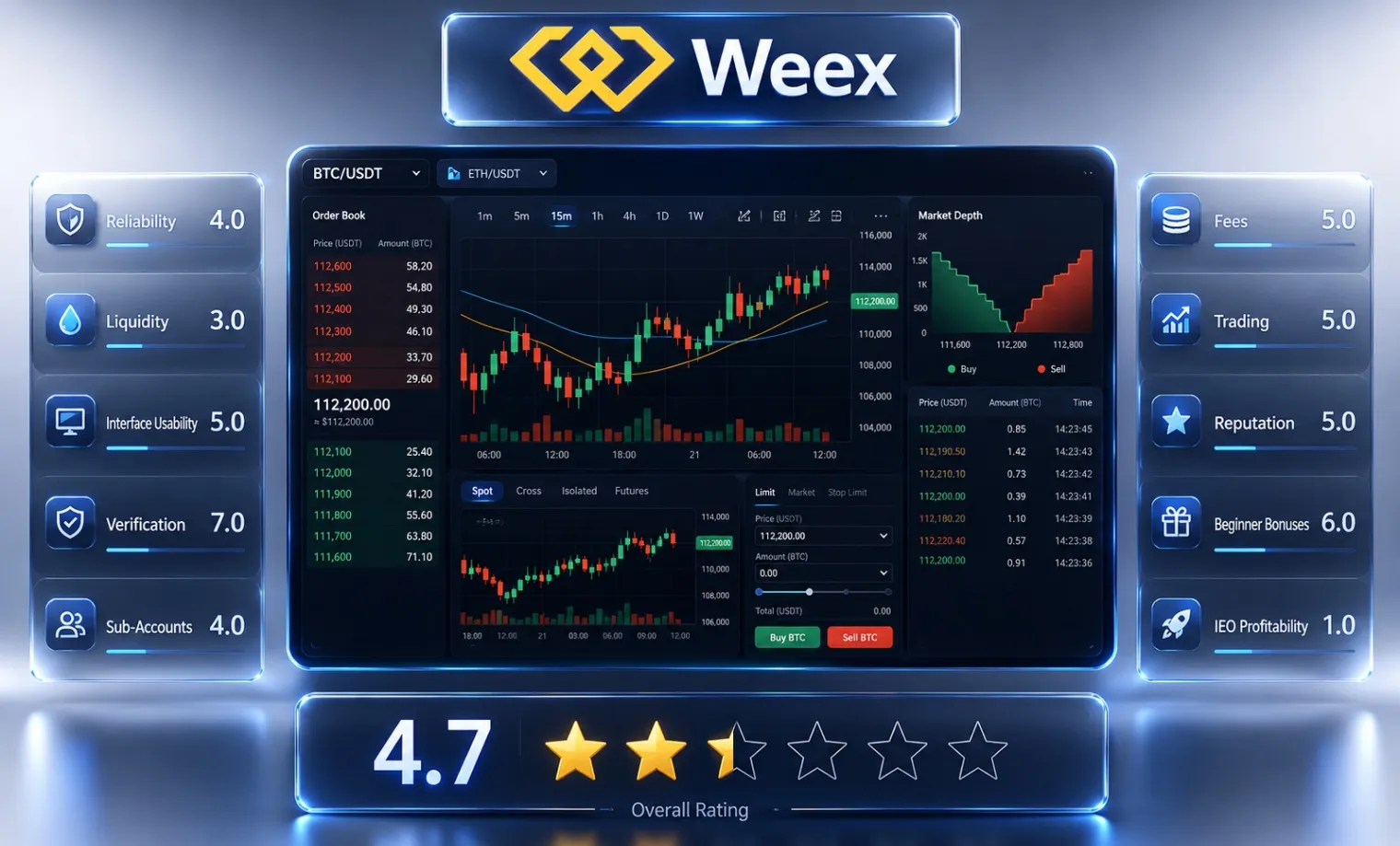
📘 Weex at a Glance: Features the Exchange Highlights
Weex presents itself as an exchange with a standard set of widely used CEX tools. These include spot trading in hundreds of coins and tokens, perpetual contracts with high leverage, TradingView charts and indicators, copy trading, bonus campaigns, an insurance fund, and Proof-of-Reserves.
It is important to distinguish between two layers of information. The first is the platform description provided by the exchange itself. The second is independent user experience.
KYC: Know Your Customer procedure, meaning identity verification. It is usually required to increase limits and unlock certain features.
PoR (Proof-of-Reserves): proof of reserves. In the strict sense, this is a public cryptographic verification showing that an exchange actually holds assets sufficient to cover its obligations to clients.
Perpetual contracts: derivatives without an expiration date. Their price stays close to the index through a funding mechanism. Leverage increases both potential profit and liquidation risk.
Copy trading: automatic replication of trades made by a selected trader. The outcome depends not only on that trader’s strategy, but also on how accurately the follower’s orders mirror the original trades.
🧪 Review Analysis Methodology: What Was Examined
- Recent reviews and longer review threads on Trustpilot were examined, including exchange replies and escalation dates.
- Recurring wording was tracked, including phrases such as “account frozen,” “withdrawal completed, but funds missing,” and “bonus expired because of a condition.”
- For TradingView, ideas and charts under the WEEX: prefix were taken into account, along with the absence of an official exchange rating.
- A separate distinction was made between the company’s own marketing claims and independent user assessments.
📊 Metrics and Quick Take: What the Reviews Indicate
 2.9 / 5 ~466 reviews
  no official rating ideas and charts are available for instruments with the WEEX: prefix
 Trustpilot Rating Breakdown
| Rating | Share of reviews | Comment |
|---|---|---|
| 5★ | 11% | Users praise the fees and interface |
| 4★ | 27% | Users praise the core features but still mention fees and bonus conditions |
| 3★ | 30% | Reviews describe working core functionality but note occasional delays and bonus disputes |
| 2★ | <1% | Rare but clearly negative cases |
| 1★ | 31% | Complaints focus on withdrawals, freezes, and support |
📚 Common Review Terms: What They Mean
Account freeze: a temporary restriction on account activity until a review is completed. It usually affects withdrawals and sometimes trading as well. In reviews, it is most often linked to KYC, AML, or an internal risk review.
AML check: a review of the source of funds and the nature of transactions. In practice, this may involve requests for documents related to deposits, the source of funds, and transfer history.
Liquidation: the forced closure of a futures position when the loss reaches a critical threshold. The higher the leverage, the faster the price can reach the liquidation level.
Funding: a periodic payment between longs and shorts in perpetual contracts. It is used to keep the contract price from drifting too far from the underlying index.
Bonus funds: a separate type of balance with restrictions on transfer and withdrawal. They should not automatically be treated as equivalent to a regular deposit.
📊 Review distribution: why users leave 1, 3 and 5 stars
1–2 stars: 48% of reviews
- 🚫 Withdrawal complaints: the account shows the status “completed”, but the coins do not arrive in the external wallet.
- 🚫 Reports of account freezes without a clear explanation, including after profitable trades.
- 🚫 Support is described as slow and template-based. There is no quick resolution of the problem.
3 stars: 44% of reviews
- 😐 Basic functions work normally: registration, spot trading and opening positions do not cause major complaints.
- 😐 Negative feedback is more often linked to fees, bonus terms and individual delays.
- 😐 For small amounts, some users consider the experience acceptable. For larger amounts, reviews more often mention the need to separately check withdrawals and limits.
4–5 stars: 8% of reviews
- ✅ Users praise low fees and the set of conditions for active trading.
- ✅ Users mention a clear interface and familiar TradingView charts.
- ✅ Users note the wide selection of coins and trading pairs.
🧠 Typical Review Cases: Where the Main Problems Appear
These reviews do not prove that every user will face the same outcome. They show where problems appear most often: withdrawals, freezes, bonus restrictions, and slow support responses.
🛡️ Security, TradingView, and Regulatory Position: Key Factors
Technical side
- 2FA for login and withdrawal, anti-phishing codes, and address whitelists restrict access to the account and withdrawal actions without confirmation.
- TradingView integration provides direct access to charts, indicators, and markup tools inside the terminal without switching to a separate service.
- Proof-of-Reserves and an insurance fund are presented by the exchange, but the interface does not provide a direct way to verify coverage of user liabilities.
Legal side
- The exchange is not among platforms supervised by the FCA or SEC, so disputes over withdrawals and freezes are handled through internal support.
- AML checks include analysis of the source of funds and transfer history; in these scenarios, the exchange requests documents and restricts operations until the review is completed.
🚦 What Withdrawal Testing Reveals in Weex Reviews
- A minimum deposit through a widely used network such as USDT-TRC20 is used in these cases as a way to check fees and confirmation time separately without moving a large amount of funds.
- A test withdrawal to an external wallet shows whether the address, network, fee, and processing time match the parameters shown in the interface.
- The appearance of a txid in the network explorer separates the platform’s internal application status from the fact that funds were sent to the blockchain.
- Comparing the actual fee and processing time with the stated parameters shows the gap between the interface and real processing.
- Repeating the same test during a quiet period and during heavy load shows how stable the withdrawal processing speed actually is.
The combination of the date, network, amount, txid, screenshots, and support replies makes it possible in disputed cases to distinguish an actual withdrawal delay from an internal application status.
✅ Weex Pros and ❌ Cons from User Reviews
✅ Pros
- Low trading fees and a wide choice of pairs. Users associate this with convenience for frequent trades.
- Built-in TradingView charts. This reduces reliance on a separate terminal for basic technical analysis.
- High leverage and copy trading. The exchange provides access to more aggressive trading scenarios.
- Registration without mandatory KYC. Getting started can be faster, although limits and additional checks may apply later.
- Bonus campaigns. Some users use them to test the platform without making a large deposit.
❌ Cons
- Withdrawal difficulties: there are cases where the status says “completed,” but the asset never reaches the wallet.
- Account freezes: some users report restrictions after profitable trades or transfers between accounts.
- Opaque bonus terms: complaints focus on bonuses expiring because of details noticed too late.
- Regulatory status: the exchange is not among platforms under strict oversight by major regulators. As a result, disputed situations depend more heavily on internal support.
- Support performance: users often mention template replies, repeated requests for the same data, and slow escalation.
❓ Weex FAQ: Withdrawals, KYC Checks, Bonuses, and Account Freezes
Can you use Weex without completing KYC?
What does “completed” mean if a Weex withdrawal has not arrived?
Why do Weex bonuses expire or arrive only partially?
What can trigger an account freeze on Weex?
Does TradingView provide an official rating for Weex?
What is the basic way to reduce operational risk when using a CEX?
🧾 Weex Review: Main Takeaways
Weex can be viewed as a platform for spot trading, perpetual contracts, built-in TradingView charts, and a fast start without mandatory KYC at the initial stage. Positive reviews most often focus on the interface, fees, and the range of trading pairs.
For storing a larger balance without prior testing, Weex shows a stronger dependence on withdrawal speed, KYC completion, and support responsiveness. Negative reviews regularly describe withdrawal delays, account freezes, and template-based support communication. For that reason, the key factors in any assessment remain withdrawal testing and the consistency of operational procedures.
In this review,