What Upbit users say about trading, withdrawals and checks
Upbit is a major Korean crypto exchange. User reviews vary widely. This overview brings together real user stories from international platforms and forums. They cover KYC (identity verification), withdrawal delays, support, the interface and the mobile app.
Purpose of the article: to show recurring usage scenarios on Upbit. The overview shows what the platform is praised for, where difficulties arise and which conditions more often reduce problems during verification and withdrawals.
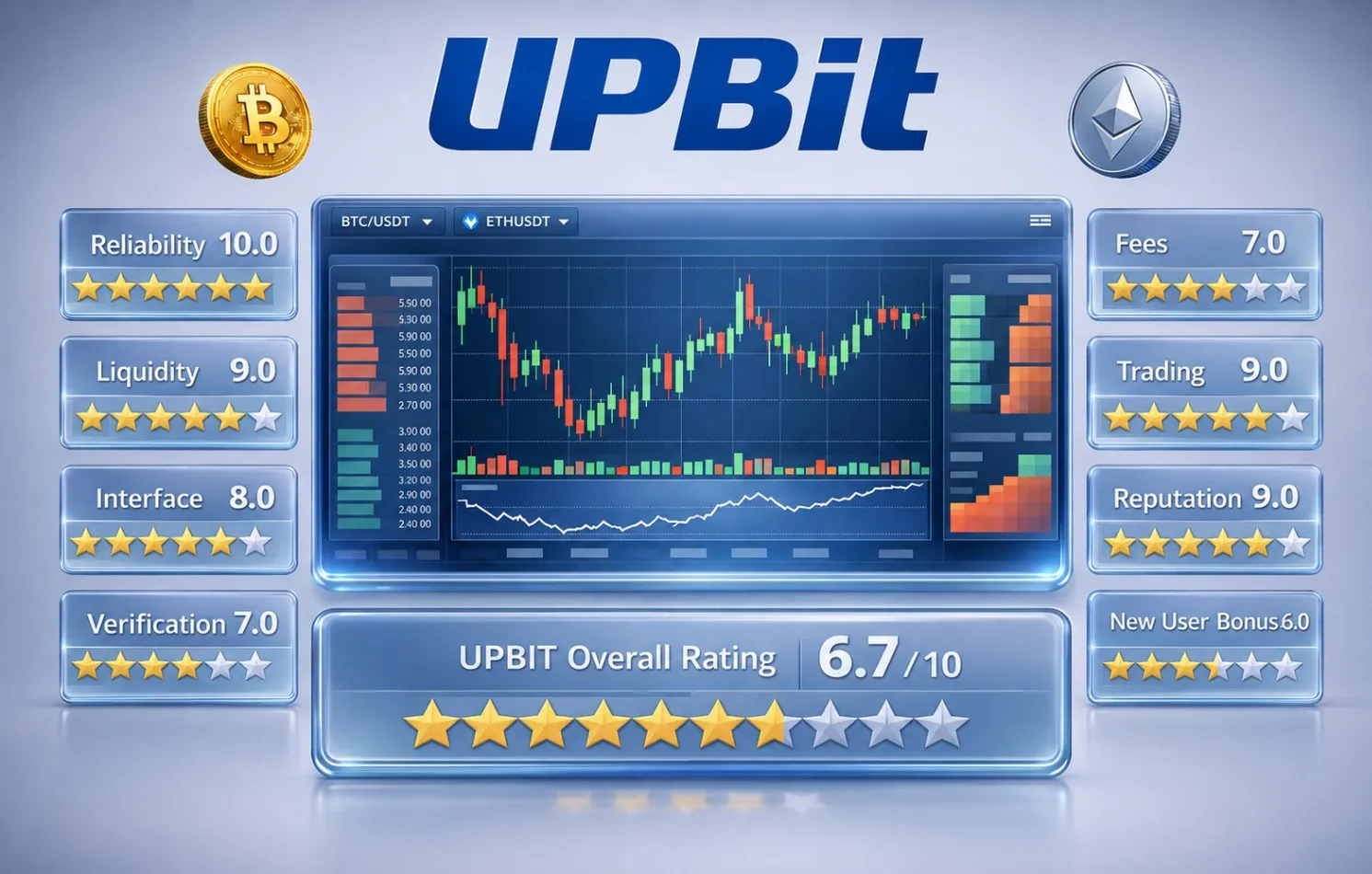
A short snapshot of ratings and user impressions

Positive reviews here are mainly related to trading: charts, order execution and platform speed.

Negative ratings here are more often linked to disputed situations: repeated document requests, AML checks, meaning checks of the source of funds, and waiting for support replies.
Short glossary of Upbit terms
KYC: identity verification. It usually includes an ID document, a selfie and proof of address.
AML check: a check of the source of funds and transaction route. It is most often triggered during a disputed withdrawal or unusual activity.
TXID: the unique transaction hash on a blockchain. It can be used to check whether a transfer was sent and what stage it is at.
Liquidity: market depth and available order volume that affect order execution without significant slippage.
Order book: the book of buy and sell orders where prices, volumes and market depth are visible.
Limit order: a buy or sell order at a specified price that executes only when market conditions match it.
Maker/taker: a maker adds an order to the order book, while a taker executes an existing order.
Leverage: borrowed funds in a trade that increase position size and the risk of forced liquidation.
Whitelisted addresses: pre-approved withdrawal addresses. They reduce the risk of mistaken or unauthorized transfers.
Methodology and analysis sources
Analysis period: the last 12 months of user reviews and discussions on specialized platforms.
Data sources: trader reviews on forums, Reddit, Trustpilot, the App Store and Google Play, as well as reviews with verifiable facts about the platform’s interface, fees and functions.
Filtering: duplicates, one-word emotional messages and spam were removed from the sample. Only cases where it is clear what the user did, what the exchange requested and how the situation ended were retained.
Review classification: registration and interface, deposits and withdrawals, fees and trading, reliability and security, support, mobile app.
Analysis limitation: each individual review reflects personal experience. Conclusions considered only topics that repeated across different users.
Upbit summary metrics
| Parameter | Comment |
|---|---|
| Platform type | Spot exchange (asset trading without leverage or futures contracts) without derivatives (derivative contracts) and margin trading (trading with borrowed funds). The main focus is the Korean won (KRW) market. |
| Trading fees | KRW pairs ≈ 0.05%; BTC/USDT pairs ≈ 0.25% (maker/taker). Fees are fixed and known in advance. |
| Crypto withdrawals | The amount depends on the network. Examples: BTC — 0.0005 BTC, ETH — 0.01 ETH. Fiat withdrawal inside Korea works through a linked bank account. |
| App | Available for iOS and Android. Users most often praise its speed, notifications and access to core trading functions. |
| Support | Support works through the platform’s official contact channels and help materials. International requests involving complex cases may take longer to process. |
| Audit and reserves | Proof of Reserves reports are published, meaning public confirmations of reserves. A partnership with BitGo is also mentioned. After 2019, the exchange strengthened custody of funds and withdrawal controls. |
Summary of Upbit reviews by category
| Category | More often praised | What users dislike | Complaint frequency |
|---|---|---|---|
| Registration and interface | Fast start for residents; built-in TradingView charts | Multi-stage KYC; some scenarios require more documents | 🔴 High |
| Deposits and withdrawals | Fast KRW transfers; several withdrawal networks | AML checks; local bank account requirement for fiat | 🔴 High |
| Support | Official contact channels and request history in the account | In complex cases, replies may be templated; resolution timelines are not always clear | 🟡 Medium–high |
| Reliability and security | Regulated platform; 2FA (two-factor authentication) and cold asset storage | Strict AML triggers; users recall the 2019 hack | 🟡 Medium |
| Fees and trading | Transparent fees; high liquidity on top pairs | No volume discounts; withdrawal cost depends on the network | 🟡 Low–medium |
| Mobile app | Stable performance; fast notifications | Some functions are limited in the international version; some labels are not fully translated | 🟢 Low |
Upbit review distribution: ratings and key reasons
1–2 stars
- Withdrawal problems. A request may move into review status or remain without a final result for a long time. Users most often connect this with an AML check, meaning a check of the source of funds and the transaction route.
- Account freeze for review. Some operations are blocked until documents are uploaded. The review timeframe is not always clear in advance.
- Demanding KYC. Users complain about the volume of documents: passport, proof of address, bank statement and sometimes an explanation of the source of funds.
- Support does not speed up the process. Phrases such as “the request has been forwarded for review” do not show how long the check will take or what happens next.
- Distrust of the platform. Some authors recall the 2019 hack, even when the current complaint is no longer about security but about withdrawals or identity checks.
3 stars
- The trading functionality is acceptable, but new users may find the interface dense. One screen contains many prices, buttons and statuses.
- Ordinary operations are processed quickly, but repeated document checks or an unusual transfer route can create delays.
- Fees look predictable, but users note the absence of volume discounts and the lack of an internal token for fee reductions.
4–5 stars
- Stable operation. Trading runs without noticeable freezes. Order execution looks predictable.
- Convenient interface and mobile app. Users quickly find markets, orders, balances, transaction history and notifications.
- Fast transactions. Ordinary deposits and withdrawals, especially in KRW and popular networks, go through without long waiting times.
- Wide asset selection. Users value access to top coins and rarer listings that are absent from some other spot platforms.
| ⭐ Rating | 📊 Frequency in the editorial sample | 💬 Main reasons |
|---|---|---|
| 1–2 stars | Prevail among sharp complaints | AML checks, account freeze, complex KYC, formal support replies |
| 3 stars | Appear as intermediate ratings | Good interface, but delays and feature overload occur |
| 4–5 stars | Reflect positive experience without disputed checks | Stability, transaction speed, reliability and convenient app |
Upbit registration and interface
🇰🇷 South Korean residents
A local user gets a short path to trading: identity is confirmed, a bank account is linked and operations with the Korean won become available immediately.
- Identity and bank account verification usually takes minutes, not days.
- Integration with national banks simplifies KRW deposits and withdrawals.
- Built-in TradingView charts and familiar order logic make the start of trading faster.
A local client gets quick access to KRW operations, bank linking and the full set of functions without workaround scenarios.
⚙️Experienced traders
The experienced trader scenario is linked to understanding order book logic, limit orders and trade history without using derivative instruments such as futures.
- Order history, alerts, portfolio and the order book are collected in one working environment.
- The web and mobile versions behave similarly. Switching between devices does not require adjustment.
- Users note smooth navigation and stable operation without frequent freezes.
A typical Upbit scenario is a predictable spot interface without separate screens for leverage and derivatives.
🌍New users and Upbit Global users
The international version has more friction at the entry stage. Verification and prior understanding of unavailable operations become part of the scenario without a local bank account.
- The verification process often requires more documents than users expect before the first deposit.
- Some restrictions become visible only when working with fiat or withdrawing large amounts.
- International requests involving complex cases may take longer to process.
Incomplete KYC before deposit increases the likelihood of an expanded document check at the first withdrawal attempt.
Risk map: when Upbit triggers checks and which factors activate them
- Documents most often requested: passport or ID, proof of address, bank statement or proof of source of funds, as well as screenshots of incoming transactions from the sending wallet.
- Withdrawal route: a test amount, saved TXID and a clear network without intermediate transfers through third-party platforms reduce the number of questions during request review.
- Account profile and behavior: full name and address should match the documents. Before a large withdrawal, risk increases after a sudden change of device, IP address or security settings.
Deposits and withdrawals on Upbit
When everything goes smoothly
Ordinary transfers follow a clear pattern: the request is created, the network confirms the transaction and the user sees the status and processing time in the interface.
- KRW deposits and withdrawals are processed quickly thanks to the exchange’s link with a bank account.
- Crypto deposits are credited after the standard number of network confirmations.
- Operation statuses and processing stages are visible directly in the account, without hidden intermediate steps.
Upbit processes deposits and withdrawals quickly, while the user sees a clear chain of statuses.
When checks appear
Most withdrawal complaints are not about funds disappearing, but about a temporary pause in the request until identity, source of money or transaction route is checked.
- A typical scenario looks like this: the user creates a withdrawal, the system puts the request into review, then the exchange asks for documents and only after that resumes processing.
- The most commonly requested documents are a passport, proof of address and a bank statement or another document showing the source of funds.
- The review period is not fixed. It depends on document completeness and compliance team workload.
- Any offers to “speed up unfreezing for a fee” are fraud. The official check is not paid separately.
Documents prepared in advance and a transparent history of incoming transfers do not cancel the check, but often shorten its duration.
Fiat and bank linking
Fiat operations are structured more strictly than crypto operations. KRW requires a bank account in the account holder’s name. In the international version, some fiat operations are completely unavailable.
- Fiat transfers are available only after full identity verification and a linked bank account.
- Non-residents sometimes need expanded KYC even when withdrawing only cryptocurrency.
- In Upbit Global, fiat operations are unavailable, but the choice of networks for crypto withdrawals remains.
Without a Korean bank account, fiat restrictions become part of the basic platform usage scenario.
Fees and trading experience on Upbit
Trading and withdrawal fees
The platform uses a clear fee model. The rate is known in advance, while the withdrawal fee depends not on user status but on the selected network and coin.
- KRW pairs — around 0.05%; BTC/USDT — approximately 0.25% (maker/taker).
- There are no volume discounts or loyalty tokens, so conditions are the same for all accounts.
- The withdrawal fee is tied to the asset and network: BTC ~0.0005 BTC, ETH ~0.01 ETH.
- Users value not the lowest possible rate, but the fact that it is known in advance and does not change inside the trade.
On Upbit, trading and network costs can be calculated in advance because the fee structure is simple and does not depend on a complex tier or bonus system.
Liquidity and order execution
A strong part of the exchange is the spot market with clear depth on major pairs and an interface without switching between futures and margin screens.
- On major pairs, users note narrow spreads and fast order execution.
- Integration with TradingView helps analyze charts and move directly to placing an order.
- The platform does not support futures or margin trading, so the user works only with spot and does not face liquidation risk from leverage.
- The absence of derivatives simplifies the interface: fewer modes, fewer switches and less confusion around position types.
A typical Upbit trading scenario is direct access to spot and liquid pairs without leverage or futures.
Transparency and trust
Users rarely dispute hidden charges. Tariffs and fee conditions are described in advance and usually match what is visible in the operation itself.
- Tariffs are published openly and align with the costs the user sees in a trade and during withdrawal.
- Reviews almost do not describe unexpected deductions that are not explained by platform rules.
- Separate complaints about higher costs are more often linked not to the trading fee, but to an expensive withdrawal network or urgent sending during a congested moment.
- On fees, the exchange is more often described as predictable than cheap at any cost.
Transparent tariffs reduce fee disputes because the user sees in advance exactly what the charge is for.
Upbit reliability and security
Regulated and licensed exchange
Upbit operates within the South Korean legal framework and applies strict KYC and AML procedures. This means mandatory identity, address and source-of-funds checks in disputed operations.
- The exchange is registered as a virtual asset service provider (VASP), meaning a service for exchanging and storing crypto assets within a regulated framework.
- Identity verification and compliance are built into ordinary user scenarios rather than activated only in exceptional cases.
- The strictness of checks creates difficulties during withdrawals, but also reduces room for anonymous and opaque transfers.
Strict KYC slows down fast entry to the platform, but explains why the exchange firmly pauses disputed withdrawals and checks documents again.
Lessons from the 2019 incident
The 2019 hack remains the main historical risk in Upbit discussions. Users recall it not only as an attack, but also as the point after which the exchange strengthened asset custody and transaction control.
- In 2019, attackers withdrew 342 000 ETH, and the losses were compensated from company reserves.
- After that, the exchange strengthened cold storage, transfer monitoring and internal withdrawal-control procedures.
- Audits and Proof of Reserves, meaning confirmation of reserves held by the exchange, play an important role in public security messaging.
- Therefore, in modern reviews, the old hack is more often mentioned as an argument in a trust debate, not as a description of current user experience.
The exchange placed emphasis on custody controls, transaction monitoring and public confirmations of reserves.
Global and local context
The local and international versions of the platform provide different user experiences. A local client gets access to KRW and the full banking link. An international user gets a more limited set of functions.
- Korean users have access to bank integration, local support and the full fiat workflow.
- Upbit Global has no access to KRW, so the international version is built primarily around crypto deposits and crypto withdrawals.
- Non-residents usually need a more detailed set of documents to confirm identity and source of funds.
- Because of this difference, reviews from local clients and international users often describe two platforms that feel different.
The level of security in both versions is perceived as high, but the available function set and verification complexity differ noticeably.
Upbit user support
🤝 Strengths
Upbit uses official contact channels and help materials to process user requests. In standard situations, support more often confirms the request status and links the request to the account history. In reviews, local clients more often describe a clearer communication channel than users of the international version.
🤔 Difficulties and limitations
International support works more slowly and is less effective for complex cases. During a withdrawal review, the user often receives confirmation that the request has been forwarded to a specialized department, but does not receive an exact timeframe or a list of next steps. For this reason, negative support reviews are more often linked not to rudeness, but to a lack of concrete detail in replies.
✅ Pros
- Official contact channels and help materials cover standard account questions.
- Standard requests are usually resolved without long correspondence.
- Request status and contact history are visible in the account dashboard.
❌ Cons
- International requests involving non-standard cases may take longer to process.
- During a long check, the user often does not receive an exact resolution timeframe.
- Support does not provide a separate accelerated scenario for large amounts or VIP status.
Upbit mobile app
📲Functionality and convenience
The Upbit App covers the main tasks: trading, order control, asset management and reaction to price movement through notifications.
- The app includes trading, deposits and withdrawals, portfolio, order history and price notifications.
- The interface is designed around frequent actions: opening a market, checking the balance, placing an order and checking operation status.
- Many users work only with the mobile version and do not move to the web version for standard tasks.
- The charting part of the app is linked to TradingView, so familiar analysis elements remain available on the phone.
The mobile version provides full access to trading and operation control, not only balance viewing.
🔒Security and data protection
The app includes not only trading functions, but also core account-protection measures: login confirmation, session control and notifications about sensitive actions.
- Two-factor authentication (2FA) and biometric login, such as Face ID or fingerprint, are supported.
- Push notifications show logins and transactions in real time, helping detect unauthorized activity faster.
- Repeated session or device checks are more often linked to account security than to a technical app error.
- Users rarely complain specifically about mobile-client security. Complaints more often concern verification and withdrawals.
With 2FA and biometrics enabled, the mobile app remains a convenient working point without a noticeable compromise in account protection.
🌍Upbit Global: restrictions and localization
The international app version preserves the basic interface logic, but works within a narrower set of functions than the local version with KRW and a bank account.
- Not all coins, pairs and fiat scenarios are available to users outside South Korea.
- Some labels and help screens may not be fully translated, which complicates the start for new users.
- New users may find the app dense because the first screen contains a lot of market information and quick links.
- At the same time, app speed and stability are usually rated positively even in the international version.
The international version provides trading and asset control, but does not replicate the fiat function set of the local version.
Typical disputed cases in Upbit reviews
| Situation | Which complaint pattern repeats |
|---|---|
| Withdrawal “under review” | Complaints are usually linked to long waiting after a document request and the absence of a clear response timeframe. |
| Address or tag error | Negative reviews appear when a transfer is sent without a required Memo or Destination Tag and the dispute drags on. |
| Deposit not received | Complaints more often arise from a gap between user expectations and the actual number of network confirmations or internal crediting time. |
What Upbit users say
“According to active spot traders’ reviews, deposits and withdrawals in ordinary trading scenarios are fast, while the app works stably”.
— summary of recurring reviews
“According to Upbit Global user reviews, without a local bank account and full KYC, withdrawal restrictions feel noticeably stronger”.
— summary of recurring reviews
“According to users after AML checks, support more often replies after requesting documents, but does not always explain timelines and next steps in detail”.
— summary of recurring reviews
FAQ about Upbit: KYC, withdrawals and the mobile app
Why are Upbit reviews so different?
Why can a withdrawal receive review status?
Why does the exchange request so many documents?
Are Upbit fees high?
Can non-residents use Upbit?
How convenient is the Upbit mobile app?
Upbit user experience and risks
What user experience shows: where the platform is strong, which restrictions repeat most often and what reduces the risk of withdrawal delays.
What works well. Users value Upbit for its stable spot interface, clear fees and convenient mobile app. In ordinary trading scenarios, the exchange looks fast and predictable, especially where disputed transfers and repeated document checks do not arise.
What creates difficulties. The main source of negativity is not trading, but strict compliance. During withdrawals, the platform may request an expanded document package, while the international version has stricter fiat restrictions and slower support in complex cases.