📘 WEEX Exchange Overview: Market Focus, Licensing, and Core Features
WEEX is an international cryptocurrency exchange founded in 2018 and registered in Singapore. The platform focuses mainly on derivatives, meaning futures contracts. At the same time, it also operates a spot market, where assets are bought and sold at the current market price. According to the exchange, WEEX serves more than 6 million users across 130+ countries.
- 📊 More than 1,500 trading pairs across spot and futures markets.
- ⚡ Leverage of up to 200x on major assets and up to 400x on selected altcoins.
- 📈 Listings include major coins, meme tokens, new altcoins, and tokenized stocks.
According to the exchange, average daily turnover exceeds $400 million. In some periods, trading volume reaches $2–3 billion over 24 hours. WEEX promotes the platform through bonus campaigns, partner programs, and ambassador activity. As a result, a significant share of its audience comes from the retail segment.
🗂️ Legal Status and Regulatory Registrations
The platform operator is WEEX International Exchange Ltd. The exchange reports several registrations and licenses across different jurisdictions.
- 🇺🇸 🇨🇦 MSB registrations, meaning Money Services Business status for money service operators, in the United States and Canada.
- 🇦🇺 AUSTRAC license, meaning registration with the Australian financial monitoring regulator.
- 🇸🇻 Bitcoin Services Provider license in El Salvador.
- 🇻🇨 Registration in Saint Vincent and the Grenadines.
- 🌍 Global headquarters listed in Dubai.
💱 Supported Assets and Fiat Access
WEEX does not support direct fiat deposits and withdrawals through its own internal balance. Buying cryptocurrency with a card or through a payment service is handled by third-party providers. Its core operating model remains crypto-to-crypto: the account is funded with digital assets, trading takes place inside crypto markets, and withdrawals are sent back through a blockchain network.
The listing includes around 600–1,000 tokens. The exchange covers both major markets and the segment of new altcoins and speculative instruments. This reflects a fast listing pace and a focus on retail trading flow.
🔒 Security Model and Insurance Fund
WEEX places strong emphasis on its insurance fund and public proof of reserves. The insurance fund is intended to cover losses during non-standard events. Publishing reserves makes it possible to check whether the platform holds assets at addresses available for monitoring.
- 🔐 The exchange states that it maintains a public insurance fund of 1,000 BTC.
- 📑 In March 2025, after a server failure and an ETH/USDT flash crash, WEEX said it covered more than $6 million in user losses from that fund.
🌐 KYC Policy and Verification Thresholds
WEEX uses a model in which basic trading is available without mandatory identity verification. In this mode, users can access the main functions without uploading documents. At the same time, limits and the range of services remain lower than for verified accounts.
- 🔹 Without KYC: withdrawals of up to 50,000 USDT per transaction and up to 500,000 USDT per day.
- 🔹 With KYC: the limit increases to 100,000 USDT per transaction and up to 2 million USDT per day.
- 🔸 Fiat operations are unavailable without identity verification. In cases of suspicious activity, the exchange may request additional documents.
📣 User Reputation and Common Complaints
Reviews of WEEX are sharply mixed. Positive feedback more often highlights the large number of trading pairs, low fees, and access to trading without mandatory KYC. Negative feedback more often centers on withdrawals and risk control checks, meaning internal risk checks that can lead to temporary account restrictions.
- ✅ Positive feedback most often mentions market variety, fees, and access to futures.
- ❌ Negative feedback most often includes complaints about withdrawals, slow support, and sudden account restrictions.
🔍 Key Strengths and Limitations of WEEX
✅ Pros
- High leverage on futures.
- Wide selection of trading pairs and newly listed tokens.
- Low fees and regular promotional campaigns.
- Access to trading without mandatory KYC.
❌ Cons
- Limited regulation and an offshore operating model.
- Complaints about support and account freezes.
- No direct fiat balance inside the exchange.
- Repeated complaints about withdrawals and account checks.
WEEX is used mainly for active trading rather than long-term capital storage. Its main practical advantages are tied to futures, high leverage, and a broad range of trading instruments. Its main limitations are tied to withdrawal complaints and higher operational risk compared with the largest regulated exchanges.
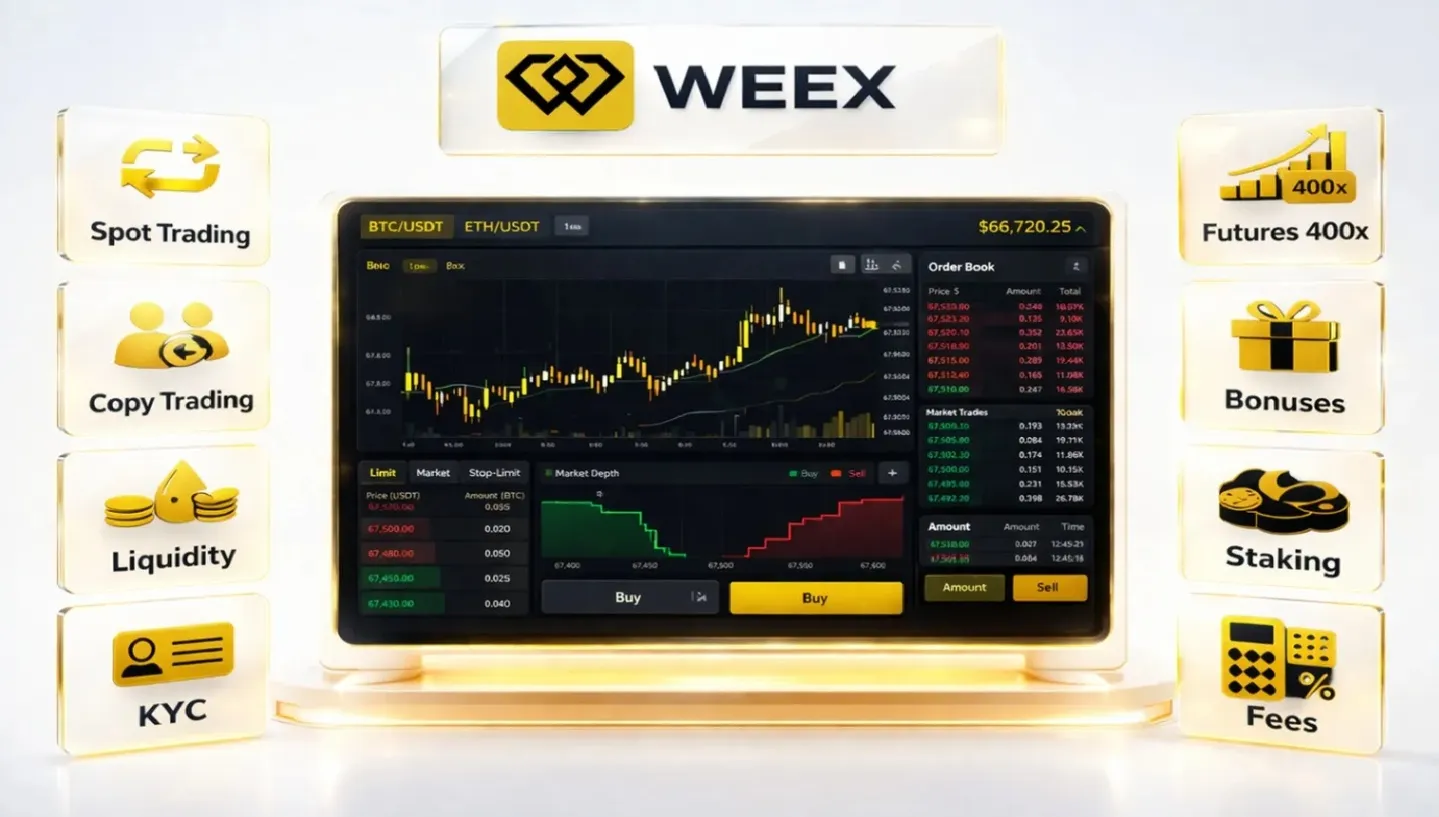
💼 Trading Modes and Market Tools Available on WEEX
💱 Spot Trading
The WEEX spot market includes more than 900 cryptocurrencies and over 1,500 trading pairs. It covers both major coins and newer, higher-risk assets.
- Tight spreads and high liquidity on BTC/USDT and ETH/USDT.
- Fee: 0% for makers and 0.1% for takers.
- TradingView interface with customizable charts.
- Fast conversion without using the order book.
The spot market combines a broad asset listing with low fees. The main limitation is the platform’s overall operating risk.
📈 Futures
Futures are WEEX’s core product. The exchange states that it offers more than 1,500 contracts, including perpetual and dated instruments. Perpetuals, meaning futures without an expiration date, account for a visible share of this segment.
- Leverage up to 200x on major assets and up to 400x on altcoins.
- Fees: 0.02% (maker) and 0.08% (taker).
- Cross Margin and Isolated Margin modes, meaning the use of either the full position balance or only a pre-allocated portion of margin.
- Hedge mode for holding long and short positions at the same time, meaning positions on both the rise and the decline of the same asset.
The futures section concentrates the platform’s main derivatives functions. The main risk appears when leverage is high or when trading pairs have lower liquidity.
📊 Margin Logic
Margin trading is implemented through futures. The account works with derivatives rather than borrowed coins.
- Cross Margin uses the full account balance to support a position.
- Isolated Margin limits risk to a pre-allocated amount for a single position.
- There is no fixed borrowing rate.
- A funding rate is used, meaning periodic payments between long and short positions that keep the contract price closer to the spot price.
The margin model depends on futures mechanics. The main risk is tied to leverage, the funding rate, and the distance to liquidation.
🧮 Options
Options are not available on WEEX. The platform does not support call and put contracts.
- Alternative passive products are available.
Options strategies are not available on WEEX. The platform’s derivatives segment is limited to futures.
🤖 Copy Trading and API Automation
Copy Trading, meaning the automatic copying of a selected trader’s positions, and the API, meaning a programmatic interface for connecting external services, form the main automation model on WEEX.
- Trade copying with configurable risk parameters.
- Leader statistics: return, drawdown, and risk.
- API access for connecting third-party bots.
- No built-in bots for basic strategies.
Copy Trading shifts execution of some trades to a selected trader, while the API allows external algorithms to be connected. The main limitation is dependence on copy settings and external service configuration.
👥 Subaccounts: Availability and Current Limits on WEEX
WEEX currently does not offer a public and fully functional subaccount mechanism. On major exchanges, a subaccount is a separate account inside the main user cabinet. This format helps separate teams, strategies, or trading roles. On WEEX, this mode is not available in the standard interface for the broader user base.
🛡️ Verification (KYC): Limits, Access, and Account Restrictions on WEEX
KYC is the procedure used to verify a client’s identity. On WEEX, basic trading is also available without KYC, so the starting mode does not require uploading a passport or ID card. This is one of the reasons the exchange stands out for users who do not want to complete verification immediately.
What is available without KYC
- 📌 Registration by email or phone number without uploading documents.
- 📌 Withdrawals of up to 50,000 USDT per transaction and up to 500,000 USDT per day.
- 📌 Access to spot, futures, copy trading, and cryptocurrency deposits.
- ❌ No full access to fiat operations.
- ❌ Some bonuses and promotions may be unavailable.
📑 What Full Verification Unlocks
- ✅ The withdrawal limit rises to 100,000 USDT per transaction and up to 2,000,000 USDT per day.
- ✅ Access becomes available to fiat gateways, meaning the purchase of cryptocurrency through cards and partner banking payment solutions.
- ✅ Some bonus programs and event activities are available only to verified accounts.
- ✅ In disputed situations, the account owner can be linked more easily to a specific identity, which simplifies communication with support.
🚧 How the KYC Process Works
The procedure is standard. It includes uploading a document that confirms identity. In some cases, a selfie check is also required. According to the exchange, processing takes around 5–15 minutes if the system does not send the application to an additional manual review.
- 🖼️ A passport or ID card is uploaded.
- 📷 A selfie or facial confirmation may be required.
- ⏱️ Under a standard review, the response arrives within a few minutes.
The no-KYC mode lowers the document threshold for entry. Full verification remains a tool for reducing operational risk. The longer the relationship with the exchange and the higher the turnover, the more visible the value of a verified account becomes.
🎁 Bonuses and Promotions: What WEEX Users Can Realistically Receive
WEEX actively uses bonus campaigns to attract new users. The exchange advertises the chance to receive up to $30,000 in coupons, trading bonuses, and activity rewards. In practice, that amount is almost always split across many conditions. As a result, the real value of bonuses is usually much lower than the advertised maximum.
Which bonuses appear most often
- 🎯 A bonus for registration and completing initial tasks, such as a deposit and the first trade.
- 🎟️ Tasks in the Rewards Hub tied to trading activity, deposits, and inviting friends.
- 💳 A referral program with a share of the fees paid by invited users.
- 🎁 Spin to Win promotions, lotteries, and temporary promo campaigns for new accounts.
⚠️ Where the Gap Between Advertising and Reality Appears
- ✅ Small bonuses can be received if the conditions are followed exactly.
- ✅ Large bonuses almost always require visible trading volume or a large deposit.
- ❌ If multi-accounting or rule violations are suspected, bonuses may be cancelled.
🎖️ Promotions for Active Traders
- 📊 Volume or return tournaments with a prize pool.
- 🪙 Airdrop and Launchpool campaigns, meaning token distributions tied to holding an asset or completing tasks, usually linked to the WXT token or task completion.
- 📈 Temporary offers on Earn products, meaning passive-yield tools inside the platform, with higher rates.
On WEEX, bonus campaigns make up a visible part of the user acquisition model. They are a marketing tool rather than a criterion for judging platform reliability.
💧 Liquidity on WEEX: Market Depth, Distribution, and Trading Limits
📊 Overall Liquidity and Reported Metrics
Liquidity shows how quickly an order can be executed without a major price deviation. It depends on order book depth, spread, and the market’s response to large orders.
- Daily trading volume is reported in the range of $1–2 billion.
- The main share of volume comes from derivatives.
- Tight spreads and a deep order book are reported on BTC/USDT and ETH/USDT.
- Spot Pro infrastructure, meaning an expanded trading terminal for the spot market, supports up to 20,000 TPS, meaning up to 20,000 transactions per second.
- Publishing reserves makes it possible to verify that assets exist at on-chain addresses.
The reported metrics point to deeper order books in key pairs and in the derivatives segment.
📉 Liquidity Distribution Across Market Segments
Liquidity on WEEX is unevenly distributed and depends on both the market type and the specific asset.
- Spot: the best conditions are on major pairs and weaker on new tokens.
- Futures: the highest volume and depth are on key contracts.
- OTC, meaning over-the-counter deals, takes place outside the order book for large volumes.
Liquidity is concentrated in major assets and futures. In the remaining segments, market depth is lower.
⚠️ Liquidity Risks and Market Constraints
Liquidity weakens in part of the market. This affects execution price and the ability to exit a position.
- Slippage rises on small-cap assets.
- Withdrawal limits are possible on low-liquidity tokens.
- Part of the volume may be generated by market makers and bots.
Liquidity risk becomes more visible when trading rare assets and larger positions.
📌 Practical Criteria for Liquidity Assessment
An exchange’s total volume does not describe the conditions of a specific trade. Assessment is done through the parameters of an individual trading pair.
- Order book depth is analyzed.
- Spread size is assessed.
- The effect of trade size on price is checked.
Liquidity is best assessed at the level of a specific pair rather than through the platform’s total turnover.
🖥️ Interface and Mobile App: Layout, Navigation, and Trading Workflow on WEEX
WEEX offers a web terminal, a desktop client, and mobile apps. The interface is built around spot trading, futures, copy trading, bonus activity, and a help center. This is not a minimalist exchange with a single trading page. The design is centered on a retail workflow in which users often move between several types of operations within one session.
Which interface elements cover the main user flows
- 🌐 Several client platforms are supported.
- ⚡ The main terminal combines the chart, order book, and order form in one workspace and uses a TradingView-style logic familiar to traders.
- 📱 The mobile app includes spot trading, futures, copy trading, and balance management.
- 🎛️ The terminal can be customized with its own windows, charts, and order panels.
- 📚 Built-in educational materials and prompts are available for basic use cases.
📈 How Different Users Experience the Interface
- Beginner: gets access to buying cryptocurrency, basic navigation, and simple orders without moving through a large number of screens.
- Experienced trader: gets access to indicators, terminal customization, hotkeys, and API connectivity.
🚩 Where the Interface Lags Behind Larger Competitors
- ❗ Some advanced order types and supporting tools found on the largest exchanges are missing.
- ❗ The speed of support responses inside the app and web version does not always match user expectations.
📱 What the Mobile App Covers in Practice
- Spot trading, futures, charts, stop orders, and balance management are available from a smartphone.
- Charts, stop orders, and position management can be handled without switching to a browser.
- For active retail trading, the app brings spot, futures, charts, and open-position management together in one interface.
The WEEX interface brings the main trading functions into one working environment. At the same time, it still trails the largest platforms in the depth of advanced tools.
🚀 Launchpad and Token Sales: How WE-Launch Operates on WEEX
WEEX has its own format for launching new projects called WE-Launch. It is closer not to a classic exchange investment round, but to a token distribution model built around tasks, holding WXT, and promotional activity. In this model, the exchange uses project launches not only for primary distribution, but also to retain users inside its ecosystem.
What the user gets in WE-Launch
- 🌟 Access to new tokens before regular spot trading begins.
- 🎁 Airdrop distributions for holders of the WXT token.
- ⚙️ Participation terms that are often tied to registration, holding WXT, and basic trading activity.
📊 What Participation Usually Requires
- ✅ An exchange account, and in some cases completed KYC.
- ✅ WXT on the account if the distribution is tied to holding.
- ✅ Tracking the exchange’s announcements, because the participation window is limited in time.
🚨 Key Risks to Consider
- ⚠️ After listing, the token may fall sharply in price even if the distribution initially looked attractive.
- ⚠️ The exchange may temporarily limit withdrawals of new assets until the market stabilizes.
- ⚠️ Rules on multi-accounts and bonus arbitrage also apply to these campaigns.
WE-Launch works primarily within the existing WEEX user base and among WXT holders. For scenarios that require strict project selection and large token sales, this mechanism still looks limited in scale.
💰 Fees on WEEX: Trading Costs, Withdrawals, and Hidden Friction
WEEX’s fee model is built around a low base rate and further reductions through VIP tiers and the WXT token. In active trading, this is one of the most noticeable factors because even a small fee difference affects the final financial result.
🔖 Trading Fees
| Trading type | Maker (limit orders) | Taker (market orders) |
|---|---|---|
| Spot trading | 0% | 0.1% |
| Futures (perpetuals) | 0.02% | 0.06–0.08% |
What can reduce the fee further
- 🎟️ VIP tiers tied to trading volume and WXT balance.
- 💰 Paying fees in the WXT token, if the exchange offers a separate discount for that.
- 🎁 Temporary zero-fee campaigns on selected pairs.
📤 Deposits and Withdrawals
- ✅ Cryptocurrency deposits are usually free on the exchange side.
- ✅ Withdrawals incur a network fee, and the amount depends on the specific coin and network.
- ❌ Fiat operations go through third-party payment services and add an extra fee.
⚠️ Where Indirect Costs Appear
- 🔄 In quick-convert mode, part of the cost is lost not through a direct fee but through the spread.
- 📅 Perpetual futures use a funding rate, meaning regular payments between long and short positions.
- 🚧 Buying cryptocurrency with a card through a partner service adds the fee charged by the payment gateway itself.
Direct trading fees on WEEX remain low. At the same time, the full trading cost is not made up only of the exchange tariff. In an active trading scenario, spread, funding rate, and the cost of entry through third-party payment services also matter.
🛠️ Operational Risks and Practical Use Cases for WEEX
Working with WEEX requires not only an understanding of fees and functions, but also operational discipline. The exchange offers a wide range of trading modes and derivatives tools. At the same time, repeated complaints about checks, support, and withdrawals make its risk profile noticeably stricter than that of platforms with a more stable user history.
Which factors create operational risk
- 📌 The absence of a history of test deposits and withdrawals increases uncertainty as the balance grows.
- 🔐 Disabling two-factor authentication, not using an anti-phishing code, and not using withdrawal address whitelists, meaning a pre-approved list of withdrawal addresses, increase the risk of withdrawal compromise.
- 📑 Scenarios involving high turnover and regular withdrawals more often fall into the KYC and manual review perimeter.
- 📉 High leverage and large position size accelerate liquidation and increase sensitivity to market moves and system failures.
- 🚧 Keeping the full balance on the exchange increases the amount of funds dependent on a single platform.
- 🎟️ Bonus campaigns add the risk of reward cancellation in disputes over conditions, multi-accounting, or trading volume.
- 🤖 In Copy Trading, risk depends on the leader’s drawdown, capital allocation, and copy parameters.
- 🔗 Moving through unofficial domains and apps increases the risk of phishing and address substitution.
📌 Practical Model of Using the Exchange
- ✅ The main use case is tied to active trading rather than long-term storage of a core reserve.
- ✅ Operations are more often built around liquid networks and assets with predictable withdrawal speed.
- ✅ Bonuses, API, and copy trading increase the number of separate operations and complicate internal accounting.
- ❗ Multi-accounting and bonus arbitrage raise the risk of reward cancellation and account restrictions.
- ❗ Strategies built only around high leverage depend more heavily on volatility and technical failures.
The practical logic of using WEEX centers on trading rather than capital storage. The higher the turnover and the more aggressive the strategy, the more important withdrawal control, risk distribution, and position size become.
❓ FAQ on WEEX Exchange
What kind of exchange is WEEX?
WEEX is a cryptocurrency exchange focused mainly on futures trading, while also supporting the spot market, copy trading, API connectivity, and basic bonus programs.
Which markets can you access on WEEX?
WEEX offers spot trading, futures, and leveraged trading through futures contracts. Traditional crypto options are not available on the platform.
Can you use WEEX without completing KYC?
Yes, basic trading on WEEX is available without mandatory identity verification. Without KYC, users can register an account, fund it with cryptocurrency, and use the main trading functions.
What withdrawal limits apply on WEEX without KYC?
Under the stated conditions, withdrawals of up to 50,000 USDT per transaction and up to 500,000 USDT per day are available without KYC. After completing KYC, the limits are higher.
What does full account verification unlock on WEEX?
After completing KYC, withdrawal limits increase, access to part of the fiat gateways becomes available, and some bonus programs that require a verified account can be used.
How does the KYC process work on WEEX?
KYC usually includes uploading a document that confirms identity and, in some cases, a selfie check. According to the exchange, standard processing takes 5 to 15 minutes if the application is not sent for manual review.
Can you withdraw funds from WEEX without verification?
Yes, cryptocurrency withdrawals without KYC are available within the stated limits. In cases of suspicious activity or a disputed transaction, the exchange may temporarily restrict the account and request documents.
Does WEEX support direct fiat deposits and withdrawals?
No, there is no direct fiat balance inside the exchange. Buying cryptocurrency by card or through a payment service is handled by third-party providers.
Does WEEX offer copy trading and built-in trading bots?
Copy Trading is available on WEEX as a separate function. There are no built-in bots for grid trading and DCA strategies, meaning strategies based on buying an asset step by step with equal amounts at set intervals, but the platform supports an API for connecting external services.
Does WEEX provide subaccounts?
WEEX currently does not offer a public and fully functional subaccount mechanism. For the broader user base, this mode is not exposed in the standard interface.
🧾 WEEX: Core Capabilities and Operating Limits
WEEX combines a futures-focused product line, a wide listing of trading pairs, high leverage, and low base fees. This set of functions supports active trading rather than conservative capital storage.
Its main limitations lie elsewhere. Repeated complaints concern withdrawals, account freezes, and internal risk checks. In scenarios involving long-term storage of a large balance, these factors increase operational uncertainty.
Active spot and futures trading remains the platform’s main working scenario because this is where its market range, leverage, and fees are concentrated. In scenarios involving long-term storage of large sums, its operating model offers less predictability.