What Yobit offers: fast onboarding, rare markets, and where disputes begin
Yobit is a centralized crypto exchange that has been operating since 2014. The platform is commonly described as an exchange with no mandatory KYC at signup, a fixed 0.2% spot fee, and a broad range of rare altcoins.
No mandatory KYC at entry, access to non-standard markets, limited transparency in some services, uneven liquidity in rare pairs, withdrawal complaints, and the absence of derivatives make Yobit a controversial platform.
Yobit is a niche crypto exchange with fast onboarding and no mandatory KYC, but its reputation around withdrawals and internal services remains disputed.
Review focus: to explain how fees, deposits and withdrawals, InvestBox — an internal rewards service, Virtual Mining (VMining) — a model with “virtual miners,” and Dice — a betting-based gaming section, work on Yobit, and to show where the exchange is used for arbitrage and where risk rises for beginners.
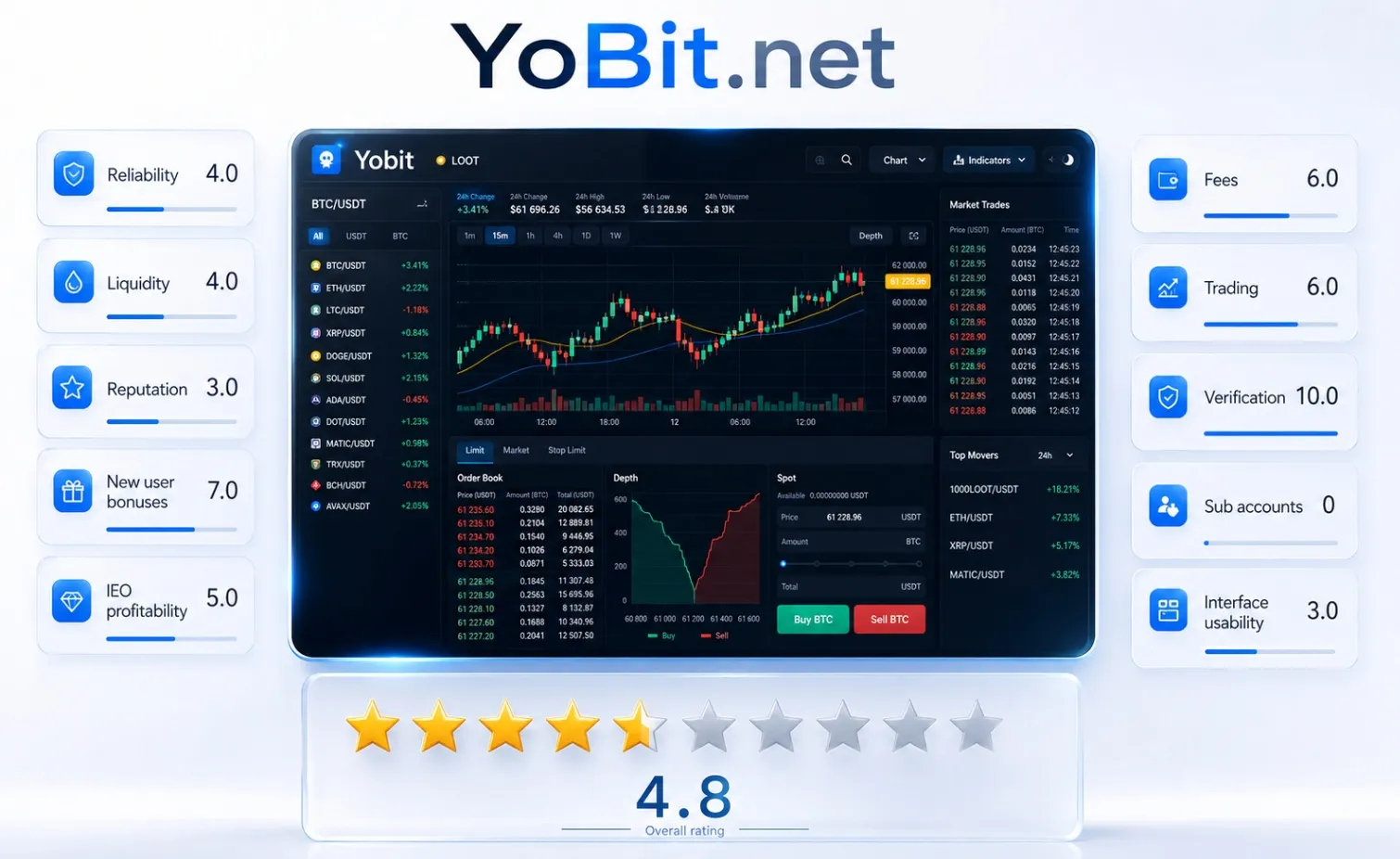
Yobit overview: what matters before your first trade
Key facts
- Model: a centralized exchange with no mandatory KYC at the basic registration stage.
- Spot fee: a fixed 0.2% on all trades.
- Asset range: 500+ coins and up to ~8,500 trading pairs according to aggregators.
- Fiat routes: separate deposit and withdrawal channels through payment providers.
- Internal services: InvestBox — an internal rewards service, Virtual Mining (VMining) — a model with “virtual miners,” and Farming — a section built around internal token farming schemes.
- Gaming section: Dice / YoDice — a gaming section that issues tokens for BTC bets.
- Ecosystem token: YO, used in the exchange’s internal mechanics.
- Coin launches: AddCoin — a section for listing new coins, ICO, and RocketIco — a format for launching and promoting new tokens that may be linked to InvestBox.
| 💰 # Coins | 💱 Fiat routes | 🔄 Pairs / markets | 💸 Spot fee | 🔐 KYC | 🎛️ Features |
|---|---|---|---|---|---|
| 500+ by aggregators | Through payment providers | ~8,500 pairs; bases: BTC/ETH/USDT/DOGE/YO/WAVES | 0.2% on all spot trades | Not mandatory | InvestBox, VMining, Dice, YO token |
Yobit review summary: what Trustpilot shows and where complaints concentrate
 1.5 / 5 170 reviews
 Rating distribution on Trustpilot
| Rating | Share of reviews | Comment |
|---|---|---|
| 5★ | 8% | Positive reviews are usually linked to quick onboarding, rare coins, and individual successful trading scenarios. |
| 4★ | 5% | High but not maximum ratings are rare and more often describe basic trading without complex disputed operations. |
| 3★ | 2% | Neutral ratings represent a small share and usually note working functionality while doubts about support and withdrawals remain. |
| 2★ | 2% | Low ratings are linked to partly negative experiences, delays, and unpredictable problem resolution. |
| 1★ | 83% | The main group of complaints focuses on withdrawals, wallet status, account blocks, and weak support response. |
| Aspect | What users praise | What users criticize | Comment |
|---|---|---|---|
| Registration and start | Quick entry without mandatory KYC | Unclear exchange actions during disputed operations | Registration without mandatory verification speeds up the start. In a dispute, it is not clear in advance what data the exchange may request. |
| Fees and trading | Fixed 0.2% is easy to calculate | Wide spreads and few orders on rare pairs | On rare markets, the problem is often not the fee. The problem is the large gap between the buy and sell price. |
| Deposits and withdrawals | Fiat and crypto routes are available | Withdrawal delays, Maintenance status on wallets, and disputed operation statuses | Withdrawal time depends not only on the network. It also depends on the exchange wallet status, the selected provider, and manual processing of a disputed operation. |
| InvestBox and VMining | Some users mention internal accruals and non-standard mechanics | Opaque payout rules and high loss risk | InvestBox and VMining are not passive income. The result depends on the plan rules, demand for the token, and the platform’s own decisions. |
| Dice / YoDice | There is a bonus mechanic with tokens | Gamification increases the risk of losing the deposit | YoDice issues tokens for BTC bets. The mechanic itself remains a game with a direct loss risk. |
| Support | — | Slow replies, unresolved tickets, and complaints about lack of response | Most negative reviews are linked to withdrawal delays, account blocks, and long ticket correspondence. |
| Mobility | The web terminal is usually used without installing software | No official app; fake clients appear | Safe access is tied to the official website and browser-based use. |
Yobit functionality: how its core products work and where risk builds up
YO: the internal token of the Yobit ecosystem.
RocketIco / New ICO: sections used to launch and promote new tokens on the exchange.
Spot trading and market structure
Yobit supports hundreds of assets and thousands of pairs, including rare altcoins and non-standard base markets such as DOGE, YO, and WAVES alongside BTC, ETH, and USDT. The fixed 0.2% fee makes trading costs easier to calculate. On rare pairs, another issue often appears: the gap between the best buy and sell price can be wide, while there are few orders in the order book.
Fiat deposit and withdrawal channels
Yobit uses separate payment providers for fiat deposits and withdrawals. Here, not only the provider fee matters. The route itself matters as well: the same direction may differ in crediting time, final amount received, and withdrawal availability at a given moment.
InvestBox
The exchange describes InvestBox as a service with daily rewards under selected plans. The risk here is high. Payouts depend on the rules of a specific plan, on demand for the linked token, and on whether the exchange continues to support that reward model in its previous form.
Virtual Mining (VMining)
VMining offers the purchase of “virtual miners.” After that, the user receives daily token rewards. The model is only partly described: part of the funds is directed to support the MINEX2/BTC pair and buy back YO. The user does not see a transparent framework showing how the sustainability of these payouts is calculated.
Dice / YoDice
Dice and YoDice are internal gaming sections where tokens are issued for BTC bets according to a fixed grid. Here, it is important not to confuse the reward format with investment yield. The user receives bonus tokens, but the original operation still remains a bet with a direct risk of loss.
Coin additions and ICO launches
AddCoin and New ICO are used to launch and promote new tokens, including through RocketIco and links with InvestBox. The risk here is tied to price behavior. In such scenarios, it often rises during a short burst of interest, then quickly loses liquidity and falls back.
Fees and withdrawals: what to check before moving funds
| Section | Terms | Comment / risk |
|---|---|---|
| Spot fee | 0.2% on all trades | The fee structure is simple. On rare pairs, total costs often rise because of the wide spread. |
| Crypto withdrawal | Depends on the asset and network; reviews mention an example of BTC ~0.0012 BTC | The fee and wallet status may change right up to the moment the request is submitted. |
| Fiat withdrawal | The fee depends on the provider; reviews mention values around 3–4% | The total route cost is shaped by the fee percentage, provider limits, and the final amount received. |
Yobit reputation: where the main disputes start and why ratings vary so widely
“Yobit remains usable for arbitrage scenarios as long as only a working balance is kept on the account and the main risk is not moved into internal services.”
— opinion of an active trader
The difference in user experience is tied not to a “different exchange,” but to different ways of using Yobit. The larger the account balance, the weaker the liquidity of the selected market, and the deeper the user goes into internal services such as InvestBox or VMining, the higher the risk of running into a problem that cannot be resolved quickly with a standard trade.
User rating breakdown: why Yobit gets 1–5 stars
❌ 1–2 stars: the main complaints
Low ratings usually appear where the user could not quickly restore access to funds or did not receive a clear response on a problematic operation.
- The withdrawal remains “stuck” or unavailable for a specific coin or network.
- Tickets remain unanswered for weeks, and there is no live chat.
- The terms of InvestBox or VMining change, and the expected rewards stop.
The lowest ratings are usually tied to
⚠️ 3 stars: a neutral experience
Average ratings are given by users whose basic trading worked without a critical loss, but trust in the exchange still did not emerge.
- Spot trading works, but additional services raise doubts.
- It is difficult to understand from the operation status where the delay actually occurred.
- Support responds, but the correspondence drags on and does not always end with a clear resolution.
An average Yobit score appears where trading goes normally, but a disputed situation still remains hard to predict.
✅ 4–5 stars: what users praise
High ratings are more often left by users who need not a universal large CEX, but fast access to rare markets without mandatory verification.
- Registration without KYC speeds up onboarding and removes an extra step before the first trade.
- The exchange offers coins and pairs that are not available on larger platforms.
- With careful use, some users go for years without any conflict with support.
Yobit usually receives a high score where the main advantage is an
Typical user cases: where losses and delays appear most often
“Registration takes minutes, and rare coins can indeed be found. The main area of tension appears where fast and predictable withdrawal is required without prolonged correspondence.”
— user opinion
Yobit for arbitrage: where profit may appear and what can close the trade window
What creates the opportunity: on rare coins and non-standard base markets such as DOGE, YO, and WAVES, a noticeable price gap sometimes appears between Yobit and more liquid exchanges. Registration without mandatory KYC also reduces the number of steps before the first trade and simplifies the setup of a working account.
What creates the risk: in those same rare pairs, there are often few orders in the book, so the margin calculated on paper may disappear before the order is filled. Fund transfers create another risk: the arbitrage window closes if the deposit or withdrawal is delayed because of the network, the wallet status at the exchange, or an internal check.
Yobit for beginners: what makes the start easier and where mistakes begin
Yobit has a low entry threshold: registration is quick, there is no mandatory KYC, and the core actions in the web terminal are usually clear without lengthy setup. The problem appears later. A beginner may mistake simple registration for a sign of reliability and underestimate the risk of rare markets, internal services, and withdrawal delays.
Mini-cases: how Yobit scenarios look in practice
“Fast arbitrage”
The price in a rare pair on Yobit differs noticeably from the price on another exchange. The trade looks profitable only until execution begins. If the order book is thin or the transfer takes too long, the real margin can disappear quickly. In a working scenario, part of the operating capital is placed on the exchange in advance, and the exit point is defined before the trade is opened.
“Gaming tokens”
YoDice issues tokens for bets, which can make the section look like a source of additional upside. But the economic logic of the operation does not change: the user risks a deposit in a game and only then receives a bonus asset that still has to be sold successfully.
“InvestBox with daily yield”
The plan promises daily rewards while the selected payout scheme remains active and interest in the linked token stays in place. When the rules change or demand falls, the rewards no longer offset the price drawdown. That is why such plans are more logically viewed as short-term speculation with a small amount rather than as a stable source of income.
Yobit pros and cons: who the exchange suits and where the limits are too high
✅ Pros
- Fast onboarding: trading is available without mandatory KYC.
- Rare markets: the exchange offers many non-standard pairs and less common coins.
- Simple fee: 0.2% is easy to include in trade calculations.
- Fiat routes: deposit and withdrawal options through providers are available.
- Additional scenarios: InvestBox, VMining, Dice, and the YO token are available.
❌ Cons
- High risk in internal services: payout terms may change, and returns are not guaranteed.
- Weak support predictability: disputed cases may take a long time to resolve.
- Uneven liquidity: rare pairs have a wide spread and few orders.
- No official mobile app: this increases the risk of installing a fake client.
FAQ about the Yobit exchange
Is KYC required to trade or withdraw funds on Yobit?
Does Yobit offer an official mobile app?
What determines the risk in InvestBox and VMining?
What spot trading fee does Yobit charge?
Why does Yobit attract so many negative reviews?
Yobit: key strengths, risks, and practical limits
Yobit remains a niche exchange for users who need fast onboarding without mandatory KYC, access to rare altcoins, and the ability to look for price dislocations in non-standard markets. The simple 0.2% spot fee and the wide range of pairs make the platform more suitable for targeted tasks than for broad capital storage.
The main limitations lie elsewhere: liquidity may be weak in rare pairs, withdrawals may be unpredictable in timing, and internal services such as InvestBox and VMining remain high-risk. In that logic, Yobit remains an exchange for a narrow operating scenario rather than a primary place to hold large balances.
Yobit is suitable for scenarios where