What LATOKEN users most often write about
LATOKEN reviews vary sharply. Some users praise the terminal, access to rare altcoins, and participation in IEOs — initial exchange offerings of tokens on an exchange. Others complain about withdrawal delays and weak support communication. This material brings together LATOKEN reviews from different platforms to separate recurring positives from recurring complaints.
The material shows what users write about the interface, LATOKEN withdrawals, KYC/AML — checks of identity and source of funds, fees, LATOKEN support, and the platform’s everyday reliability.
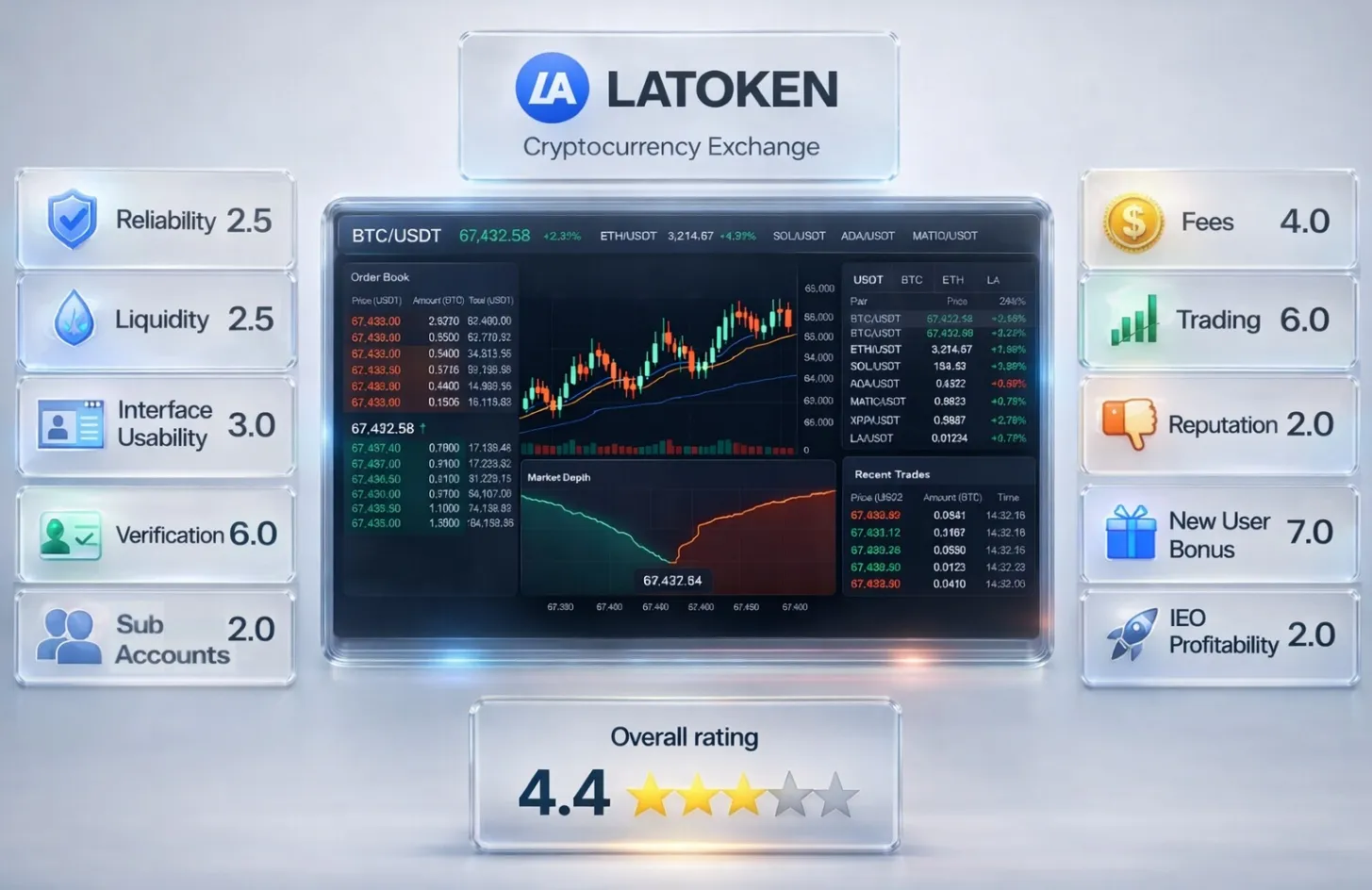
LATOKEN profile: key facts and review terms
| 📅 Founded | 🌍 Status | 💠 Asset range | 🧩 Products | 🔐 Protection | 📱 Apps |
|---|---|---|---|---|---|
| 2017 has operated in the market for several years | International platform users most often assess withdrawals, support, and account checks | Many altcoins and new tokens focus on rare listings | Spot, IEO/launchpad, Earn IEO — initial exchange offering of tokens on an exchange; Earn — passive yield products | 2FA, cold wallets, DDoS protection 2FA — login with an additional code; DDoS protection — filtering of overload attacks | iOS / Android trading and withdrawals from a phone |
KYC: identity verification using documents and address data. In reviews, this stage is often mentioned when a large withdrawal is delayed.
AML: transaction checks under anti-money laundering rules. In reviews, AML checks often move an account or withdrawal into manual review.
Spread: the difference between the best buy price and the best sell price. On rare pairs, a wide spread immediately worsens the entry or exit price.
Slippage: an order executes at a worse price than expected. This becomes visible when the order is large and order book depth is low.
TXID: a transaction identifier on the blockchain. In disputed withdrawal requests, a TXID helps connect an operation to a specific transfer on the network.
Cold wallets: storage of most funds offline. This format reduces the risk of an external breach of the exchange’s hot infrastructure.
How ratings are distributed and what users give stars for
The analysis includes open reviews that describe specific user scenarios: trading, withdrawals, KYC/AML checks, support, fees, the mobile app, and trades in rare tokens.
The material records recurring themes available at the time of preparation, rather than the full history of LATOKEN publications; the conclusions include only topics that appeared across different platforms or in several independent reviews, while isolated emotional messages without details were not used as a standalone basis for conclusions.
| Rating | Main reasons | Comment |
|---|---|---|
| ⭐⭐⭐⭐⭐ / ⭐⭐⭐⭐ | Fast terminal, clear interface, rare coins, convenient app | These ratings come from active traders and users who need access to niche altcoins |
| ⭐⭐⭐ | The exchange works, but support and checks raise questions | Neutral reviews come down to one point: trading is possible, but withdrawals and support raise concerns |
| ⭐⭐ / ⭐ | Withdrawal delays or rejections, lengthy AML review, weak support communication | Low ratings are linked not to trading itself, but to problems after a withdrawal request or an additional account check |
Interface and usability in everyday trading
Positive LATOKEN reviews often start with the interface. Users praise the speed of the terminal, the layout of tabs, and navigation between trading, the wallet, and transaction history. In reviews about rare tokens, users separately note that orders are submitted without noticeable delays.
Example: “I place and cancel orders without delays, and the chart updates smoothly. For quick altcoin trades, this is enough.”
Users also praise token filters and search. On a long list of coins, this reduces the time needed to manually find the required pair. Interface complaints appear less often. In such cases, the issue usually concerns older app versions or outdated screenshots in guides.
KYC/AML: where users most often face problems
The basic process looks simple: document, selfie, and address confirmation. On smaller volumes, users may be able to trade with restrictions. For large withdrawals, reviews consistently mention identity verification.
Problems usually begin not during the first document submission, but at the stage of an additional AML check. Reviews repeat the same chain: trading works without problems → the user requests a withdrawal → the account goes under review → documents have been submitted → the status does not change for a long time. This chain creates most of the negative stories.
Example: “They requested another KYC check for a large withdrawal, I uploaded everything on the list — the status did not change for more than a week, and there were no replies to the ticket.”
- For a repeated KYC check, the document package includes an identity document, proof of address, and up-to-date contact details.
- In reviews about large transfers, users often describe a staged path: first a test amount, then the main withdrawal.
- Screenshots, TXIDs, and operation dates help clarify disputed cases.
During a long review, a connected history of support requests plays a decisive role. Users keep ticket numbers, send follow-up messages within the same case, and refer to already submitted documents.
Deposits and withdrawals: where most complaints arise
Deposits and withdrawals most often generate the most conflict-heavy LATOKEN reviews. Positive cases also exist: transfers go through quickly, statuses update correctly, and network fees are shown without surprises. But most complaints relate to withdrawals: requests get stuck, deposits or withdrawals for specific tokens are temporarily closed, and rejections arrive without a clear explanation.
Example: “Closing orders was fine. I requested a USDT (TRC20) withdrawal — the status stayed ‘processing’ for more than a day, and support said they would pass it to the technical team.”
- In reviews, a small test transaction is described as a way to check the network, limits, and withdrawal availability.
- The network status and fee size before submitting a request affect the speed and cost of the operation. This is especially visible when using alternative networks.
- When withdrawals are rejected, the dispute often arises not because of the rejection itself, but because the reason and conditions for a repeat attempt are not stated clearly.
Fees and hidden costs: what users pay in practice
The fee structure is simple. Trading fees depend on monthly volume. Crypto deposits are processed without an exchange fee. Withdrawals are calculated at a fixed rate for a specific coin or network. In reviews, users less often dispute the exchange’s formal fee. More often, they complain about market costs: wide spreads, slippage, and poor market order execution on rare pairs.
Maker/Taker: a maker adds liquidity with a limit order. A taker removes liquidity with a market order or with the part of a limit order that executes immediately. The taker pays more.
Spread and order book: when the order book has few orders, a market order executes across several prices in sequence. Losses from this execution can be higher than the exchange’s formal fee.
Support: how communication works in complex cases
Officially, support operates through chat and tickets 24/7. Positive stories exist, especially for standard questions. But in complex cases, users complain about infrequent status updates and replies after which the problem remains unresolved.
- Request structure: a ticket number, a short description of the problem, and a list of already submitted data help quickly restore the case context.
- Response time: reviews often note that the absence of a clear feedback interval intensifies conflict around the request.
- Communication channels: parallel use of chat and email helps preserve the message history and link follow-up requests to one case.
Security and reputational risks: what affects trust in the platform
The platform has a standard set of protective measures: two-factor authentication (2FA), cold storage of most funds, and protection against DDoS attacks — attempts to overload infrastructure with a large number of requests.
In the reviewed set of user feedback, major hacks with loss of funds are not the main recurring theme. But trust more often declines not because of technology, but because of processes around the account and withdrawals. Users write about long AML checks, account restrictions, and disputes around listings from previous years.
🔐 Two-factor authentication
Linking an account to an authenticator app and backup codes is treated as a basic level of access protection.
🧊 How holding a large balance affects perceived risk
Negative LATOKEN reviews often intensify in scenarios where a large balance stays in the account for a long time, and then a check, withdrawal delay, or account access dispute appears.
🧯 What helps clarify a disputed case in reviews
In reviews, disputed situations look easier to assess when the case includes a deposit history, TXID, copies of support messages, and backup access to 2FA — two-factor authentication.
Trust in LATOKEN is reduced not by reports of technical failures, but by complaints about checks, account restrictions, and disputed withdrawal situations.
Mobile app: how convenient trading and withdrawals are from a smartphone
The iOS and Android apps repeat the main functions of the web version: registration, trading, deposits, withdrawals, and portfolio tracking. In reviews, the app is praised for simple navigation and stable basic operation. Confirmation code delays are mentioned among the downsides. Such complaints describe isolated issues, not a constant problem.
Positive reviews of the mobile scenario are more often linked to accounts where biometrics, a separate 2FA app, and active session control are already enabled.
The mobile app is perceived as a convenient working tool when account protection has been configured in advance.
LATOKEN strengths and weaknesses — concise and practical
✅ Pros
- Fast and clear terminal with a familiar tab structure
- Wide choice of altcoins and access to IEO/airdrop activities — token distributions under project conditions
- Convenient mobile apps for basic operations
- Crypto deposits are processed without an exchange fee
❌ Cons
- Frequent complaints about withdrawal delays and lengthy AML checks
- Unstable support communication in disputed and complex cases
- Noticeable losses on thin pairs due to spread and slippage
- Reputational concerns caused by older complaints about account restrictions and listings
Common review scenarios and typical case development logic
💬 Scenario 1 — “Withdrawal stuck for 24+ hours”
- The check starts with network status, address correctness, and limits.
- Case review relies on screenshots, TXID, and a ticket describing the request.
- Follow-up messages are tied to the same ticket to preserve the history.
A delay more often appears after a request is created and intensifies when connected correspondence and transaction data are missing.
🧾 Scenario 2 — “Repeated KYC requested”
- The request concerns an updated document package: identity, address, and source of funds.
- Fragmented file submission slows down the review.
- The absence of status and review timelines intensifies the conflict.
The main risk is linked not to the first verification, but to a repeated check after a withdrawal request.
🧮 Scenario 3 — “A rare-token trade caused a loss”
- The reason is weak order book depth.
- A large market order executes across several prices and creates slippage.
- The final loss includes the fee, spread, and execution quality.
On rare pairs, the trade outcome is determined by liquidity, not only by the trading fee.
Problem scenarios in reviews come down to three risk zones: withdrawals, repeated checks, and trading on low-liquidity pairs.
Where else to study user experience and compare other centralized exchanges
LATOKEN FAQ: withdrawals, KYC, and user reviews
Is LATOKEN a scam or a working platform?
Why can LATOKEN withdrawals be delayed?
Is KYC mandatory on LATOKEN?
What are the trading and withdrawal fees?
How convenient are the mobile apps?
How do reviews describe long-term asset storage on LATOKEN?
Why does the price get “eaten” on rare tokens?
How do reviews rate LATOKEN for trading rare altcoins?
LATOKEN: strengths and risks based on reviews
What users like: a fast terminal, clear navigation, a wide choice of altcoins, access to IEOs and airdrops — token distributions under project conditions, as well as convenient mobile apps. These points are most often mentioned in positive reviews about short trades with rare tokens.
What users dislike: a large number of complaints about LATOKEN withdrawals, long AML checks, weak support communication in complex cases, and losses on thin pairs due to spread and slippage. Older reputational claims increase caution.
LATOKEN is used as a venue for operational trades. Long-term storage of a large balance is described in reviews and analysis as a less predictable scenario.