Bitget trader reviews: what to know before getting started
Bitget is a centralized crypto exchange (CEX, centralized exchange). Its main focus is derivatives (futures and options) and copy trading (automatic copying of a selected trader’s trades on a connected account). Bitget reviews most often discuss operations that trigger checks: withdrawals, P2P exchange (user-to-user transactions through the platform), fiat routes through partners, 2FA recovery (two-factor authentication), and repeated verification.
Purpose of the material: to group Bitget reviews from the past 12 months by recurring operational scenarios (KYC — identity verification, AML — source-of-funds checks, deposits/withdrawals, P2P and fiat, margin, copy trading, support), so that the difference between 1–2★ and 4–5★ reads as a difference in conditions and review triggers rather than as the platform’s “average reputation.”
Bitget is more often praised for its trading terminal, liquidity, and copy trading, while criticism more often concerns withdrawal holds, repeated checks, and disputed cases on P2P and fiat routes.
An average rating does not show which operations most often create problems. In reviews, it is more informative to track triggers: which events move an operation into manual review, which themes repeat in complaints, and which themes describe stable trading without conflicts.
Which themes dominate negative reviews
On platforms with a large flow of reviews, comments often appear after a conflict. As a result, complaints repeat the same themes: withdrawal restrictions, Risk Control blocks (internal risk control), 2FA reset or loss, repeated verification, stuck fiat deposits through partners, and disputes over P2P transactions.
Which themes dominate reviews from active traders
Trader discussions more often describe the terminal, liquidity on major pairs, and the convenience of copy trading. Negative cases there are more often tied to compliance (KYC/AML procedures and additional checks): identity confirmation, source-of-funds confirmation, and operational restrictions after atypical transactions.
Analysis topics:
- rating distribution and typical reasons for 1–2★, 3★, and 4–5★ reviews;
- review selection principles and grouping of cases by operation type;
- the terminal and trading modes that appear more often in positive reviews;
- fees and execution costs: spread (the difference between buy and sell prices), funding (periodic payments on perpetual futures), and network withdrawal fees;
- deposits/withdrawals, P2P, and fiat: scenarios that more often move an operation into manual review;
- support, KYC/AML, and risk control: reasons for restrictions and the typical set of requested documents;
- a summary of recurring positives and risks based on review wording.
Bitget: review and official exchange page
Go to the Bitget review and official exchange page
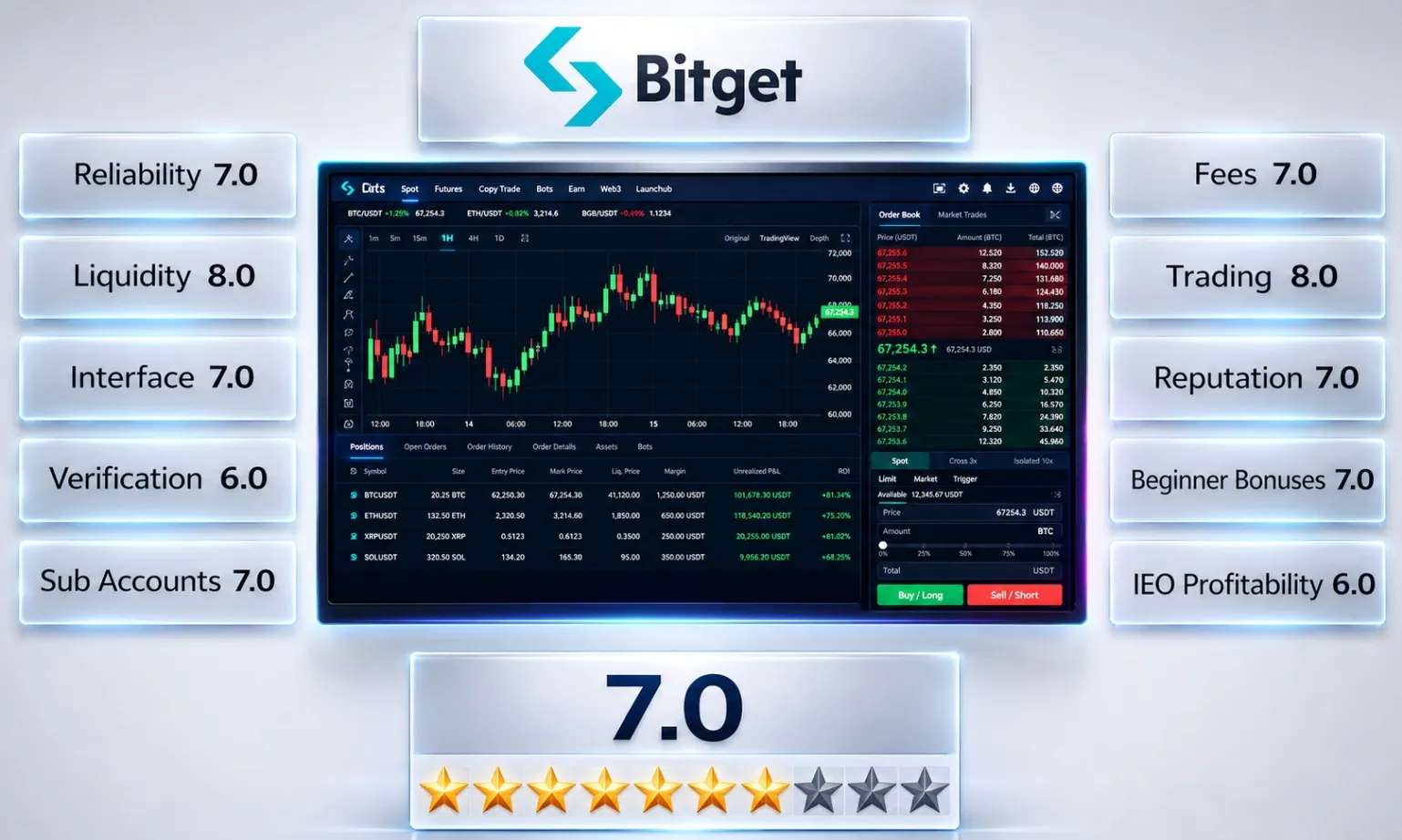
General information about Bitget
Bitget was launched in 2018 and positions itself as a global centralized exchange focused on derivatives, copy trading, and Web3 tools for wallets and on-chain scenarios. For review analysis, two points are critical: the quality of order execution in the terminal and the logic of operational restrictions for withdrawals, fiat routes, and access recovery.
Bitget promotional descriptions usually emphasize futures and copy trading. Reviews more often discuss operations where compliance checks and Risk Control are activated.
Markets | Copy trading | Reserves | Fiat | Regulation | Volume |
|---|---|---|---|---|---|
| Global markets access depends on jurisdiction | Available public leader profiles | Proof-of-Reserves reports on reserves and liabilities | P2P, cards, providers currency set depends on the provider | Offshore + licenses enhanced compliance | Active markets centralized trading platform |
Product profile and typical risks in reviews
- Products: spot, futures, margin, options, copy trading, Earn products with separate accrual conditions, P2P, TradingView integration, mobile apps.
- Focus: derivatives and social trading; copy trading is presented as a separate product with public leader statistics.
- BGB token: used for fee discounts and promotional mechanics inside the platform.
- Infrastructure security: public communications mention cold storage, Proof-of-Reserves, and an insurance fund.
- Review-based risks: operational restrictions during KYC/AML checks, manual withdrawal holds, disputed cases on P2P, and fiat routes through partners.
Summary of user ratings
The polarity of Bitget reviews is more often linked not to the trading side, but to whether an operation enters manual Risk Control and compliance review.
Bitget review distribution: where 1★ appears and where 5★ appears
Bitget reviews regularly repeat three groups of scenarios: conflict over access to funds (withdrawal hold, operational block, 2FA recovery), mixed experience with fiat routes and P2P, and stable trading with typical deposits and withdrawals without manual review.
1–2 stars: withdrawal holds, blocks, and long checks
Low ratings are more often linked to situations where withdrawals or part of the account operations are restricted. In such cases, the review is prolonged by sequential document requests and the absence of a fixed completion deadline.
- Withdrawal holds and operational blocks: Risk Control moves an operation into manual review based on risk signals.
- Access recovery and 2FA: complaints mention video confirmations and requests for deposit history with wallets and transactions.
- Fiat and P2P: recurring cases involve stuck transfers through partners, payment disputes, and claims related to chargebacks (bank reversal of a payment).
- Cross margin and leverage: negative stories include claims about using the total balance as collateral and the speed of liquidation.
- Support correspondence: reviews describe repeated requests for the same materials and the absence of a case resolution deadline.
A typical 1★ review theme: the withdrawal is restricted by a check, the document list expands during correspondence, and the review completion deadline is not fixed.
— from user complaints3 stars: trading works, but checks create delays
A 3★ rating is more common in reviews where the trading side is assessed positively. The experience worsens on operations that go into manual review or depend on external fiat providers.
- Terminal and order execution: positive assessments of the trading side are combined with complaints about withdrawal checks.
- Derivatives and copy trading: users describe the functionality as working, but some conditions are considered unclear without reading the rules.
- P2P and fiat: the convenience of entering and exiting fiat is accompanied by the risk of payment disputes.
- Support: reviews include wording about template replies and repeated document requests.
A typical 3★ review theme: trading is satisfactory, but withdrawals and fiat routes periodically require additional checks.
— user impressions4–5 stars: stable trading and typical withdrawals without conflicts
High ratings more often describe a scenario with completed verification, enabled account protection, and standard deposit and withdrawal routes without disputed P2P cases.
- Terminal and charts: positive reviews about the interface and TradingView integration repeat often.
- Crypto withdrawals: withdrawals to a personal address are described as predictable for typical amounts and addresses.
- Copy trading: reviews more often emphasize leader statistics and the ability to limit copying parameters.
- Fees and spreads: low transaction costs are mentioned on liquid pairs.
- Mobile app and API: reviews mention trading from a phone and connecting trading bots.
A typical 5★ review theme: verification is complete, account security is enabled, and deposit and withdrawal operations pass without escalation to manual review.
— experience of regular clientsMethodology: sources and review analysis principle for Bitget
The summary is based on recurring operational scenarios, so the source set and grouping rule are central to interpreting the reviews.
Sources and rules for analyzing Bitget reviews
- Period: reviews from the past 12 months; cases that became outdated due to rule or interface changes were not included.
- Sources: Trustpilot, TradingView, specialized forums, social networks and open trader communities, as well as public Bitget materials.
- Selection: priority was given to reviews describing a specific operation and its stage (deposit, withdrawal, P2P, margin, access recovery), including references to requested checks or documents.
- Classification: reviews were grouped by operation type: registration and KYC, deposits and withdrawals, P2P and fiat routes, margin trading, copy trading, interface, support, and security.
Recurring wording and claims were matched with specific operations and typical check triggers. This separates systemic causes of low ratings from isolated failures and individual user expectations.
Overall review impression: trading scenario and manual review scenario
Bitget reviews more often describe two operating modes. The first is trading and standard crypto withdrawals without conflicts. The second includes situations where operations are restricted by compliance and Risk Control because of P2P and fiat routes, large amounts, or access recovery procedures.
No-conflict scenario: KYC completed, crypto deposit, trading, withdrawal to a personal address
Positive reviews often describe one sequence: completing KYC, depositing cryptocurrency, trading on spot or futures, and withdrawing to a personal wallet address. The withdrawal is confirmed through 2FA and email.
Review scenario: P2P/fiat, large amounts, 2FA recovery, source-of-funds confirmation
Negative stories more often begin after a trigger: a P2P payment dispute, a fiat deposit through a partner, a large withdrawal to a new address, 2FA recovery, or a request to confirm the origin of funds. In such cases, the operation is moved to manual review, and withdrawals may be restricted until the procedure is complete.
Operations and settings that reviews associate with fewer conflicts:
- KYC completed before large deposits and large withdrawals.
- 2FA enabled before withdrawals and before changing security settings.
- Withdrawal address allowlist enabled for recurring routes.
- P2P operations conducted without moving communication outside the platform chat and with payment evidence preserved.
Bitget interface, trading terminal, and mobile apps
Reviews of the Bitget interface often mention the chart, order book, order form, and position panel on one screen. Positive assessments are tied to the speed of switching between pairs and panel customization.
What users more often praise in the Bitget interface
- TradingView integration: order placement from the chart interface after account connection.
- Workspace customization: themes, hidden panels, favorite pairs, and quick access to orders.
- Mobile apps: position alerts, biometric login, and security settings.
Typical theme: the terminal feels overloaded at first, but after configuring the panels, it becomes clearer.
— from trader reviewsWhat users more often criticize in the Bitget interface
- Learning curve: a large number of tabs and modes makes it harder to quickly find the needed function.
- TradingView connection: some order types are discussed as less convenient when placed from TradingView.
- Volatility lag: reviews mention delayed quote and chart updates during peak moments.
Bitget trading interface settings mentioned by users in the context of reducing operational errors:
- reducing the interface to core elements: chart, order book, order form, and position panel;
- using post-only mode, where the order is placed as a maker order and does not execute immediately at market price;
- checking selected order types and cancellation scenarios on small volumes before using large amounts.
Trading, liquidity, and copy trading on Bitget
Trading modes and liquidity
Trading reviews of Bitget more often emphasize liquidity on BTC, ETH, and major altcoins. Such pairs are described as having narrower spreads (the difference between the buy price — bid, at which participants are willing to buy an asset, and the sell price — ask, at which the asset is offered). The same reviews more often describe more predictable order execution than on low-liquidity instruments.
- Spot: a wide selection of coins and stablecoins; complaints are more often linked to deposits/withdrawals and checks than to trade execution.
- Derivatives: perpetual contracts and futures with leverage; some reviews are tied to liquidations and margin rules.
- Margin: isolated and cross margin; cross margin is discussed as a risk because it uses the total balance as collateral.
Typical theme: trading functions are rated higher than check procedures on deposits/withdrawals and fiat routes.
— from comments by active tradersCopy trading: mechanics and sources of complaints
Copy trading on Bitget is described as automatic copying of a leader’s trades to a connected account with settings for the share of funds and copying parameters. Complaints in reviews are more often linked to choosing a leader based on a short period and to the absence of risk limits.
✅ What is more often described as an advantage
- automatic copying of a leader’s trades after connection;
- public statistics: return on investment (ROI), drawdown, trading style, number of followers;
- observing position management in real trades.
⚠️ What is more often described as a risk
- choosing a leader by high return on investment (ROI) over a short period without assessing maximum drawdown and history length;
- lack of limits: share of deposit allocated to copying, maximum position size, leverage restrictions;
- expectation of “passive income” instead of treating copy trading as trading risk.
Risk parameters in copy trading that repeat in reviews:
- limit on the share of the deposit allocated to copying a leader;
- limit on the maximum position size per leader;
- leader selection by long-term history and maximum drawdown rather than by a single growth period.
Fees and hidden costs
Exchange fees
- Spot: around 0.1 % maker/taker, lower for large volumes and when paying with the BGB token.
- Derivatives: reduced maker rates and standard taker rates; the VIP schedule provides discounts for high volumes.
- Crypto deposits: usually without an exchange fee; costs arise on the network side when sending a transaction.
Execution costs and position holding costs
- Spread: the difference between bid and ask; on low-liquidity pairs, the spread can consume part of the result on entry and exit.
- Funding: periodic payments between sides of a position on perpetual futures; reviews mention funding as a cost when holding a position for hours or days.
- Network withdrawal fees: the amount depends on the network and coin; some reviews describe network selection as a source of a noticeable difference in final withdrawal cost.
Typical theme: base tariffs are assessed positively, while final costs become more noticeable on exotic pairs and during long futures position holding.
— from trader reviewsComponents of “trade cost” calculation in reviews:
- exchange fee according to the tariff;
- instrument spread at entry/exit;
- funding for perpetual futures when holding a position;
- network fees when withdrawing through the selected network.
Deposits, P2P, and withdrawals
Cryptocurrency deposits
A crypto deposit in reviews is described as a direct scenario: selecting a coin and network, deposit address, and network confirmations. Problem cases are more often linked to a network or address error when sending funds.
P2P and fiat
The Bitget P2P platform is described as cryptocurrency exchange between users with an escrow mechanism. Conflict stories are more often linked to payment disputes and the quality of payment evidence.
✅ What is mentioned as positives
- flexibility by currency and payment method;
- no exchange fee for a P2P transaction;
- use in regions without direct banking gateways.
⚠️ What is mentioned as risks
- fraud scenarios: fake payment confirmations and attempts to move communication outside the platform;
- chargebacks and banking disputes if payment evidence is insufficient for arbitration.
Typical P2P safety conditions repeated in reviews:
- selecting counterparties with a strong transaction history and rating;
- keeping communication and payment evidence inside the platform chat;
- releasing escrow (temporary locking of cryptocurrency on the platform side until the P2P transaction is complete) only after actual receipt of funds and confirmation of payment details.
Withdrawals
Crypto withdrawals in stable cases are described as selecting a coin, network, and address with confirmation through 2FA and email. In complaints, restrictions are more often tied to the amount, a new address, a link to fiat, or a P2P dispute, after which the operation is moved to manual review.
Withdrawal review triggers most often mentioned:
- a large withdrawal amount relative to account history;
- withdrawal to a new address with no operational history;
- a link between the withdrawal and a P2P dispute or fiat operation through a partner;
- changes to security settings and 2FA recovery before the withdrawal.
Support, KYC, and compliance
KYC and repeated checks
Basic KYC usually includes a document and a selfie. For higher-risk operations, reviews mention requests for source-of-funds confirmation, statements, and additional photo/video checks.
- Additional documents: statements, source-of-funds confirmation, and sometimes a short video confirmation.
- 2FA recovery: multi-step scenarios are described with confirmation of ownership of wallets and accounts used for deposits.
- Restrictions during review: 1★ reviews describe situations where withdrawals and some operations are temporarily blocked during an additional account check (compliance or KYC procedure).
Recurring support complaints
Negative reviews repeat two themes: the document list expands during correspondence, and the review completion deadline is not fixed. In such cases, the main risk is uncertainty over timing.
Typical theme: the first reply is quick, followed by repeated requests for materials and waiting without a stated deadline.
— from negative reviewsData set most often described as “requested by support”:
- operation chronology: amount, network, address, time, and transaction identifiers;
- payment evidence for fiat routes: receipts, statements, screenshots;
- source-of-funds materials in the format requested by compliance;
- video confirmation of identity and account ownership during 2FA recovery.
Security and risk control
Infrastructure security
Public Bitget descriptions and some reviews mention cold storage, Proof-of-Reserves, and an insurance fund as elements of the exchange’s asset custody risk management model.
- Asset storage: separation into cold and hot wallets, limits, and transaction monitoring.
- Proof-of-Reserves: reserve reports and mechanisms for checking whether liabilities are included in the report.
- Insurance fund: an asset pool positioned as a source of coverage during systemic incidents.
Account security and Risk Control triggers
- 2FA through an app and additional confirmations (email, login notifications).
- anti-phishing code in emails and active device control.
- withdrawal address allowlist as a restriction on withdrawal routes.
In complaints, Risk Control is more often mentioned as the reason for restrictions when several factors coincide: a new withdrawal address, a large amount, a fiat operation through a partner, a P2P dispute, and 2FA recovery.
Recurring wording around “basic hygiene” in reviews:
- separating capital into a trading portion on the exchange and long-term storage outside the exchange;
- enabling 2FA and an anti-phishing code before withdrawal operations;
- using an address allowlist for recurring withdrawals.
Bonuses, promotions, and Earn products
How Bitget bonuses are described
Bitget bonuses are more often described in reviews as fee coupons, welcome packages, deposit bonuses, and trading activities. Conflict stories are more often tied to turnover conditions and bonus expiration periods.
- in positive wording, the bonus is described as a fee discount and a resource for testing trading scenarios;
- in negative wording, the bonus is described as a source of withdrawal restrictions if turnover conditions are not met.
Typical theme: the bonus works under its conditions, while an attempt to withdraw the bonus portion without meeting the requirements ends with a restriction.
— from user reviewsPromotion condition parameters most often mentioned:
- minimum turnover and the list of products counted toward turnover;
- bonus validity period and deadline for meeting the conditions;
- restrictions on withdrawing the bonus portion and conversion conditions.
Bitget pros and cons based on reviews
✅ What is more often listed as positives
- Fees and liquidity: low costs on liquid pairs and comfortable order execution.
- Derivatives and copy trading: a broad set of tools for active trading and a separate copy trading product.
- Terminal: interface and TradingView integration as a frequent object of positive reviews.
- Public transparency signals: mentions of Proof-of-Reserves and the insurance fund.
- Promotional activity: regular bonuses and campaigns as a source of cost discounts for some users.
❌ What is more often listed as risks
- Compliance and checks: withdrawal holds, repeated verification, source-of-funds requests, and lengthy checks.
- Fiat routes: dependence on partners and an additional layer of delays.
- P2P disputes: risk of payment conflicts and dependence of the outcome on payment evidence.
- Margin modes: claims related to cross margin and liquidations under high leverage.
- Interface complexity: terminal overload as a frequent complaint among beginners.
What repeats in Bitget reviews:
- Positive ratings are more often tied to trading functions: terminal, liquidity, derivatives, copy trading.
- Negative ratings are more often tied to operations outside the terminal: withdrawals, KYC/AML checks, P2P, and fiat routes.
- Rating polarity is more often explained by differences in review scenarios rather than differences in trading conditions on liquid pairs.
Questions and Answers (FAQ) about Bitget
How safe is it to hold funds on Bitget?
Security discussions around Bitget more often mention cold storage, Proof-of-Reserves, and an insurance fund, while at the account level they mention 2FA, an anti-phishing code, and a withdrawal address allowlist.
In conflict stories, the risk is more often linked to operational restrictions during compliance checks. Reviews often mention a separation model: trading capital on the exchange and long-term storage outside the exchange.
Is KYC mandatory on Bitget?
Yes. Like on any centralized crypto exchange, KYC on Bitget is used to remove limits and process withdrawal operations. For atypical transactions or source-of-funds checks, additional information may be requested as part of compliance procedures.
Which fees affect trade cost beyond the exchange tariff?
Beyond the exchange fee according to the tariff, reviews more often mention spread (bid/ask), funding on perpetual futures, and network fees for withdrawals through the selected network.
Which deposit and withdrawal scenarios look most conflict-prone based on reviews?
Conflict cases more often involve links to fiat and P2P, as well as withdrawals to new addresses and operations after changes to security settings. Stable cases more often describe a crypto deposit and withdrawal to a personal address after prior verification.
What is most often considered a risk in copy trading on Bitget?
Reviews more often link copy trading risk to choosing a leader based on a short period of returns and to the absence of limits on the share of funds and position size, causing the leader’s drawdown to transfer to the connected account.
Is Bitget available in different countries?
Bitget operates in many countries, but some jurisdictions are restricted; reviews and overviews mention exclusions, so checking the list of restricted countries is usually tied to the exchange’s terms of use.
How does Bitget differ from other large exchanges based on reviews?
Comparative discussions more often highlight copy trading and derivatives as Bitget’s key products, while the main conflict area is described as KYC/AML checks and Risk Control restrictions on withdrawals and fiat routes.
Structure of Bitget reviews
Where positive sentiment concentrates. Positive reviews are more often tied to the trading layer: terminal, liquidity on major pairs, derivatives tools, and copy trading as a product with leader statistics.
Where negative sentiment concentrates. Negative reviews are more often tied to the operational layer: KYC/AML checks, 2FA recovery, withdrawal holds, fiat providers, and P2P disputes, where the outcome depends on checks and the quality of supporting materials.
The polarity of Bitget ratings in reviews is more often linked to whether an operation enters manual review and restrictions rather than to the quality of the trading terminal on liquid markets.