📘 LATOKEN: what the exchange offers, who it is for, and where it focuses
LATOKEN is a centralized crypto exchange. It focuses on early altcoin listings, token offerings through its Launchpad — the exchange section for initial token sales, including IEOs (initial exchange offerings) — and spot trading without full verification at the start. This operating model places the platform around newly listed tokens and trading in a segment with elevated volatility. The absence of futures and margin instruments limits LATOKEN’s role in scenarios that require derivatives trading and deep liquidity across a broad range of pairs.
LATOKEN stands apart from large general-purpose exchanges through its stronger emphasis on early listings, IEOs, and spot trading. As a result, the key evaluation factors here are fees, limits, verification, security, and liquidity quality in less common pairs.
- Platform focus: spot trading, Launchpad, and listings of new tokens, including small-cap coins.
- Main use case: trading new assets and gaining early access to tokens before deep liquidity is established.
- KYC and access: basic trading is available without full verification, but higher limits and participation in IEOs usually require KYC — identity verification based on documents.
- Fees: base rates for retail users are higher than on the largest competitors, but they decrease with high trading volume and when using the LA token.
- Main risks: an offshore operating model, weak liquidity in less common pairs, and additional AML checks — procedures that verify the origin of funds — during withdrawals.
LATOKEN’s model is closely tied to early listings and IEOs. For large capital and more complex trading strategies, the lack of derivatives, the offshore operating model, and weak liquidity in some less common pairs create clear limitations.
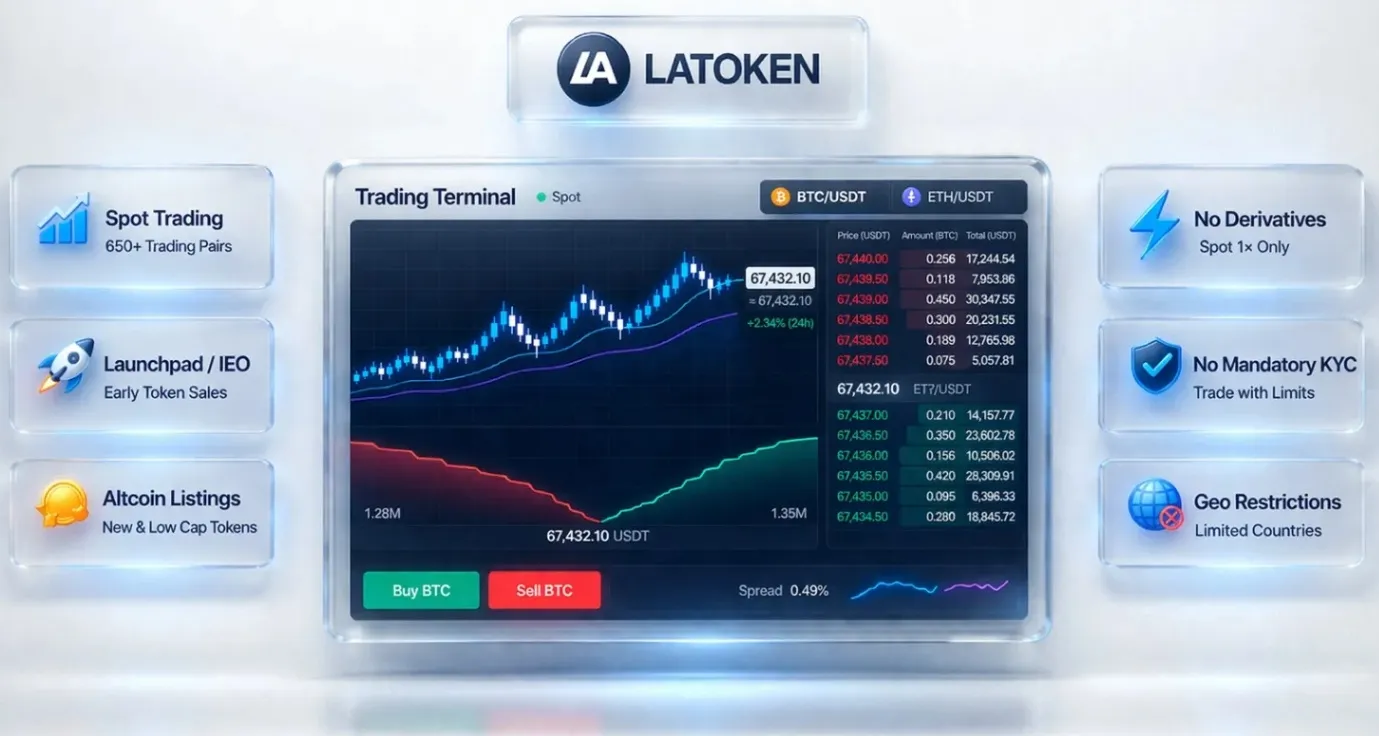
LATOKEN’s core products: spot trading, IEOs, and platform structure
💱 Spot trading
Spot trading is LATOKEN’s main product. A trade is executed at the current market price. There is no leverage and no separate derivatives contract here. The exchange offers hundreds of cryptocurrencies and about 650 crypto-to-crypto pairs. The main base markets are BTC, ETH, USDT, and LA. Fiat pairs are not used in the exchange order book. Card purchases and local payment methods are routed through the “Buy Crypto” and P2P services — direct exchange between users.
- TradingView charts, an order book, a trade feed, and limit and market orders.
- Core liquidity is concentrated in BTC/USDT and ETH/USDT pairs.
- Less common tokens may have wide spreads and low volumes.
- Trading is available without full verification, but withdrawals are limited by account-level restrictions.
LATOKEN’s spot market is used for trading liquid pairs and accessing new tokens, but trading conditions for less common assets may differ because of spreads and limited order book depth.
📈 Futures and leveraged trading
LATOKEN does not offer futures, options, or margin trading. Only spot trading with 1× settlement is available. The platform does not support leveraged or hedging strategies.
- No futures contracts or options.
- No margin trading or leverage.
- All trades are executed without the risk of position liquidation within the platform.
LATOKEN does not cover derivatives trading needs and is used only for spot-market activity.
🚀 Launchpad and IEOs
Launchpad is a key LATOKEN product. The exchange runs IEOs, where tokens are sold before open trading begins. Users gain access to a token at an early stage, while the project gains audience reach and liquidity.
- Buying tokens before they are listed on the exchange.
- KYC and a balance in USDT or BTC are usually required for participation.
- After the sale, tokens are often listed on LATOKEN.
- The outcome depends on the project and market demand after listing.
IEOs provide early access to tokens, but the final result depends on market behavior after trading begins.
🏦 Asset tokenization and RWA
LATOKEN originally developed around the idea of RWA (real-world assets) — the tokenization of real assets. At the moment, this direction is represented only in a limited way and is not the platform’s main product line.
- No broad lineup of RWA instruments.
- Individual products appear irregularly.
- Some instruments may be linked to commodities or securities.
- Development is constrained by regulatory requirements.
RWA remains a secondary direction on LATOKEN and does not define the exchange’s core operating model.
LATOKEN fees: trading costs, deposits, and withdrawals
Fees affect the final outcome of every trade. On LATOKEN, base rates for retail users are higher than on the largest global exchanges.
LATOKEN’s base trading fees are above the market average. A multi-tier discount applies to higher trading volumes. As a result, the total cost of a trade depends not only on the fee schedule but also on trading volume over the past 30 days.
📈 Spot trading fees
| Condition | Maker | Taker | Comment |
|---|---|---|---|
| Base tier | 0.49% | 0.49% | Standard rate for most pairs |
| Volume-based VIP from $5M over 30 days | 0.02% | 0.04% | Fee reduction under the multi-tier schedule |
| Some low-liquidity pairs | 0.49% | 0.98% | Higher rate for selected less common tokens |
💵 Deposits and withdrawals
- ➕ Crypto deposits — no exchange-side fee.
- ➖ Fiat deposits — processed through third-party providers, which usually charge around 2–5%.
- 🔁 P2P — no exchange fee, but the final price depends on the spread set by the seller or buyer.
- 📤 Withdrawals — subject to a fixed network fee: benchmark examples may look like BTC 0.0005, ETH 0.0114, USDT-TRC20 around 3 USDT; for less common tokens, withdrawals may cost more because of network specifics.
Verification and access: KYC tiers and geo-restrictions
The access level on LATOKEN depends on more than registration alone. The depth of account verification determines withdrawal limits, participation in IEOs, and access to certain features.
On LATOKEN, basic crypto-to-crypto trading is available without full identity verification. KYC is identity verification based on documents. It becomes mandatory for higher limits, card purchases, and some additional products.
📑 KYC tiers
| Tier | Requirements | Features and limits |
|---|---|---|
| Tier 1 | Email or phone number | Spot trading, withdrawals of about $10,000 per day |
| Tier 2 | Document and selfie | Withdrawals of about $100,000 per day, participation in IEOs, access to card purchases |
| Tier 3 | Document and proof of address | Maximum limits and full access to platform tokens and campaigns |
🌍 Regional restrictions
LATOKEN does not serve users from a number of countries. Some jurisdictions may face a full ban. In other jurisdictions, the platform may restrict only selected products. As a result, access depends not only on registration but also on the rules of the user’s country.
LATOKEN security: technical safeguards and regulatory model
Exchange security has two layers. Technical protection of accounts and reserves reduces operational risk, while the company’s legal operating model defines the limits of legal protection.
🛡️ Technical measures
- 🧊 Cold storage for the main part of reserves and multi-signature controls for wallet management.
- 🔐 2FA, an anti-phishing code, and a withdrawal address whitelist.
- 🧪 Vulnerability discovery programs and regular infrastructure updates.
⚖️ Regulatory status
LATOKEN operates through an offshore jurisdiction and does not hold licenses from major regulators. This gives the exchange more freedom to list new tokens. At the same time, it reduces the client’s level of legal protection in disputes compared with large licensed platforms.
Interface and apps: web platform and mobile experience
LATOKEN’s interface is built around trade execution. Quick access to markets, listings, and the wallet shows that spot trading and promotional activity take priority over more advanced professional functions.
The LATOKEN web terminal follows a relatively simple structure. Its main elements are the market list, TradingView chart, order book, and order form. The platform prominently highlights new listings, IEOs, and airdrop activities. These sections appear more often than advanced trading panels.
- 🧭 Fast navigation across Markets, Exchange, Wallet, Launchpad, Airdrops, and P2P.
- 📱 Mobile apps for iOS and Android with a basic feature set.
- 🔔 Notifications about listings, promotions, and account events.
Interface limitations
- ❌ No advanced order set such as OCO, where one order automatically cancels another.
- ❌ No separate derivatives terminal and no demo mode.
- ❌ The interface is designed for spot trading and promotional activity rather than professional trading across a wide range of scenarios.
LATOKEN is used primarily for spot trading, IEOs, and transactions in new tokens. For more complex active trading, the platform’s toolset is noticeably narrower.
LATOKEN scale: users, trading volume, and market coverage
Audience size, trading volume, and the number of listings show which segments concentrate LATOKEN’s core market activity.
- Registered users: about 1.5M+; the active audience is noticeably smaller than the total number of accounts.
- Daily volume: usually in the $200M–500M+ range, with a significant share concentrated in the most liquid pairs.
- Listings: 600+ coins and about 650 trading pairs.
- Exchange token: LA under the ERC-20 standard — the token standard on Ethereum — used for internal discounts and some platform mechanisms.
By scale, LATOKEN trails the largest global exchanges in liquidity and product breadth. The platform’s main activity is concentrated in new listings and less popular tokens.
LATOKEN reputation: what users value and what they criticize
Reviews of LATOKEN are usually not centered on platform design. The main themes are withdrawal speed, support quality, and liquidity in less common assets.
User reviews of LATOKEN vary widely. Positive feedback more often concerns access to less common tokens, early listings, and a simple spot terminal. Negative feedback more often relates to withdrawal delays, additional account checks, and slow support responses in disputed situations.
Typical user complaints
- ⚠️ Temporary withdrawal delays and requests for additional verification.
- ⚠️ High fees for smaller trading volumes.
- ⚠️ Weak liquidity and sharp price moves in some less common tokens.
Additional checks are more common with incomplete KYC, large transactions, and trading in less common pairs with limited liquidity.
LATOKEN’s reputational risk comes from the combination of high fees, selective liquidity, and strict withdrawal checks.
Bonuses and promotions: what LATOKEN offers beyond trading
LATOKEN’s bonus mechanisms are built around user acquisition, trading activity, and maintaining balances in selected platform products.
- 🤝 Referral program — rewards of up to 25% of the fees paid by invited users.
- 🎟️ Airdrops — token distributions for completing simple actions within the ecosystem.
- 🏆 Trading competitions — contests with prizes in tokens or USDT.
- 🌱 Staking/Earn — placing assets into products with advertised yield.
- 💳 Promo codes and cashback — targeted campaigns with reduced fees or a one-time bonus.
A bonus should not be treated as guaranteed yield. Most promotions come with conditions tied to volume, holding period, or account tier.
LATOKEN compared with Binance, LBank, and BingX
LATOKEN should be compared through specific parameters. The most important factors here are early listings, liquidity depth, trading costs, and product range.
| Criterion | LATOKEN | Binance | LBank | BingX |
|---|---|---|---|---|
| Launch year | 2017 | 2017 | 2015 | 2018 |
| Regulation | Offshore model, no major licenses | Licenses in a number of jurisdictions | Offshore or multi-jurisdiction model | Partial licenses in selected regions |
| Coins / pairs | 600+ / ~650 | ≈350 / 1200+ | 800+ / 1300+ | ≈500 / 800+ |
| Fees (spot) | 0.49% base | ≈0.1% | 0.10% | 0.10% |
| Derivatives | No | Yes | Yes | Yes |
| Core strength | Early listings, IEOs, airdrops | Liquidity and a broad product set | Large selection of altcoins | Copy trading and derivatives |
LATOKEN does not compete with the largest exchanges in regulatory reliability, liquidity depth, or the range of trading scenarios. Its main niche is early access to new tokens, IEOs, and promotional activity around those launches.
LATOKEN’s place in the market: it is a supplementary venue for tasks related to new listings.
LATOKEN advantages and limitations
LATOKEN’s strengths are tied to new listings, IEOs, and spot trading. Its limitations become more visible in other scenarios: derivatives trading, deeper liquidity, and stronger regulatory protection.
✅ Pros
- Wide selection of new and less common tokens.
- Strong emphasis on IEOs, listings, and promotional activity.
- Low entry barrier thanks to basic trading without full verification.
- Discounts and bonus mechanisms through the LA token and referral system.
❌ Cons
- No licenses from major regulators.
- High base fees for retail users.
- No derivatives and no advanced order types.
- In less common pairs, liquidity may be weak, and withdrawals may involve additional checks.
Operational practice and risk control when using LATOKEN
- KYC status. The verification tier affects withdrawal limits, participation in IEOs, and the likelihood of additional checks during disputed transactions.
- Order book depth in less common pairs. Low liquidity increases spreads and makes it harder to exit a position without significant slippage.
- Total transaction cost. The final burden consists of the trading fee and the network withdrawal fee.
- Selected withdrawal network. For stablecoins, the difference between networks can affect total costs even more than the spot fee itself.
- IEO and new-token parameters. An early listing does not reduce project risk; it shifts that risk to the stage after trading begins.
- Capital storage structure. LATOKEN is used primarily for transactions and listing-related activity rather than for long-term storage of the entire balance on the exchange.
- Deposit and withdrawal pattern. Large and sudden transfers are more likely to fall into the zone of additional AML checks.
- Account security settings. 2FA and a withdrawal address whitelist reduce the risk of unauthorized withdrawals within a centralized custody model.
- Listing and promotion calendar. Platform announcements affect traffic inflow, short-term liquidity, and the behavior of new tokens after launch.
FAQ about LATOKEN exchange
What is LATOKEN and what is the exchange mainly used for?
LATOKEN is a centralized crypto exchange whose main specialization is tied to spot trading, early altcoin listings, and offerings through Launchpad and IEOs. This product model shifts platform activity toward new tokens and limits the role of derivatives, since the exchange does not offer futures or margin markets.
Do you need verification to use LATOKEN?
Basic crypto-to-crypto trading on LATOKEN is available without full identity verification. Higher withdrawal limits, participation in IEOs, and access to some additional functions usually require completing KYC.
Does LATOKEN support futures and margin trading?
LATOKEN does not offer futures, options, or margin trading. The platform’s trading model is limited to the spot market without leverage and without the risk of position liquidation inside the exchange.
How do Launchpad sales and IEOs work on LATOKEN?
LATOKEN’s Launchpad is used for initial token sales before open trading begins. An IEO takes place within the exchange infrastructure, and access to participation usually depends on KYC status and holding a balance in base assets such as USDT or BTC.
What are the main risks of using LATOKEN?
LATOKEN’s key risks are tied to its offshore operating model, selective liquidity in less common pairs, high base fees, and additional withdrawal checks. These factors become more visible in scenarios involving large amounts and low-liquidity assets.
LATOKEN’s role in the market and its main use cases
LATOKEN has a narrow specialization. The flow of new listings and IEOs shapes its role as a supplementary venue for working with new tokens, while broader use cases require wider liquidity, derivatives, and regulatory protection.
LATOKEN is a niche centralized exchange. It provides early access to new tokens, IEOs, and the trading opportunities associated with them. This specialization is built on a steady flow of listings, a simple spot terminal, and the ability to start basic trading without full verification at the outset.
LATOKEN’s weaker sides appear in scenarios that require low base fees, deep liquidity across a large number of pairs, derivatives, and strong regulatory protection. As a result, LATOKEN serves as a supplementary venue for tasks related to new listings and IEOs rather than as a single center for storing and trading an entire portfolio.
LATOKEN’s model is tied to