📖 Gate.io: real user reviews and key takeaways
This material brings together recurring user assessments of Gate.io over the past 12 months. It is based on customer reviews on Trustpilot and trader discussions on TradingView. Complaints and praise are grouped by topic; each topic includes the wording that appears most often.
The goal of this material is to list what users write about Gate.io and show which conditions and actions in the reviews themselves are more often linked to a more predictable experience: completed
General information about Gate.io
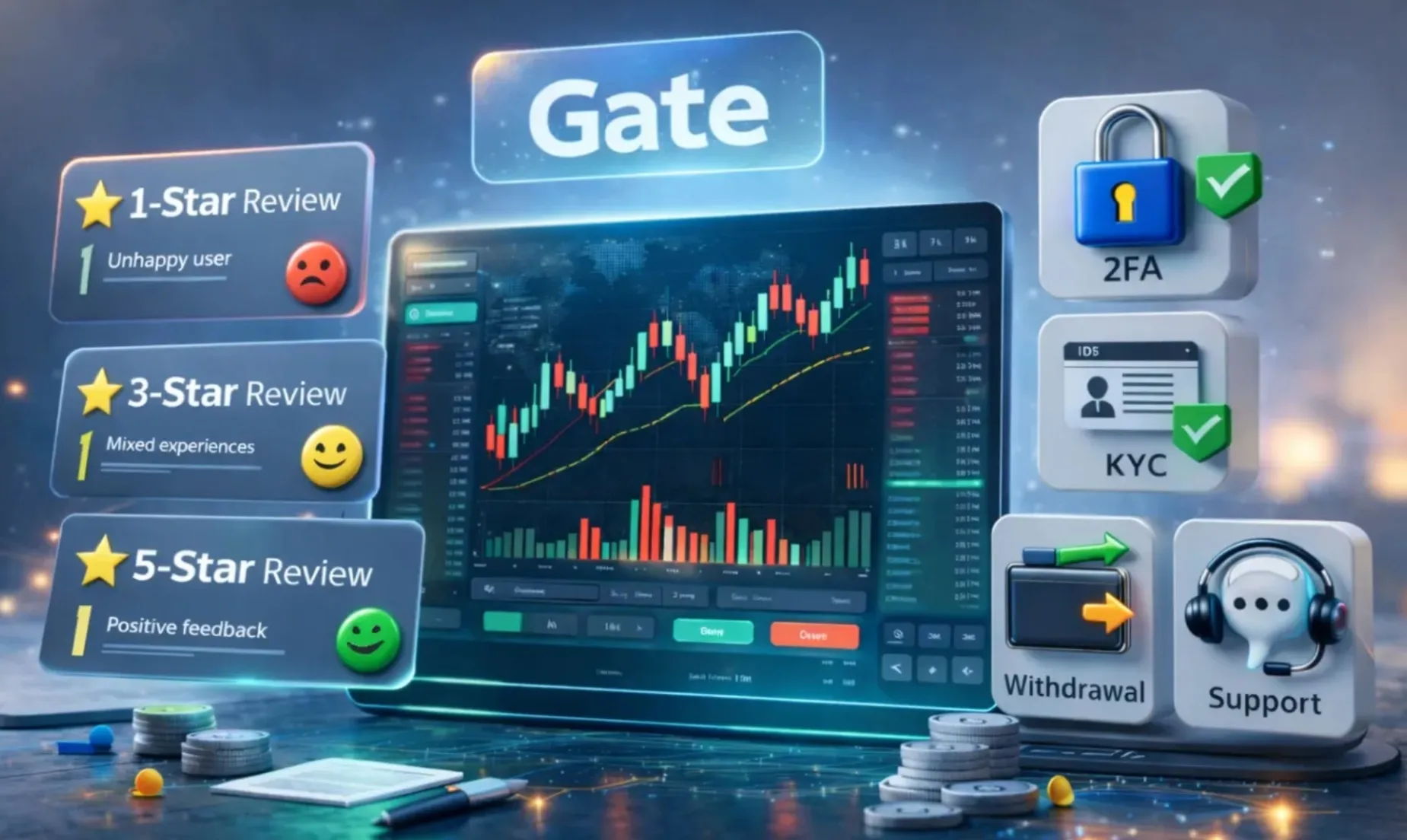
Gate.io is a crypto platform with tools for spot trading (buying and selling an asset with actual crediting to the balance), futures (derivative contracts based on the price of an asset), margin trading (trades using borrowed funds and margin — collateral for the position), copy trading (copying the trades of other traders), Earn products (placing assets in yield products), Launchpad/Startup (early-access token platforms), an NFT marketplace (a platform for trading non-fungible tokens) and mobile apps. The company says it supports hundreds of assets, regularly adds listings (adding a token or trading pair to the exchange) and publishes Proof-of-Reserves reports (PoR), where reserves, according to the company, exceed customer liabilities.
In reviews from the past 12 months, users praise the range of trading tools while also describing withdrawal delays, disputed situations on derivatives (contracts whose price depends on an underlying asset) and problems with support quality.
Methodology and sources
Period: the past 12 months.
Sources: text-based customer reviews on Trustpilot and open trader discussions on TradingView (ideas, asset feeds, overview posts).
Filtering: obvious duplicates and one-word responses without factual details were excluded; cases with details were considered (amounts, dates, tickets — support request numbers,
Limitations: reviews are subjective; some responses may be affiliated (written by people connected to the service) or emotional. No legal assessment is given; the material lists recurring complaints and praise, as well as the conditions and actions that users themselves most often associate with fewer problems (
Short overview of public ratings and signals for the year
 1.3/51,388 reviews, most often 1★
 TVGate data is available in charts and ideas
Review summary by key aspects
Escalation means transferring a request to a higher support level. If a first-line operator does not resolve the issue or responds without facts on the case, the request is transferred to a case manager or a specialized team. Reviews mention escalation in connection with withdrawal delays, account freezes and disputes over financial operations.
| Aspect | What users praise | What users criticize | Comment |
|---|---|---|---|
| Interface and UX (user experience) | Deep charts, familiar TradingView interface, fast orders (buy or sell requests) | Difficult for beginners, many sections and settings | Experienced traders more often praise the trading screen; beginners in reviews are more often confused by navigation, order types and the number of sections |
| Fees | Low trading fees, promotions and discounts | Differences in the received amount during withdrawals and delistings (removal of tokens from the exchange) of small tokens | Withdrawal complaints repeatedly mention differences between the expected and actual amount received due to the network, fee and asset status |
| Security | 2FA, PoR, withdrawal address books | Stories about frozen funds and disputed derivative cases | PoR means reserve reports; the presence of PoR increases trust, but reviews still contain complaints about account freezes, withdrawal delays and disputed liquidations (forced position closure due to insufficient margin) on derivatives |
| Support | Sometimes helps with simple requests | Slow replies, template emails, prolonged escalations | Long cases more often include the request number, address, network and |
| Asset range | Very many coins, early listings | Low liquidity (market depth and order volume) of rare tokens and the risk of slippage (trade execution at a worse price than expected) | Early listings provide access to rare tokens, but low liquidity on specific pairs increases slippage when buying and selling |
| Derivatives | Wide contract range, low fees | Separate incidents with the price index (the contract’s calculated price based on data from several markets) and liquidations | Derivative complaints are more often linked to leverage (borrowed increase in position size), liquidations and disputes over the index price in specific contracts |
| Withdrawals | Small amounts often go through without problems | Delays, repeated KYC, canceled requests | Calmer cases more often mention small amounts and standard networks; complaints mention large amounts, repeated KYC and canceled requests |
| Stability | No mass outages in everyday trading | Rare derivative incidents and execution disputes | Spot reviews are more often neutral; criticism becomes stronger during periods of high volatility (sharp price swings) and on derivatives |
Review distribution: rating and reason
Data: approximate and averaged over the past 12 months; sources are Trustpilot (text reviews) and the TradingView trader community. Shares are rounded, and reasons are grouped into recurring wording about withdrawals, support and trading incidents.
1–2 stars
- Reviews describe withdrawal delays: the status says “completed,” but the transfer does not arrive.
- There are stories about account freezes after profitable trades and long reviews.
- Support replies slowly or with templates, and case escalation stretches out.
- Disputed derivative incidents are mentioned, including cases involving specific contracts (for example, LA/USDT).
3 stars
- Users are satisfied with the interface and fees.
- Deposits and withdrawals sometimes go through quickly and sometimes are delayed without explanation.
- Support resolves some issues, but response time and quality depend on the case.
4–5 stars
- Users mention a convenient trading terminal and built-in TradingView charts.
- Low trading fees and tight spreads (the difference between the best buy and sell price) on major pairs are noted.
- Users praise the large coin selection and fast listings of rare altcoins (alternative cryptocurrencies outside BTC).
- Successful trading and withdrawals without problems are described.
| ⭐ Rating | 📊 Share of reviews | 💬 Main reason |
|---|---|---|
| 1–2 stars | ~70% | 🚫 Withdrawal delays, account freezes, weak support, disputed derivative cases |
| 3 stars | ~10% | 😐 Interface and trading fees are acceptable, but withdrawal delays and support complaints occur |
| 4–5 stars | ~20% | 👍 Convenient trading terminal, low fees, early listings, successful trading and withdrawals |
Interface and ease of use
Experienced traders often praise the structure of the trading screen: the order book (a list of buy and sell orders), the trade feed (recent executed trades), the order form and the TradingView chart with indicators and settings. Users write that it is convenient when they already use TradingView charts for analysis.
Beginners more often write about navigation complexity: a multi-level menu, a large number of markets, order types, withdrawal network selection and separate products (Earn, Startup, NFT and so on). Reviews include the wording “the functionality is broad, but onboarding is difficult.” Reviews with a calmer experience more often mention spot trading, a limited set of active panels, completed
Fees and hidden charges
Reviews describe Gate.io’s basic trading fees as low and comparable to those of other exchanges; discounts and promotions are mentioned separately. For futures, users more often note low fees compared with alternatives. Complaints about trading fees appear less often than complaints about withdrawals.
The main complaints in reviews concern withdrawals and token delistings. Users describe cases where one amount is shown on the withdrawal confirmation screen, but after the fee is charged, a noticeably smaller amount arrives in the wallet.
When low-liquidity tokens are delisted, fees and conversion rules can result in only a minimal balance remaining after deductions. Users link their complaints to the gap between the expected and actual amount received.
Security and trust
Stated measures. The exchange publishes
User experience. Reviews regularly include stories about frozen funds and prolonged checks during withdrawals. A separate group of complaints relates to derivatives: users describe abnormal price movements on specific contracts, liquidations and compensation disputes. Users link lower trust to these cases because the dispute affects margin deductions and the final balance.
Factors that reviews associate with fewer problems
- 🔒 Users more often keep a working amount for trading and separate long-term storage from the exchange account.
- 🔑 Cases without access complaints more often mention enabled
2FA , backup codes, a separate password and an anti-phishing code. - 🛡️ In withdrawal scenarios, users often mention address whitelists and additional device/IP restrictions; if Gate.io supports
U2F (Universal 2nd Factor; hardware second-factor key), it is also noted as an additional barrier. - 📤 For large transfers, reviews more often mention splitting the amount and making a test transaction along the same route.
Support and response speed
One scenario repeats often in reviews: replies arrive with a delay, emails look templated, and escalation for complex cases stretches over weeks. Users sometimes resolve
- A ticket is usually created with a short title and a timeline of events.
- The first message most often includes withdrawal status, transaction hash, address, network and
KYC data. - During prolonged correspondence, users add updates with new facts rather than repeating one-word requests.
- If there is no movement on the case for several business days, the correspondence usually includes a request to escalate it to a case manager.
- In dispute emails, users repeat the ticket number and the full set of facts about the withdrawal or account check.
Withdrawals and fiat operations
The most frequent negative feedback in reviews concerns withdrawals: delays, cancellations, repeated
Stability and bugs
In spot trading reviews, users more often write that the website and apps work steadily and trades execute without mass outages. Negative feedback more often appears because of rare but visible derivative incidents and disputed order execution cases. Users describe such cases as critical when an incident coincides with high volatility and leads to liquidations.
Reputation compared with competitors
Reviews describe Gate.io as a platform with a large number of markets and products (spot, futures, margin trading, Earn, Launchpad/Startup, NFT). Reputation complaints in reviews are more often tied to withdrawal delays, support quality and conflict situations on derivatives. As a result, some users use Gate.io for trading and access to rare listings, while others avoid it because of repeated checks and disputed derivative deductions.
What reviews link to a more predictable experience
Before deposit
- Cases without problems more often mention completed
KYC and2FA with backup codes in advance. - Before a large transfer, users often mention a test deposit and withdrawal of a minimal amount with checks of the address, network and
memo/tag requirements. - Descriptions of calmer experience include an anti-phishing code and address whitelists before the first large operations.
- In derivative reviews, more neutral experience is more often linked to limiting leverage and predefined risk parameters.
- Users often separate long-term storage from the exchange trading amount.
During a withdrawal delay
- In escalation cases, users first collect the request number, status screenshot,
TXID /hash, address, network and correctmemo/tag . - Further correspondence usually revolves around the timeline of events and attached confirmations.
- If there is no progress for several business days, the ticket more often includes a request for escalation to a case manager.
- Users often repeat the ticket number and issue description in official support channels.
- In later cases, some users link fewer problems to smaller amounts and more standard withdrawal networks.
❓ FAQ on Gate.io reviews
How safe is Gate.io?
Is KYC required for withdrawal?
Which fees cause the most complaints?
How do reviews describe a “stuck” withdrawal?
Does Gate.io have TradingView integration?
How do reviews describe Gate.io derivatives?
How do reviews describe fiat and P2P?
How do reviews describe Gate.io compared with competitors?
Can Gate.io be used for long-term storage?
How do reviews describe getting started on Gate.io?
🧾 Gate.io review takeaways
According to reviews, Gate.io combines a broad range of markets and products (spot, futures, margin trading, Earn, Launchpad/Startup, NFT) with complaints about withdrawal delays and prolonged support replies. The positives in reviews are more often linked to the trading terminal, early listings and trading fees.
Negative feedback is more often linked to withdrawal delays, repeated checks, support quality and disputed cases on derivatives and delistings. Users more often use Gate.io for trading and access to rare assets, while keeping the main amount outside the exchange.