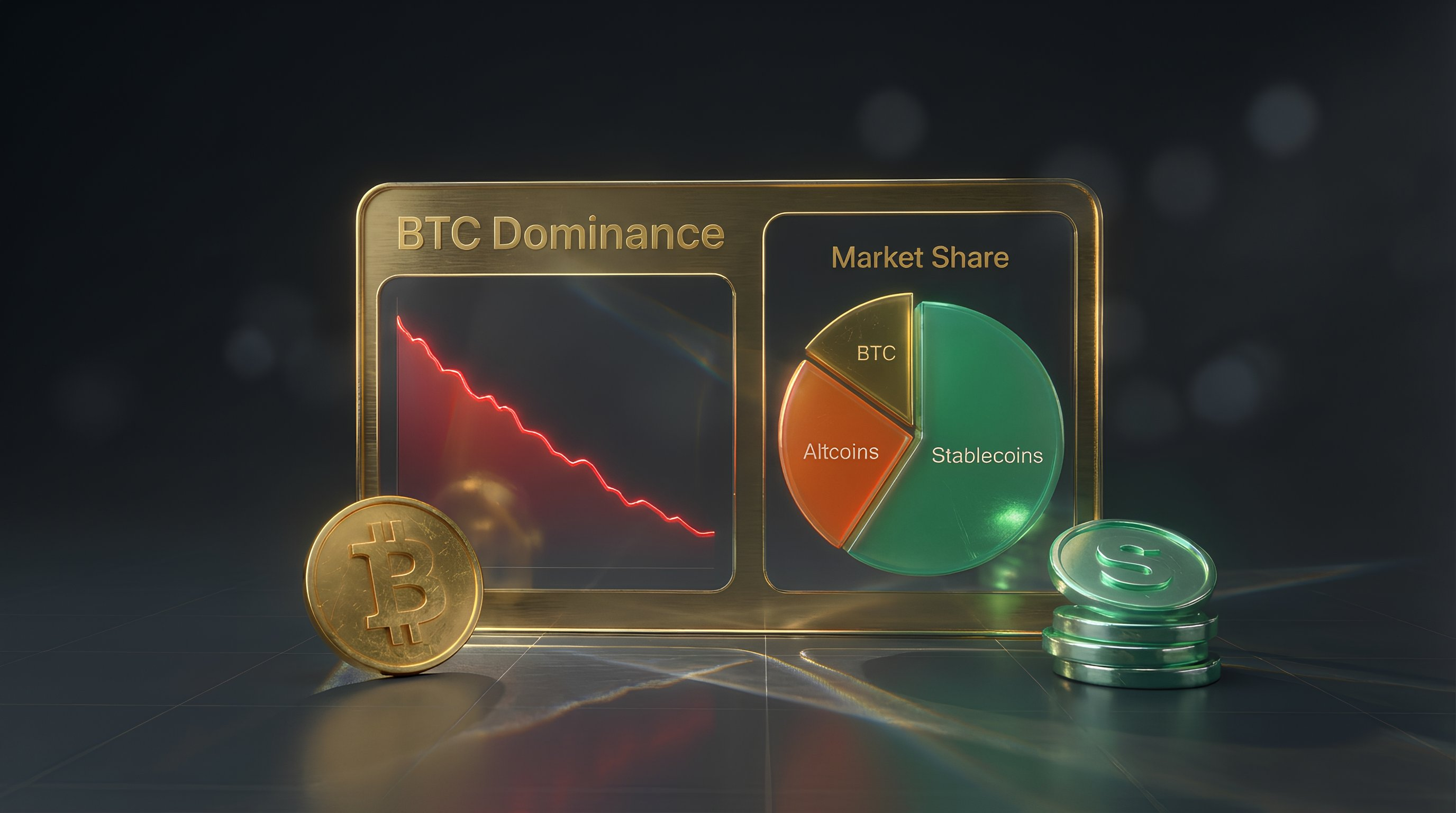
BTC dominance (BTC.D) is BTC’s share of total crypto market capitalization; a decline in BTC.D is often read as a signal that “alts are taking share,” but the metric can fall even without broad altcoin growth. Core interpretation errors and sources of false signals are covered in BTC dominance as a metric: what it actually measures.
Purpose of the article: to provide a practical way to distinguish a decline in BTC’s share from a situation where most altcoins are genuinely outperforming BTC.
What exactly becomes misleading when BTC.D falls
Altseason is a period when most altcoins rise faster than BTC at the same time.
- Stablecoins (USDT, USDC). BTC.D can fall when capital moves into stablecoins while prices of most altcoins remain flat.
- Narrow growth. BTC.D can fall when 1–3 major altcoins rise while the rest of the market does not show comparable momentum.
- BTC decline. BTC.D can fall when BTC drops faster than the market; in this case, ALT/BTC — the ratio of an altcoin’s price to BTC — often looks stronger because BTC is weak, not because demand for altcoins is rising.
- Token base changes. BTC.D can shift when an aggregator adds or removes assets from the total market capitalization calculation.
Scenarios: BTC price, BTC.D, and Total3
Total3 is the CRYPTOCAP:TOTAL3 index, which reflects the total market capitalization of altcoins excluding BTC and ETH.
Spot is the market for immediate buying and selling of an asset without a derivatives contract; spot market depth shows the volume of orders near the current price.
OI (open interest) is the volume of open derivatives positions, funding is the periodic payment between sides of a perpetual futures contract, and leverage is the borrowed multiplier applied to a derivatives position.
| BTC price | BTC.D | Total3 | Working interpretation | Control criterion |
|---|---|---|---|---|
| ↑ | ↑ | ↓ or ↔ | Market growth is concentrated in BTC; the altcoin segment is lagging. | ALT/BTC across most coins and spot market depth in alts. |
| ↑ | ↓ | ↑ | The altcoin segment is expanding faster than BTC; an altseason phase is possible. | The share of coins outperforming BTC and the stability of ALT/BTC. |
| ↑ | ↓ | ↓ or ↔ | A decline in BTC share without altcoin growth is often linked to stablecoins or growth in a few individual assets. | The share of stablecoins and the contribution of the largest alts to the move. |
| ↓ | ↑ | ↓ | Risk-off is a mode of lower demand for risk: altcoins fall harder than BTC, and BTC’s share rises. | Alt liquidity and liquidation spikes. |
| ↓ | ↓ | ↓ | A broad downturn where BTC loses share because of a sharper decline or because stablecoins grow during the sell-off. | The share of stablecoins and the direction of ALT/BTC across the broad market. |
| ↓ | ↓ | ↑ | Rotation into altcoins amid BTC weakness is often supported by a narrow segment and changes quickly when leverage rises. | OI and funding in alts, as well as the breadth of growth in Total3. |
Interpretation matrix for a decline in BTC.D
The matrix compares the direction of BTC.D and Total3 to separate altcoin growth from scenarios where BTC’s share falls because of stablecoins, narrow growth, or BTC weakness.
| Total3 ↑ | Total3 ↓ | |
|---|---|---|
| BTC.D ↓ | Altseason candidate if growth is broad-based and ALT/BTC rises for most coins. | Usually not altseason: BTC’s share falls without growth in the altcoin segment. |
| BTC.D ↑ | Market growth with BTC dominance; altcoins rise but lag BTC in relative returns. | Altcoins decline more than BTC; demand for risk is lower than demand for BTC. |
Metrics confirming an altseason scenario during a BTC.D decline
Total3
Total3 should rise steadily, not because of a brief spike in 1–2 coins within the index.
ALT/BTC
ALT/BTC should rise across most liquid altcoins; growth in the pair for 2–3 leaders does not confirm a broad regime.
Stablecoin share
Growth in stablecoin share more often means capital parking and waiting, not redistribution into risk across altcoins.
OI and funding
Overheated OI and skewed funding often lead to sharp pullbacks without continued growth.
Liquidity
Alt liquidity is confirmed by order book depth and low slippage on spot; the order book shows limit orders near the current price, while slippage reflects the difference between the expected and actual execution price.
Control criteria for a decline in BTC.D
Criteria confirming an altseason market regime
- The direction of Total3 relative to the direction of BTC.D.
- Market breadth through ALT/BTC across a basket of liquid altcoins, not just 1–2 leaders.
- Stablecoin share and its dynamics over the same period as the BTC.D move.
- Derivatives conditions: OI and funding across major alt pairs.
- Spot liquidity: order book depth and slippage for a typical position size.
Historical cases when BTC.D fell without altseason
- Stablecoin growth during sideways altcoin movement. BTC.D declined amid inflows into USDT/USDC, while most altcoins did not show sustained growth against BTC.
- Narrow growth in large alts. BTC.D declined when the market was driven by 1–2 major altcoins, while the median coin remained weak in ALT/BTC.
- BTC falling faster than the market. BTC.D declined during sharp BTC drawdowns, while improvement in ALT/BTC reflected the difference in the speed of decline rather than a market shift into higher risk demand for alts.
FAQ on BTC dominance
Why does BTC dominance fall if altcoins are not rising?
BTC.D can decline because of growth in stablecoin share or because several major coins rise while most alts remain weak.
Why does BTC dominance fall during a market decline?
BTC.D declines when BTC falls faster than the rest of the market or when capital moves into stablecoins during a sell-off.
What does a decline in BTC dominance mean when Ethereum is rising?
A decline in BTC.D during ETH growth more often means the move is concentrated in one major asset and does not confirm broad growth across most altcoins.
When does a decline in BTC.D genuinely resemble altseason?
The scenario is closer to altseason when Total3 rises, ALT/BTC strengthens across most liquid coins, and the move is supported by normal spot liquidity without overheated OI and funding.
BTC.D as context and the role of market breadth
BTC.D can decline because of stablecoin growth, narrow growth in the largest altcoins, or a faster BTC decline, so the direction of BTC.D does not confirm mass altcoin growth on its own.
Altseason is confirmed when growth covers a broad market segment: Total3 rises, most ALT/BTC pairs strengthen, and spot liquidity allows the move to continue without dominance from derivatives leverage.
A BTC.D decline without growth in Total3 and without most ALT/BTC pairs moving upward more often means internal market redistribution, not a sustained altcoin growth regime.