🧭 Depeg in Plain English: How the Peg Breaks — and Why It Matters for Your Capital
Depeg is when a stablecoin deviates from its peg (usually
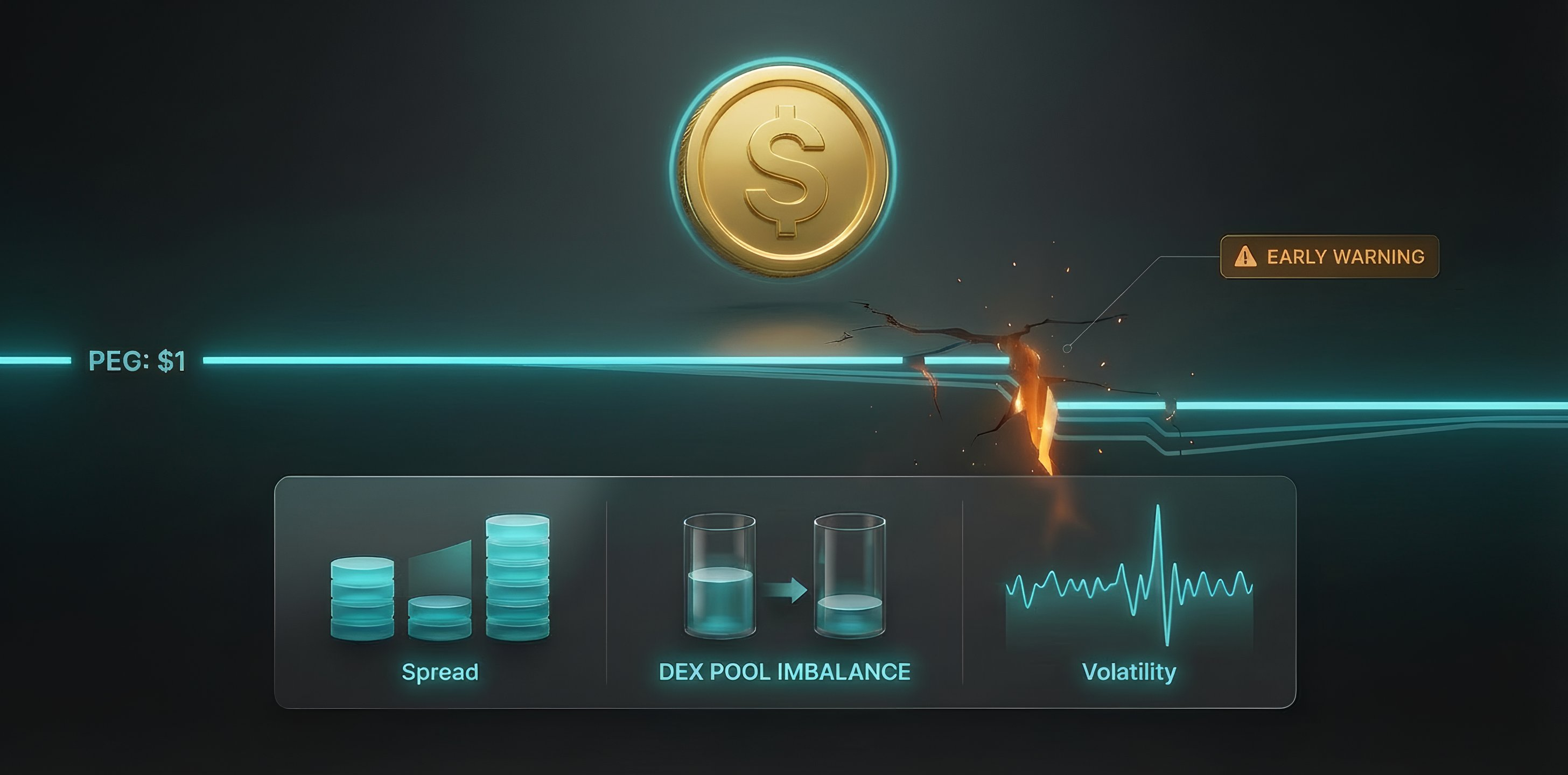
A loss of peg often starts quietly: the price drifts by fractions of a percent, but order-book/pool depth shrinks — and a larger trade begins to move the price noticeably (higher slippage).
Next, the spread widens (the gap between the best bid and best ask), and DEX pools become imbalanced: participants buy the “stronger” stable, while the “weaker” one gets left behind in the pool (DEX is a decentralized exchange; a pool is a shared liquidity reserve for swaps).
If doubts about reserves or the redemption mechanism rise at the same time, a bank run can start — a mass exit: people rush to swap the stable “while they still can,” and conditions deteriorate minute by minute.
Spread: the market’s “hidden fee” under stress — the wider it is, the more expensive entry and exit become.
Liquidity: the ability to swap meaningful size without a noticeable rate hit (and without a sharp rise in slippage).
Attention signal: a persistent deviation from
Where depeg hits the hardest:
- Savings → your “dollar” balance suddenly buys less when converted to fiat or a safer asset.
- DeFi positions → collateral and loans can drift into liquidation territory as the stablecoin price moves.
- Swaps and withdrawals → losses grow via spread, fees, and slippage — especially for larger size and thin pools.
Goal: explain what holds the peg, what most often triggers a depeg, which early signals show up before panic, and how to reduce damage — with step-by-step actions for traders and long-term holders.
What keeps the peg: the basic “$1” logic
The peg stands on three pillars: redemption, liquidity, and trust. If any one weakens, the price drifts away from
It helps to understand not only the definitions, but also how failure shows up in price (discount/premium), in the order book (spread/depth), and in pools (imbalance).
| Pillar | What it is | How failure looks |
|---|---|---|
| Redemption (redemption: 1:1 exchange) |
The ability to return the token to par via the issuer/protocol | A discount or premium: the market doubts redemption is available and will clear at |
| Liquidity (CEX/DEX: exchanges and pools) |
The ability to swap size without a meaningful deterioration in price | Wider spreads, higher slippage; larger trades “push through” the price, and DEX pools become more imbalanced |
| Trust (reserves/model/rules) |
Confidence that backing and rules can withstand stress | Exits accelerate: holders sell early to avoid queues/restrictions and not be “last out” |
- Redemption → is there a clear path to par, and are there bottlenecks — limits, pauses, “windows,” manual checks, queues?
- Market → how deep are CEX order books, and how stable is the balance in DEX pools for your size (not for $50)?
- Trust → are there triggers that break it faster than the market: reserve news, freezes/blocks, regulatory risk, protocol failures, situations where arbitrage stops closing the gap due to fees/risk/limits, or a redemption pause?
Key point: depeg often starts with one bottleneck, but develops as a chain: redemption failure or a thin market → worse exchange conditions → lower trust → larger deviation.
Depeg triggers: what most often starts the problem
Depeg develops as a chain: trigger → worse exits → faster selling. Below are the causes, early signals, and the first action that reduces losses.
🏛️ Infrastructure and reserves
-
Reserves in question (banks/custodians, asset freezes, high concentration of backing).
First signal: a persistent discount and rising demand for alternative stables/fiat exits (premium on alternatives, worse depth/spread in the pair).What to do: check primary sources and the actual status of reserves/redemption: are redemption channels working, and are there limits/delays/pauses?
-
Redemption/withdrawal restrictions (withdrawals paused, infrastructure “windows,” fee spikes, processing delays).
First signal: pricing worsens exactly where you used to exit “at par” — redemption/withdrawals, major CEX pairs, or the largest DEX pool — and the gap across venues grows.What to do: map alternative exit routes (CEX → fiat, another stable, a major DEX pool) and pre-calc fees/limits/price impact for your size.
💧 Liquidity and market behavior
-
Thin market (not enough order-book or pool depth — size moves the rate).
First signal: wider spreads and heavier slippage at the same volumes; price impact becomes visible even at your “normal” size.What to do: split size, use limit orders, route via an aggregator/multiple pools (split: break the trade into parts), and avoid “one swap for everything.”
-
DEX pool imbalance (one stable becomes “excess,” its share rises).
DEX is a decentralized exchange; a pool is a liquidity reserve for swaps.First signal: worse DEX pricing and a growing imbalance in pool composition (too large a share of the “problem” stable).What to do: compare CEX and DEX price/depth, check where price impact is lower, and choose the simplest exit with fewer fee/network surprises.
🛰️ Price, oracles, and protocol mechanics
-
Oracle failure (a price feed gives wrong data to smart contracts, amplifying liquidations).
First signal: “wicks” (brief sharp spikes) and price divergence across venues, plus abnormal liquidations/unexpected collateral requirements in protocols.What to do: check multiple price sources (several feeds/venues) and don’t confuse technical noise with a fundamental redemption/liquidity problem.
-
Negative feedback in the model (stabilization needs more and more incentives/minting and accelerates deterioration).
First signal: “rescue measures” work less and less: bounces get weaker, drops get deeper, and recovery takes longer.What to do: assess whether there’s a realistic path back to peg without the market voluntarily holding/buying the stable again: who will create demand/liquidity once risk is being shut down “right now.”
Stablecoin types and their weak points
The stablecoin type tells you in advance which depeg scenario is more likely and where the weak spot is. Read this block like a risk map: type → vulnerability → what to monitor → where to exit (CEX/DEX/redemption).
💵 Fiat-backed (centralized): USDT, USDC
The peg is supported by reserves in traditional assets and the right to redeem 1:1. The weak point is banking infrastructure, custodians, and redemption/withdrawal limits, pauses, or delays in a stress window.
- What holds the price: reserves + redemption (redeem) + arbitrage/market makers.
- Typical depeg: news → doubts about redemption availability → discount/premium while the market prices in the chance of pauses/limits and the true exit cost (spread/slippage).
- What to monitor: not “price by itself,” but exit conditions — pauses/limits/fee spikes on redemption/withdrawals, how fast the price returns to
$1 , and the price impact for your size.
✅ Pros
- Often high liquidity and tight spreads (spread = best bid/ask gap).
- Usually return to par quickly after a short-term shock.
- The mechanics are clear to the market: “reserves ↔ redemption.”
❌ Cons
- Dependence on the banking system and jurisdictions.
- Concentration risk in reserves and infrastructure (one custodian/bank/channel can become the bottleneck).
- Regulatory/banking events can hit circulation, withdrawals, and redemption.
Key point: for fiat stables, depeg is often “informational” — the price reacts to uncertainty until it’s clear how fast and predictably redemption works.
🔒 Crypto-collateralized (decentralized): DAI and similar
There’s no “bank full of dollars” here: stability relies on overcollateral (overcollateralization: collateral > 100%) and liquidation mechanics. The weak point is collateral stress and liquidation overload: queues/lack of liquidators, network fee spikes, and auction delays.
- What anchors it: overcollateralization + liquidation rules + arbitrage between DEX and CEX.
- What breaks stability: a collateral crash, liquidation bottlenecks, oracle failure (an oracle is a price feed for smart contracts).
- What to monitor: collateral composition (volatile/correlated), safety buffers in ratios, liquidation metrics, and liquidity in key pools for your size.
✅ Pros
- Less dependence on banks and traditional accounts.
- Backing is visible on-chain and can be verified.
- Rules are encoded in smart contracts and governance.
❌ Cons
- A liquidation cascade can worsen drawdowns and liquidity shortages.
- Price-feed errors can cause false liquidations and inject volatility.
- Deviations can last longer: liquidations must clear and liquidity/ratios must recover.
Key point: depeg in crypto-collateral stables often looks like “market stress”: during high volatility, holding par becomes harder.
🧨 Algorithmic: TerraUSD (UST) and the “death spiral”
Par is maintained via arbitrage incentives, but once trust breaks a death spiral can start: stabilization requires ever more minting of a “second token,” accelerating the collapse.
- What holds $1: burn/mint mechanics, ecosystem demand, liquidity in key pools.
- What breaks the model: a mass exit, liquidity imbalance, and the “second token” price dropping (along with arbitrage power).
- When it’s most dangerous: when returning to
$1 requires restoring demand/liquidity and the “second token” price, while the market is already in panic and shutting risk down “right now.”
✅ Pros
- No banks required: crypto-native logic.
- Can grow fast on strong incentives and network effects.
- On paper, it can scale without “warehousing” fiat.
❌ Cons
- Depends on trust: panic breaks arbitrage incentives.
- Yield subsidies often mask fragile demand.
- In a systemic scenario, recovery may never come.
Key point: as long as arbitrage “damps” deviations, the model survives. If arbitrage starts requiring more minting and accelerates the fall, that’s a red flag.
🏠 RWA-backed: when collateral exists but isn’t liquid
RWA (real-world assets) can look reliable over time, but in a crisis the key is conversion speed. If the liquid buffer is exhausted, you can’t “sell the reserve” quickly — and the market prices speed first.
- Key risk: illiquid backing — assets exist, but can’t be turned into cash fast without discounts and delays.
- Typical trigger: a redemption wave consumes the liquid buffer, leaving mostly slow-to-sell assets in reserves.
- What to monitor: the share of liquid reserves, redemption timelines/procedures, and what conditions kick in once the buffer is depleted: delays/limits/selling reserves at a discount.
- ✅ Strength: real-asset backing can be resilient in calm markets.
- ⚠️ Weak spot: in a stress window, sale speed matters — illiquid reserves don’t save the peg “right now.”
Key point: once the liquid buffer runs out, price can fall well below
🧪 Synthetic: delta-neutral and infrastructure risk
Synthetic stables hold par through hedging. Delta-neutral means near-zero sensitivity to the underlying price: losses on collateral are offset by a derivatives position. The weak point is margin, risk limits, withdrawal pauses, and exchange-side liquidations.
- Key term: funding rate — the funding rate on perpetual futures directly affects the “cost” of the hedge.
- Main risk: exchange/margin-model/oracle failures and liquidations in thin windows (when liquidity disappears and margin requirements jump).
- What to monitor: hedge behavior during volatility spikes (funding/margin), concentration on one venue, and the plan for withdrawal restrictions.
- ✅ Strength: hedging can hold par without direct fiat reserves.
- ⚠️ Weak spot: derivatives infrastructure risk and margin constraints during sharp volatility.
Key point: synthetics can be stable in normal conditions, but they demand disciplined risk management and infrastructure diversification.
Key cases: what happened and what lesson to take
Scenarios repeat more often than tokens. In each case: the trigger, an early signal, and a lesson you can apply today.
TerraUSD (UST), May 2022 → the algorithm couldn’t withstand a mass outflow
UST relied on the “burn UST → mint LUNA” loop and back. When outflows became large and persistent, stabilization required ever more LUNA issuance — pressuring the “reserve” token’s price and triggering a death spiral (a death spiral: stabilization attempts accelerate the fall).
USDC, March 2023 → SVB and the “weekend window”
After news that part of Circle’s reserves were linked to Silicon Valley Bank, a discount appeared: the price fell below
Iron Finance (IRON/TITAN), June 2021 → partial backing and a DeFi bank run
IRON was partially backed: part USDC, part algorithmic via TITAN. During a sharp liquidity outflow, attempts to exit through the stabilization mechanism pressured TITAN, and TITAN’s fall weakened backing further — a bank run, but in DeFi form.
USDT and Curve 3pool, June 2023 → a small depeg as a pressure signal
Amid imbalance in Curve’s 3pool, USDT’s share dominated the pool composition (above its usual range), and the price dipped to around
USDR (Real USD), October 2023 → illiquid reserves and buffer depletion
During a redemption wave, the liquid reserve portion ran out, and much of the remaining backing was illiquid — price fell to roughly
Early signals: what to monitor before it’s too late
Early signals are not a “forecast,” but markers that exit conditions are worsening (spread, slippage, limits, pauses). They help you act before panic: while withdrawals/redemption still work and spreads/slippage haven’t blown out.
| Signal | Why it matters | What to monitor and what to do |
|---|---|---|
| Spread in the order book (CEX) | Exiting becomes more expensive: there are fewer orders around |
Monitor → spread, depth, and price impact for your size.
Action → split size, move to a more liquid pair/venue, and use limit orders where appropriate. |
| Pool imbalance (DEX) | The market is structurally rotating from one stable to another |
Monitor → the token’s share in the pool and how fast it grows, plus worsening DEX pricing vs CEX.
Action → compare CEX vs DEX, avoid “one swap for everything,” and pick the route with lower price impact. |
| Borrow rates (lend/borrow) | People borrow the stable to sell it → pressure rises, and liquidity gets “consumed” faster |
Monitor → a sharp jump in borrow rate and rising borrowing volume.
Action → reduce concentration, don’t increase leverage, and price risk using a worst-case rate (incl. spread/slippage). |
| Redemption/withdrawals and “windows” | Price depends not only on risk, but on time-based exit availability |
Monitor → withdrawal/redemption status, limits, fees, processing times, and “window” schedules.
Action → preselect 1–2 alternative exit routes and test their limits/fees in practice (with a small amount). |
| Linked assets | A chain reaction is possible in partial-backing systems or “stable ↔ stable” linkages |
Monitor → what backs it, which pairs provide the main liquidity, and whether one stable is supported by another asset or its liquidity.
Action → remove cross-exposure if it makes risk depend on one node/reserve. |
🧭 If a deviation starts: what to check first
- Exit conditions → spread/depth/slippage for your size (not for $50).
- Divergences → CEX vs DEX and pool-imbalance dynamics.
- Availability → withdrawals/redemption, limits, fees, and time “windows.”
$0.995 : check spread/depth and pool imbalance; don’t place one swap/order for the full size.$0.99 : reduce concentration in parts; don’t add leverage or average down without a plan.$0.98 : use your preselected exit route; prioritize redemption/withdrawal availability and minimal price impact.
How to reduce damage: an action plan for holders
A holder’s job is not to predict depeg, but to remove three loss sources ahead of stress: concentration, a single exit route, and liquidation vulnerability.
- Split the risk → hold 2–3 stables with different models (fiat-backed/crypto-collateralized/etc.), not one asset for your whole size.
- Check the rate you’ll get for your size → look ahead at spread, depth, and slippage for your size on CEX/DEX/P2P, plus fees, limits, and withdrawal speed.
- Remove liquidation vulnerability → reduce credit positions and LTV — in a stress window you get liquidated by protocol rules, not “when it’s convenient.”
- Write triggers and action size → example: “price below
$0.99 for 30+ minutes + spreads/pool skew worsen or withdrawal restrictions appear → reduce position by 30–50% in parts.” - Keep a second route → a backup stable and an alternative venue/channel (e.g., CEX + a major DEX pool, another off-ramp, another chain), so you’re not dependent on one provider, one exchange, or one availability “window.”
What a trader can do: arbitrage, hedging, and cautious strategies
In depeg, execution matters more than the idea: spreads widen, depth disappears, and a “normal exit” can vanish within minutes. Plan entry/exit and verify liquidity for your size first — then trade.
- Before entry (filter) → check what exactly must normalize for the deviation to close: withdrawals/redemptions work without pauses, spreads tighten, pool skew shrinks, and CEX vs DEX differences narrow. If the problem is the model and trust, a discount alone doesn’t mean safety.
- During the trade (execution) → trade liquidity, not a “pretty price.” Estimate spread and slippage for your size, split the position, avoid “one click for everything,” and compare multiple venues and routes.
- Exit and protection (risk) → use hedges that cap drawdown if the peg doesn’t return, not as amplifiers. Reduce risk via partial conversion and diversification of exposure; don’t add leverage when liquidation risk and liquidity gaps are at their peak.
The regulatory layer: why rules also affect the peg
Regulation affects the peg not “in theory,” but in practice: redeeming at par, reserve quality/management, and access to liquidity (listings, limits, jurisdiction/KYC constraints).
In the EU, the MiCA framework (Markets in Crypto-Assets) introduces legal categories for what the market often calls “stablecoins.” For users, the key question is simple: what is the token’s redemption regime, and which constraints can switch on in a stress window.
Classification affects market expectations: what counts as “par” and how redemption works.
EMT (e-money token): a token pegged to a single official currency; the core idea is the right to redeem at par (redemption: 1 token → 1 unit of currency) under the issuer’s terms/regime.
ART (asset-referenced token): a token that aims to maintain stability via reference to a value/right or a basket of assets (including combinations); focus is on reserve management, risks, and mechanism resilience.
Why this matters for the peg: the market reacts not only to “price,” but to how fast and predictably redemption works, and whether liquidity remains accessible if operating conditions, listings, or infrastructure access change.
| Risk | How it hits the peg |
|---|---|
| “Window” risk | If redemption/withdrawals slow down or become less predictable, a discount appears faster than most people can exit. |
| “Liquidity” risk | Restrictions/compliance → fewer venues and volumes → wider spreads, higher price impact, more expensive exits. |
| “Reserve trust” risk | Uncertainty about reserve composition, custodians, and reporting amplifies reactions to news and rumors. |
| “Expectation fragmentation” risk | The same “stable” can trade differently if part of the market expects redemption at par while another expects “stability via reserves/model.” Liquidity fragments and deviations widen. |
A practical habit: monitor not only price, but redemption/withdrawal conditions (limits, fees, timelines), issuer reserve updates, and any signals of potential restrictions at the venues where your liquidity sits.
Depeg FAQ: thresholds, signals, and actions
Short answers to the main questions: when depeg is dangerous, what counts as a signal, and how to act without panic.
Is depeg always a “collapse” of a stablecoin?
What deviation level should be considered alarming?
Why is a DEX pool imbalance considered an early signal?
What should you check in the first minutes if the peg starts slipping?
Don’t focus on the “number” — focus on whether your exit worsens for your size.
- Exit conditions: spread, depth, slippage/price impact for your size.
- Market: CEX vs DEX gaps, DEX pool skew, “wicks,” and price anomalies.
- Par path: redemption/withdrawal status, limits, pauses, delays, and fee spikes.
Why did USDC recover after SVB, while UST did not?
Why are stablecoins with illiquid backing (RWA) risky?
Does MiCA reduce depeg risk?
Final takeaway: the peg rests on redemption, liquidity, and trust
A stablecoin is not a dollar — it’s a system with weak points. Your goal is to reduce time risk: exit while redemption/withdrawals are available and spreads/slippage haven’t blown out (instead of getting stuck in a queue, hitting caps, and paying the market’s “penalty”).
Depeg starts where at least one pillar weakens: redemption (redemption: exchange at par), liquidity (spread, depth, slippage) or trust (reserves, infrastructure, rules). Sometimes the deviation closes quickly, but in systemic scenarios recovery may never happen.
The pragmatic strategy: keep diversification (2–3 different stables),
pre-check exit routes for your size (issuer redemption / CEX→fiat / a major DEX pool / P2P),
set alerts, and write down in advance what you do when exit gets worse:
what rate you actually get for your size after spread/slippage/fees and whether withdrawals/redemption face pauses/limits.
Example thresholds:
Main point: depeg is not a reason to guess the outcome, but a signal to apply rules. The faster you identify the event type (redemption/liquidity/trust) and test exit conditions for your size, the less damage you take.