Yield-bearing stables without illusions: who pays and how you exit
If the yield looks like a “USD deposit,” ask two questions: who pays and where exactly you get your $1 back — via protocol redemption or via the secondary market.
- Yield isn’t “built into” $1 → it comes from cash flows: RWA interest (issuer/custodian), DeFi fees (borrowers/traders), funding/basis (derivatives participants).
- Key risk → protocol redemption rules + secondary market liquidity: can you exit close to $1, quickly and at size, without discounts, wide spreads, or slippage?
- Common mistake → “stablecoin = safe.” In practice, you add smart contracts, counterparties, regulators, and stress-liquidity risk.
- Base rule → separate funds by role: spending wallet / main / cold; keep per-product exposure limits.
A yield-bearing stablecoin is a product. Evaluate it as a risk-bearing strategy — not as “cash.”
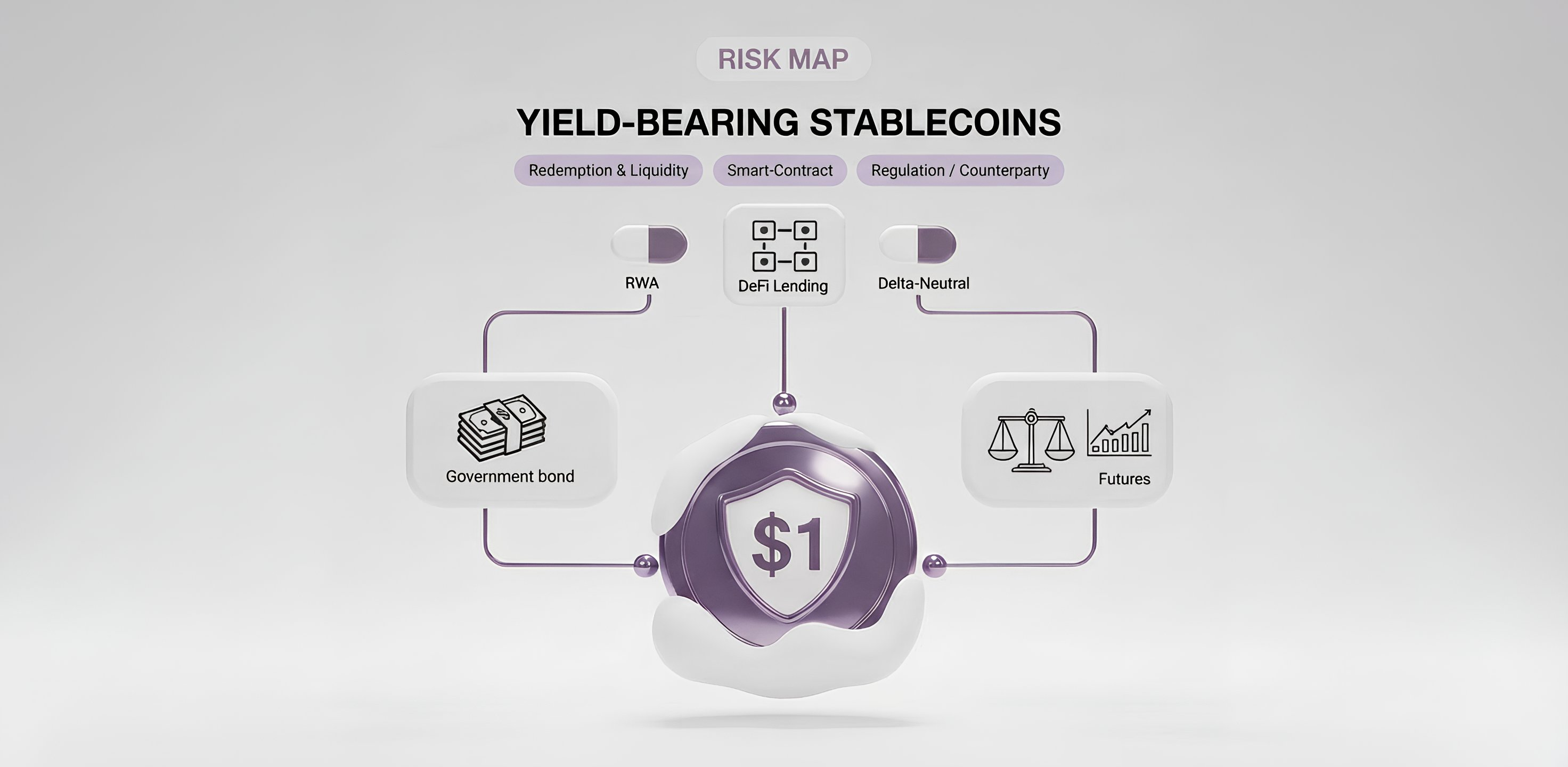
What a yield-bearing stablecoin is — and how it differs from a plain one
A plain stable stays near “$1.” A yield-bearing one targets “$1 + yield,” adding accrual mechanics and exit risk.
| Question | Plain stable (e.g., USDC) | Yield-bearing stable |
|---|---|---|
| Where does yield come from? | No yield to holders | From a source: RWA / DeFi / derivatives |
| How is it accrued? | No accrual | Either the price of a wrapper increases (a token whose price grows over time), or balance grows via rebasing (automatic balance increase), or a yield/staking version of a stablecoin or its wrapper is used |
| Main risk | Issuer / banks / regulator | Issuer + smart contracts + yield strategy + liquidity & redemption |
| First thing to check | Reserves, reports, chain, freeze risk | Yield source, redemption/exit rules, strategy risks, admin rights & dependencies |
This means: a yield-bearing stable is a “packaged strategy.” Returns and risks are defined by two things: the payout source and your exit (protocol redemption or secondary market).
Short formula: yield = cash flow, stability = exit.
RWA model: yield from real-world assets (bonds, notes, deposits)
Returns resemble government bonds/deposits, but risk shifts off-chain: who holds the assets, how redemption works, and what happens under stress.
How yield is generated
- Source
coupons on T-bills/notes, deposit interest, credit product income. - Where it sits
income accrues with the issuer/trust/custodian and is then reflected in the token. - How you see it
wrapper price increases, or balance rebases, or a yield/staking version of a stablecoin or its wrapper is used.
Practical implication: RWA is a contractual setup between the issuer, custodian, and token holder: assets live off-chain, and the token grants a right to redeem under issuer rules.
Hidden RWA risks
- Redemption & timing
exit windows, limits, delays, fees, minimums. Under stress, terms can tighten. - Jurisdiction & access
KYC/country or investor-status limits may appear later — even if “not required now.” - Counterparty & secondary market
real-world assets rely on contracts and performance. With weak liquidity, secondary prices may trade below “theoretical $1” until redemption terms are clear.
Practical implication: RWA can deliver smoother yield, but exits are often less instant — know the worst case in advance.
Micro-example: if redemption isn’t instant, panic prices a discount. This isn’t a “peg break,” but the price of time and liquidity.
RWA takeaway: this model is closest to “understandable” yield, but the key question is how you exit. Strong products spell out timelines, limits, and stress rules upfront.
DeFi model: yield via lending, LPs, and yield “wrappers”
In DeFi, yield is paid by borrowers and user fees. Upside — flexibility; downside — under stress, contract/oracle risks surface and exits worsen: worse prices, more slippage, and sometimes pauses/limits.
How it works
- Lending
you supply stables to a lending market; yield comes from borrower interest (rates move with demand). - LP/pools
yield comes from trading fees + sometimes protocol token incentives (temporary APY “boosts”). - Yield token versions
yield shows up as wrapper price growth or rebasing (auto balance growth), not as a simple balance %.
Practical implication: APY is not fixed. It falls when borrowing demand/trading volumes drop or incentives end.
Hidden DeFi yield risks
- Protocol risk
contract bugs, collateral logic errors, oracle vulnerabilities, governance risk. - Exit liquidity risk
during mass exits (bank run = panic withdrawals), swaps worsen: more slippage, wider spreads, worse prices. - Incentive risk
part of APY may be token emissions. When incentives end (or the token drops), “pretty” yield disappears.
Practical implication: if most APY is incentives, you’re holding not “USD yield,” but exposure to the protocol token.
Why it matters: “guaranteed” high stable yields often relied on subsidies. Example — Terra/UST, where demand was fueled by Anchor’s high rates.
Lesson: if yield depends on inflows and subsidies, it’s not “interest,” it’s demand support.
DeFi takeaway: separate “market” yield (interest/fees) from “marketing” yield (incentives). The more of the latter, the more important exposure limits and an exit plan.
Delta-neutral: yield via hedging and derivatives markets
“Neutral” usually means the protocol tries to reduce the impact of collateral price (e.g., ETH/LST) on the product. Risk remains in funding, exit liquidity, and hedge robustness under stress.
How it works (plain English)
- Collateral
typically ETH or LST (liquid staking token) or a basket of assets. - Hedge
the protocol opens shorts on perps/futures to offset collateral price moves. - Where yield comes from
(1) LST staking rewards, (2) funding/basis (carry / spot–futures spread), (3) fees/arbitrage (if used). - What keeps price near $1
the ability to rebalance hedges quickly and close positions without heavy spread/slippage losses.
Practical implication: you’re not holding a “stable by itself,” but a managed derivatives strategy wrapped in a token.
Main stress risk: with sharp volatility and falling liquidity, hedges can become expensive or slow. Spot and derivatives can diverge, funding can flip — and exit prices (on the secondary market or via redemption) drift from “theoretical $1”.
What to check before sizing up
- Where and how hedging is done
which venues/pools/providers are used, concentration on a single venue, and infra/counterparty risk distribution. - Liquidations & emergency modes
liquidation conditions, limits/pauses, and behavior under extreme volatility. - APY structure
staking vs funding share: funding is volatile and can turn negative (then it eats yield). - Exit scenario
where you return to “$1”: protocol redemption or market sale; windows/limits/fees; what happens when derivatives markets are congested.
Practical implication: high APY almost always means more dependencies (derivatives, liquidity, rebalancing) — keep exposure limits and an exit plan.
Micro-incident: hybrid and delta-neutral protocols have faced exploits and trust crises — e.g., Deus Finance (DEI) suffered attacks after which the stable lost trust and depegged.
Lesson: complex strategies = more attack surfaces: contracts, oracles, integrations, liquidity, and derivatives.
Delta-neutral takeaway: “delta-neutral” reduces directional price risk but doesn’t remove exit risk. If you’re not ready for negative funding and liquidity stress, keep exposure small.
Risk map: where yield-bearing stables actually break
We split risks by level: user → product → market/system. This helps quickly see whether the problem is signatures (approve/permit) / wallet access, protocol redemption rules, or secondary market exit liquidity.
| Level | What can go wrong | How to mitigate (practical) |
|---|---|---|
| User |
Phishing / site spoofing (look-alike domains) Lost seed/keys Dangerous signature: unlimited approve / permit Wrong network or address |
Use bookmarks only + verify domain/network Wallet separation: spending / main / cold Approve with limits + regular revoke Test with a small amount before going big |
| Product (protocol) |
Smart contract exploit Oracle/integration vulnerabilities Admin rights & governance risk “Broken” redemption: windows, limits, delays, manual pauses |
Audit + fix history + bug bounty (clear rules and public reports) Check dependencies: oracles, DEXs, bridges, custodian/exchanges (if any) Multisig + timelock + public roles & permissions Exposure limits + diversification across models (RWA / DeFi / derivatives) |
| Market / system |
Stress liquidity: exits worse than “theoretical $1” Negative funding (for delta-neutral) Regulatory constraints (especially RWA) Mass exits (bank run = panic withdrawals) |
Don’t keep all reserves in one product (hold buffer in plain stables/fiat) Know worst-case exit: time + possible secondary discount Don’t chase max APY: higher APY = more dependencies Exit in tranches if liquidity is thin (avoid one large swap) |
Key takeaway: yield-bearing stables usually break not on price, but on exits: redemption rules, liquidity, and trust. In stress, how you exit matters more than what APY.
Green and red flags (quick filter)
A 60-second check: what builds trust — and what most often fails under stress.
✅ Green flags
- Transparent yield source → who pays APY and when it drops.
- Exit defined upfront → redemption or secondary market, timelines, windows, limits, fees, and stress behavior.
- Security backed by facts → audit + contract addresses + fix history + active bug bounty.
- Admin rights constrained → multisig + timelock + public roles (who can change what).
- Dependencies disclosed → which oracles/DEXs/custodians/exchanges are critical to operation and redemption.
🚩 Red flags
- “Guaranteed” high APY → no clear answer who pays and what happens when rates fall.
- No transparent exit → unclear redemption vs secondary; timelines, limits, KYC, market discount.
- Mechanics built on “trust us” → no redemption scheme/dependencies/risks, only marketing.
- Audit “coming soon” → no report, no contract addresses, no versioning or change history.
- Uncontrolled admin keys → no multisig / no timelock / hidden roles enabling instant changes.
2–3 Red flags — cut size to “learning” or skip. If in doubt, start with the exit: how exactly you get $1 back and how long it takes.
If yield drifts or you’re unsure: an action plan
First identify what’s breaking: front-end/wallet, redemption/liquidity, or the protocol. Then act by branch.
-
Step 1 → 20-second diagnosis.
What you see: secondary discount / redemption delays or limits / protocol alert (pause/incident) / suspicious signature. -
Step 2 → Phishing/spoofing risk.
Action: move assets to a “clean” address, revoke approvals, avoid DeFi on this wallet until device checks are done. -
Step 3 → Exit problem (secondary/redemption).
Action: exit in tranches, avoid “one big swap,” check pool depth/spread, and pre-estimate worst-case discount. -
Step 4 → Protocol problem.
Action: cut exposure to a survivable level; don’t average “because it’s cheaper”; hold only what you can freeze under uncertainty.
Two “act immediately” cases: (1) you signed an unclear approve/permit or see odd requests — treat the wallet as at risk; (2) redemption is suddenly limited/delayed without clear rules — this is exit risk, not “price cosmetics.”
Micro-principle: in a crisis, winners aren’t those who “guessed,” but those who limited exposure early and follow a plan, not emotions.
Pre-define exit triggers: discount, redemption delays/limits, liquidity drops. When a trigger fires — execute the plan, don’t argue with it.
Checklist before buying a yield-bearing stablecoin
Four questions that explain ~80% of the risk: yield, exit, governance, and the “outside world.”
1) Yield source
- Who pays APY? — RWA / borrowers / fees / funding / incentives.
- What if rates fall? — APY drops or exit restrictions/discounts appear.
- Market or subsidies? — incentives = hidden token bet.
Quick test: can you explain APY in one sentence?
2) Redemption & liquidity
- Where do you get $1 back? — protocol redemption or market sale (DEX/CEX), and timelines.
- Any limits? — windows, caps, fees, KYC, minimums.
- Under stress? — gating/delays and secondary discounts.
Quick test: do you know the worst-case exit?
3) Protocol & governance risks
- Is the audit real? — addresses match, versions and fixes exist.
- How are bugs handled? — bug bounty, public fixes, response.
- Who holds the “levers”? — multisig + timelock + roles.
Quick test: do you know who can change parameters?
4) The “outside world” (especially RWA)
- Jurisdiction & access — countries, rules, potential bans.
- Custodian & reserves — who holds assets and how they’re proven.
- Freezes/blocks — when they can happen and what’s next.
Quick test: is the freeze scenario clear?
Final rule: if you can’t briefly explain who pays the yield and where you get $1 back, it’s not for a large allocation.
FAQ
Below are concise answers to the most common questions after a first checklist pass.
Where does yield on a “yield-bearing stablecoin” actually come from?
Always from a source: RWA interest (bonds/deposits), borrower interest in DeFi, fees/arbitrage, or funding/basis in delta-neutral models.
If the source isn’t named or sounds like “we just pay APY,” yield usually relies on subsidies/emissions and can drop quickly.
Which model is the “safest”?
There’s no universally “safest” model — each carries a different risk profile.
- RWA — often steadier yield, but adds counterparties/custodian, jurisdiction, and redemption rules.
- DeFi — transparent on-chain, but exposed to exploits and stress liquidity (exits worsen in panic).
- Delta-neutral — potentially higher APY, but sensitive to funding, derivatives liquidity, and hedge robustness.
Practical rule: diversify exposure across models and cap size per product.
If it’s a “stable,” why can it deviate from $1?
Because secondary prices depend on liquidity and trust. Under stress, redemption can be slow/limited, and markets price a discount.
The yield strategy can also break (oracles, derivatives, liquidations), hurting the mechanism that keeps “$1.”
How much is reasonable to hold in yield-bearing stables?
For most, they’re not a “cash buffer,” but a risk-capped portfolio sleeve.
Practical approach: keep reserves in plain stables/fiat; treat yield-bearing as a separate strategy: per-product caps + model diversification (RWA / DeFi / derivatives).
What should I check first if time is short?
1) Yield source: who pays APY and what happens if rates fall?
2) Redemption/exit: protocol redemption or secondary market — and how fast you get $1 (windows, limits, fees, KYC)?
3) Protocol risk: audit, fixes, bug bounty, admin rights (multisig/timelock), dependencies.
4) Secondary liquidity: what happens to price during mass exits (discount/slippage)?
If any point is “fuzzy,” cut size to “learning” or skip.
Final compass: 4 questions before “yielding $1”
If you can’t answer these in a minute, reduce size to “learning” or skip.
-
Who pays the yield? — RWA / DeFi borrowers & fees / funding & basis on derivatives / incentives.
Action: state the APY source in one sentence. -
Where do you get $1 back? — protocol redemption or market sale; timelines, windows, limits, fees, possible KYC.
Action: know the worst-case exit (time + discount). -
What breaks first? — contracts/oracles/integrations, admin rights, secondary liquidity.
Action: verify audit + fixes + bug bounty + multisig/timelock. -
How much risk are you taking? — a yield-bearing stable isn’t “cash,” but an exposure.
Action: cap size per product and diversify across models (RWA / DeFi / derivatives).
Two red zones: yield-bearing stables usually fail not on price, but on liquidity and redemption rules. In stress, “how you exit” matters more than “what APY.”
First the yield source and exit — then the size.