Prop models: where selection is fair — and where payouts are just a “showcase”
The same “prop” label can mean a fair evaluation with clear payouts — or a model where profitable traders are simply blocked from withdrawing.
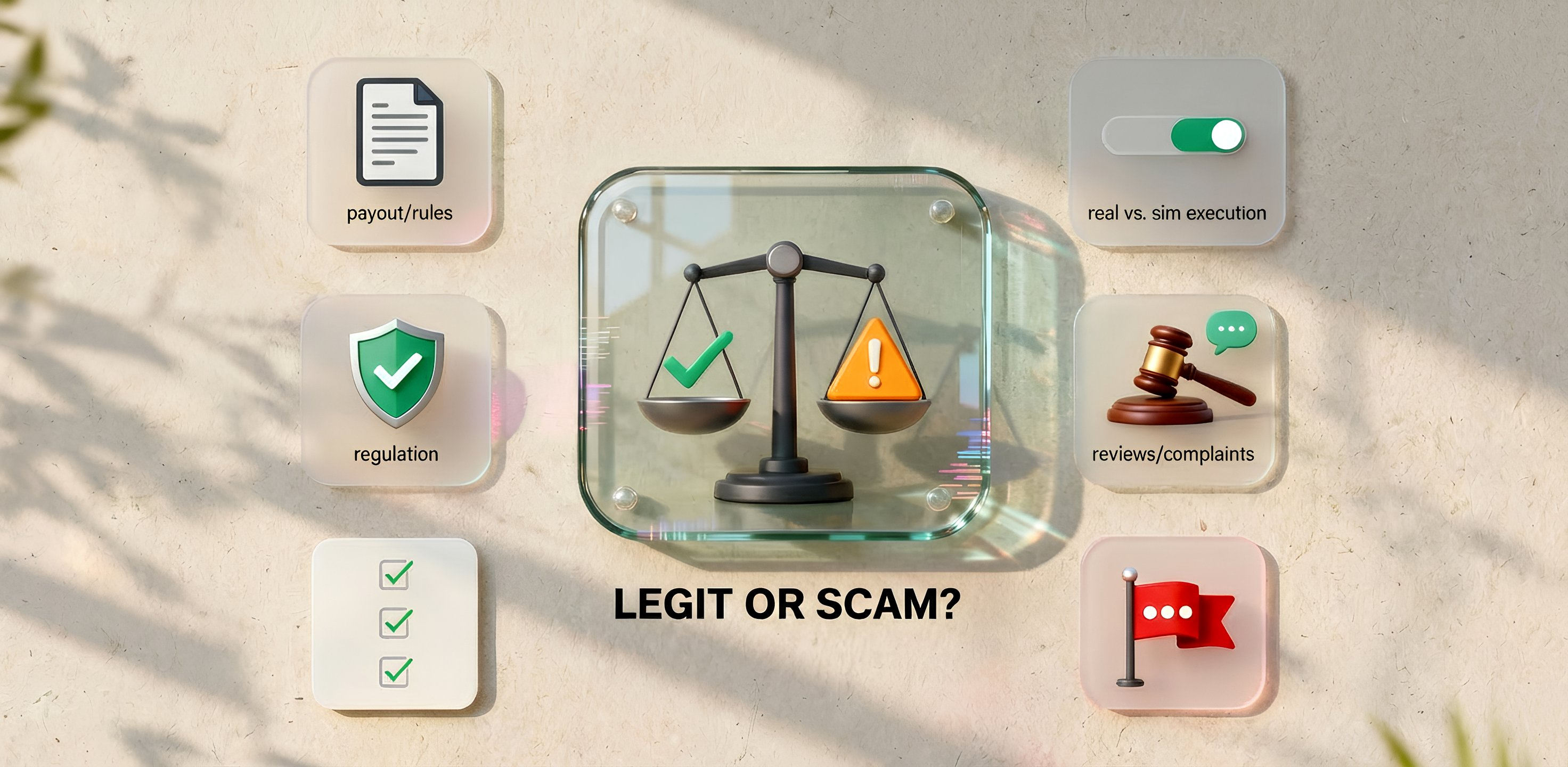
Below are verifiable markers that separate a legitimate prop firm from a payout “showcase”: live vs simulated execution, payout rules, drawdown (DD) calculation, and independent reviews before the first payout.
To quickly assess payout-denial risk, keep three scenarios in mind:
- Simulation-based evaluation → you pay a challenge fee, trade on demo/simulation, and payouts (if any) come from the firm’s internal budget.
- Remote funding → after passing, you get access to a real account/sub-account with risk limits (DD — drawdown), a list of restrictions, and a clearly defined DD calculation method.
- Pseudo-prop (showcase) → revenue comes from repeated “attempts,” while profitable accounts get filtered out via rules: sudden strategy bans, delays/slippage, last-minute rule changes, or account termination.
Next: cases, regulation, and reviews; at the end — a checklist to verify a prop firm before paying for a challenge.
Trading through prop firms involves the risk of capital loss. Terms and requirements are set by the platforms and may change. This is not investment advice.
What the conclusions are based on
To keep the text useful, we regularly refine the mechanics and add context — without “mistake stories.”
- Updates → the material reflects current practices, risks, and common schemes.
- Mechanics clarified → added specifics that affect payouts, drawdown, and rule interpretation.
- Expanded → added checklists/examples/scenarios to speed up verification before paying.
- Context strengthened → wording refined to reduce “against the trader” ambiguity.
Why this matters: you’re reading verifiable mechanics — what you’re buying, how results are calculated, and under what rules payouts are made.
Real cases: where prop models most often break
These stories matter not for “sensations,” but for repeating patterns: simulation instead of real markets, payout conflicts of interest (the firm decides whether profits “count”), and infrastructure fragility (platforms/payments/geo-restrictions).
How to read cases productively:
- Fact → what happened (fund/account freezes, payment halts, platform access revoked, shutdown).
- Mechanics → where and how trades were executed (live/simulated), and who the counterparty was.
- Trader risk → what gets “tightened” before payouts (rules, execution, profit validity criteria, blocks).
Funding Talent (2021)
An example where the model couldn’t sustain growing payout obligations.
- At peak — around 13,000 traders and rapid audience growth.
- Then — abrupt tightening of terms (splits and account rules) over a short period.
- Finale — shutdown and a wave of negative reviews.
My Forex Funds (2023)
A case where regulation and service representation were decisive.
- The regulator (CFTC) filed charges, after which operations were halted.
- At the core: how the service was represented — marketed as real-market exposure, while in practice much depended on simulation and conflicts of interest (the firm controls conditions and payouts).
- Reviews often highlight issues at the first payout stage: profit validity, execution quality, and blocks.
True Forex Funds (2024–2025)
An example of infrastructure dependence and jurisdictional risk.
- Operations paused amid issues with key infrastructure (trading platform/provider).
- Additional risk factor: jurisdictional questions and geo-restrictions.
- Outcome: suspension/closure around 2024–2025.
FundedFirm (2024)
A case with signs of fake metrics and an unverified “showcase.”
- Loud payout claims without verifiable proof.
- Suspicions of brand/material copying and aggressive promotion.
- After investigations: public numbers were revised, and the project disappeared.
Verification takeaway: if a firm doesn’t explain mechanics and payouts upfront, payout-denial risk becomes part of the model. Check three things: (1) where trades are executed and who the counterparty is, (2) how results are calculated and when payouts occur, (3) whether a clear appeal process exists.
- Mechanics transparency beats marketing: live vs simulation, counterparty, proof of results (trade history/report).
- Rule predictability: risk rises when metrics and bans change right before payout.
- Infrastructure resilience: platforms, providers, and jurisdictions can stop a business even without “direct fraud.”
Prop firm regulation: why everything depends on mechanics
Prop firms don’t have a single universal license. Regulators don’t focus on the word “prop,” but on what you’re paying for: simulation evaluation, trading on the firm’s account, or a product that effectively looks like an investment service.
Three checks before paying:
- Mechanics → live or simulation (and who the counterparty is).
- Obligations → payout rules, appeals, and denial reasons.
- Oversight → the license (if claimed) and registry entry, geo-restrictions, and regulator warnings.
| Jurisdiction | What regulators look at | What it means for traders |
|---|---|---|
| USA | How the service and payouts are described + actual mechanics | Higher risk of regulatory shutdowns and strict country limits |
| EU | Whether the model resembles an investment service (not just “demo evaluation”) | Critical to understand what’s sold: test/access/service, and who is legally responsible for payouts |
| Russia | Market risk and control (manipulation/compliance) | Fewer formal guarantees → documents, details, and payout rules matter more |
USA: what matters
- With paid access and payout promises, the key is how trading and payouts are described: live vs simulation, who the counterparty is, and who decides profit validity.
- Geo-restrictions and “workarounds” signal regulatory risk and potential sudden shutdowns.
EU: what matters
- The decisive detail is whether the firm effectively provides an investment service (e.g., promises returns; executes trades for you; sells access as an “investment product”) or only evaluates on demo.
- “Pay-per-attempt” models are a common source of complaints and regulatory scrutiny.
Russia: what matters
- No separate “prop” regime; regulators often focus on market risk (manipulation, internal controls, compliance).
- Without external oversight, you’re relying on documents, payout rules, entity details, and reputation.
Main point:
- Prop ≠ guarantee: mechanics and payout rules decide outcomes.
- Infrastructure matters: platforms and jurisdictions can stop a service even without “direct fraud.”
Reviews and complaints: how to extract truth from the “noise”
Ratings alone prove nothing (they can be inflated, negative reviews removed, or built on a small sample). Reviews matter for repeating scenarios: what happens before the first payout, which denial reasons show up most often, and how disputes are handled.
5-minute check: compare 2–3 platforms, look for repeats around first payouts, and separate “service quality” (UX/support/platform) from “payouts” (approval/denial/rules).
| What to look for | Looks normal | Red flag |
|---|---|---|
| Rating dynamics | Gradual changes; reviews spread over time | Sharp drops/spikes; many identical phrases |
| Payout cases | Disputes exist + a clear appeal path | Mass pattern: “fine until payout, then ban/denial” |
| Denial reasons | Specific rulebook clauses + a clear explanation | Vague wording, “our decision,” retroactive bans |
| Support response | Timelines, process, substantive answers | Silence, threats, “trader at fault by default” |
Most common recurring complaints
- Payout denied / account voided — especially at the first payout request, when profits are already “earned.”
- Rules change mid-stream — new strategy bans, metric recalculations, “clarifications” after you pass a stage.
- Execution degrades at critical moments — delays, slippage, spread widening where DD limits and targets matter.
- “Game-like” economics (revenue from retries) — a model funded by retries, where reaching payouts is objectively unlikely.
- Communication and appeals — silence, chat bans, cleanup of negative feedback, no transparent dispute process.
Statistics and “blacklists”: how to read without self-deception
Use “blacklists” as leads, not verdicts: check dates, sources, and matching cases. One post is noise; a series of similar payout stories is a signal.
Look for dates, screenshots/quotes of rulebook clauses, and the same denial reason across different people.
What to do if reviews smell like payout issues:
- Pause payment — until you’ve read payout rules and the full list of denial reasons.
- Cross-check 2–3 sources — look for repeating first-payout stories and consistent denial wording.
- Move to verification — entity details, appeal process, country limits, and where trades are executed (live/simulation).
Rule: if rules/metrics change right before payout, don’t argue emotionally. Check the rulebook, payout terms, and appeals — that’s where you’ll see whether it’s random or structural.
License and oversight: where “brand” ends and trader protection begins
A license doesn’t guarantee profits, but it changes two things: accountability (an external complaint channel — jurisdiction-dependent) and processes (documents, response timelines, compliance). Without oversight, payout disputes are almost always resolved internally.
- Registration (LLC/LTD) is just a legal entity — not oversight of payouts and disputes.
- License implies supervision, process requirements, and a potential external dispute channel.
Licensed / regulated
-
Clear accountability
- Entities and documents are easier to verify via registries.
- Denials are more likely to be tied to specific rulebook clauses.
-
Procedures and compliance
- More formalized rules, risk controls, and internal reporting.
- Marketing tends to be more cautious: fewer “guaranteed payout” claims.
-
Appeals and case reviews
- Higher odds of clause-by-clause review and clear response timelines.
- Sometimes an external complaint channel exists (jurisdiction- and license-type dependent).
Unlicensed (grey market)
-
No external arbiter
- Appeals often boil down to support correspondence.
- Disputes may default in the company’s favor.
-
Higher conflict-of-interest risk
- Especially when trading is simulated and the firm validates profits.
- The critical moment is the first payout — that’s when the model’s true economics show.
-
Rules can drift
- New strategy bans, metric recalculations, expanded denial reasons.
- Aggressive marketing and upsell pressure are common companions.
Main takeaway:
- Licensing adds process and accountability, but its value depends on jurisdiction and scope.
- Without a license, the trader’s main shield is documentation, predictable rules, a clear appeal process, and repeatable payout reviews.
FAQ: questions that decide the first payout
Short answers before paying for a challenge: where trades are executed (live/simulation), common payout denial reasons, and how disputes work.
Do prop firms always provide live trading?
No. In many models, “trading” happens on simulation (demo), and payouts follow the firm’s internal rules.
- The key fork is live vs simulation and who the counterparty is.
- Verification usually relies on trade history/reports and a rulebook with measurable violation criteria.
What are the most common payout cut reasons?
Most often: rule interpretation and “profit validity” issues — banned styles, disputed metrics, limit breaches, or “at discretion” wording.
- Risk rises when denial reasons are vague (“abnormal,” “suspicious”) without measurable criteria.
- A frequent conflict zone is drawdown (DD): equity vs balance, or “floating” DD (from peak/balance).
- A key protection is a written appeal process: steps, timelines, and accepted evidence.
What does “scam” mean in prop trading?
Not only “they disappeared.” A common pattern is systemic payout failure: accounts voided before the first payout, rules changed mid-stream, and disputes decided in the company’s favor.
If similar stories repeat across different traders at the first payout stage, it’s a pattern, not isolated noise.
Are there “safe” prop firms?
There’s no absolute guarantee. In practice, risk is lower with firms that have a long track record, public documents, and stable rules.
- Payout reputation looks steady: no “waves” of identical reviews or mass “fine until payout, then ban” stories.
- Disputes are reviewed clause-by-clause, and rules aren’t rewritten right before payouts.
Does a license/registration really protect traders?
Registration (LLC/LTD) means a legal entity, not oversight. A license adds protection only if it’s verifiable in a registry and covers the relevant services.
- Entity and scope alignment is critical: “licensed” must apply to this service and this entity.
- Without oversight, rely on documents, predictable rules, appeals, and repeatable payout reviews.
What should I do if a payout is denied?
An effective dispute usually follows rule → fact → evidence → requested outcome. Specifics increase the odds of a real review.
- What decides disputes: trade history/reports, correspondence, dates, and the exact rulebook clause.
- Your position is stronger when the denial is tied in writing to a rule clause and specific trades/metrics (with a ticket/reference).
How can I reduce risk before paying for a challenge?
Risk drops not with promises, but with predictable mechanics: public rules, clear DD metrics, and transparent denial reasons.
- A public rulebook and a complete list of payout denial reasons are available on the site (not “on request”).
- Independent sources show repeat stories about the first payout (or their absence).
- It’s clear how drawdown is calculated (equity/balance) and which styles are banned.
Final plan: 3 rules that reduce risk
The takeaway is simple: evaluate not promises, but payout rules, risk limits, and the appeal process — that’s where the model reveals itself.
-
Rule 1 → payouts first, “nice terms” second.
Action: confirm the first payout timeline, daily/total DD, and the full list of denial reasons. Treat “at discretion” wording as risk.
-
Rule 2 → licensing helps, but registry checks decide.
Action: registration (LLC/LTD) ≠ financial license. If a license is claimed, verify it in the registry and match the entity and details.
-
Rule 3 → risk rules matter more than targets.
Action: verify DD calculation (equity/balance), whether there’s a “floating” DD (from peak/balance), and style limits (news/weekends/scalping/EAs).
Pre-payment check (10 seconds):
- Payout rules and denial reasons are publicly available (rulebook/FAQ), not “via support.”
- An appeal process is described upfront: steps, timelines, accepted evidence.
- Risk limits are transparent: DD base (equity/balance), with no “floating” interpretations.
In prop trading, you’re choosing a rulebook: money is paid by rules, not promises. If payout rules and appeals aren’t clear, it’s better to stop before the next payment.
The information in this material is provided for informational purposes only. References to prop firms and their terms are not recommendations or guarantees of results. Participation rules, trader requirements, payouts, and restrictions are set by the platforms themselves and may change. Participating in prop trading involves a high level of risk and is not investment advice.