📖 MEXC: real user reviews, strengths, and risks based on user feedback
MEXC is an international crypto exchange. Basic trading on the platform is available without KYC, but limits and access to certain features depend on the verification level and checks. Users most often assess it by fees, withdrawals, and risk control restrictions (internal risk controls and compliance checks).
The purpose of the article is to describe the user experience on MEXC. It shows which operations go through without issues and in which scenarios restrictions arise (KYC, risk control, withdrawal). It also indicates which documents and data support requests in a disputed transaction or delayed withdrawal.
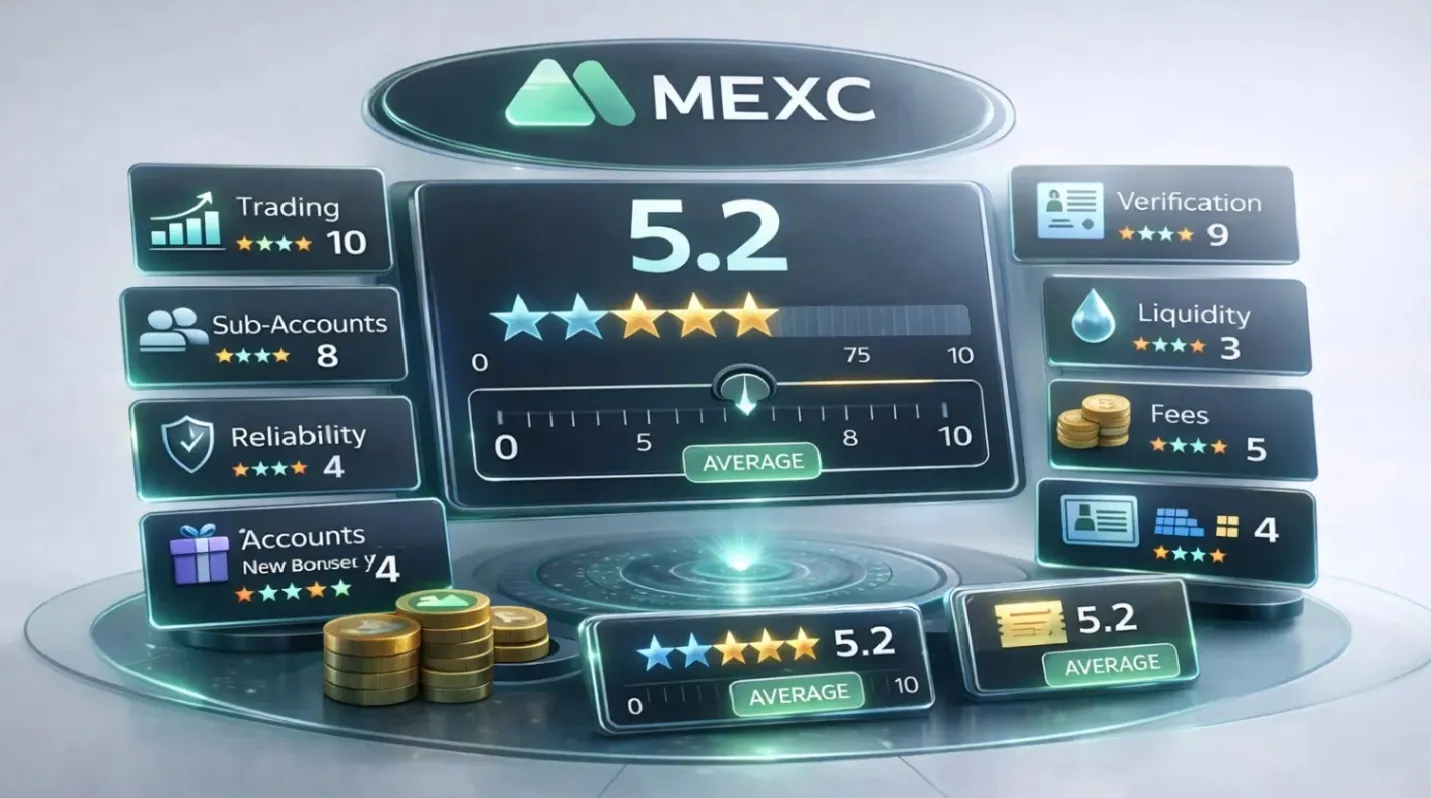
📘 General information about the exchange
MEXC profile (based on user reviews)
Key summary: users often praise low fees and the large selection of coins. Users also often complain about risk control restrictions. A separate complaint topic is futures liquidations. In reviews, users dispute them because of the liquidation price and margin calculation. Another recurring complaint is prolonged communication with support. When a withdrawal is blocked or a futures liquidation is disputed, the account may temporarily lose access to withdrawals and some features.
 TrustScore ~1.8/5 (~1,000+ reviews; high share of 1★; as of 03.05.2026)
  News context discussions of cases involving in-person KYC (identity verification in person), “clawback” (return of disputed profit under internal rules), and strengthened compliance
 📊 Review distribution
1–2 stars
- 🚫 Problems with withdrawing funds (the request is marked “completed,” but the money does not arrive).
- 🚫 Account freezes after profitable trades.
- 🚫 Support responds slowly or with templated replies.
- 🚫 Distrust due to mentions of third-party tokens in negative reviews.
3 stars
- 😐 Users like the interface and fees, but describe the service as unstable in review and dispute scenarios: withdrawal blocking under risk control, repeated KYC requests, review of a futures liquidation.
- 😐 Deposits and withdrawals are processed quickly in some cases, while delays arise in others.
- 😐 Support resolves issues, but response times depend on the complexity of the review.
4–5 stars
- 👍 Convenient interface, built-in TradingView charts.
- 👍 Low fees and tight spreads.
- 👍 Large coin selection and fast listings.
- 👍 Successful trading experience without withdrawal issues.
| ⭐ Rating | 📊 Share of reviews | 💬 Main reason |
|---|---|---|
| 1–2 stars | ~70% | 🚫 Withdrawal problems, account freezes, weak support |
| 3 stars | ~10% | 😐 Mixed experience: users like the interface and fees, but there are delays and complaints about the service |
| 4–5 stars | ~20% | 👍 Convenient interface, low fees, fast listings, successful trading experience |
🧪 Methodology and sources
- Trustpilot: recurring patterns in negative and positive reviews (withdrawal, risk control, support, liquidations), as well as star distribution and the share of 1★ reviews.
- TradingView: discussions of disputed cases and news topics around identity checks, “clawback” (return of disputed profit under internal rules), and compliance restrictions.
- MEXC documentation: pages on fees, KYC limits, liquidation mechanics, risk control, and risk disclaimers.
📊 Summary review metrics
| Metric | What reviews show | Comment |
|---|---|---|
| ⭐ Overall rating (TrustScore) | ~1.8/5 | A value below |
| 📉 Star distribution | High share of 1★ (about 3/4) | 1★ reviews most often describe risk control blocks and disputes over futures liquidations. |
| ❌ Negative themes | Risk control, withdrawal delays, clawback/liquidations, support | The most frequent source of frustration is prolonged support communication without a clear resolution timeline. |
| ✅ Positive themes | Interface, low fees, broad listing, mobile app | Positive reviews more often describe trading and withdrawals without additional checks. |
On the same review page, phrases such as “everything is convenient and fast” and “no withdrawal” appear side by side. Positive ratings more often describe trading and withdrawals without restrictions. Negative ratings more often describe risk control restrictions, document requests, and long support response times.
🛡️ Security and reliability
Technical side
The exchange uses cold storage, two-factor authentication, an anti-phishing code, and multisignature for corporate wallets. Reviews rarely contain complaints about these measures. Negative stories more often describe feature blocks and checks.
What risk control is and why it triggers
Risk control refers to internal compliance and anti-fraud algorithms. The algorithms analyze transactions and account behavior. When triggered, the exchange may temporarily disable withdrawals or trading until the review is completed.
- 🔎 Typical triggers: suspicious deposit chains, rapid transit operations, overlaps with addresses that MEXC filters mark as risky, series of orders and trades that filters classify as manipulation.
- 🧾 Data requested by the platform: documents on the source of funds, screenshots from the sending wallet or exchange, repeated verification, explanation of operations by dates and amounts.
- ⏳ A frequent cause of conflicts in reviews: long support response times and several review stages with repeated document requests.
💻 Interface and usability
- Entry threshold: users describe the interface as understandable for spot and conversion operations.
- Tools for active trading: users use the order book, trade feed, and spot/futures modes without switching between different dashboards.
- Operation navigation: users quickly find deposit, trading, and withdrawal.
- Mobility: the app repeats the key account scenarios and is suitable for managing orders and notifications.
💰 Fees and trading conditions
| Section | Maker | Taker | Note |
|---|---|---|---|
| Spot | 0% | 0.05% | Discounts when paying with MX (MEXC utility token); some pairs periodically have 0-fee promotions. |
| Futures | 0% | 0.02% | MX discounts on futures; promotional rates may apply to specific contracts. |
Liquidations and “fair price” in futures
Some user complaints relate to liquidation “at a price that was not on the chart.” On MEXC, the calculation is based on fair price. This is a calculated metric and differs from the last traded price. Liquidation may have occurred because of movement in the index or calculated price. Such a level may not have appeared on the spot chart.
🧩 Supported tokens and instruments
Listing
MEXC supports thousands of coins and tokens. In reviews, interest in the exchange is linked to early listings and the ability to buy an asset before it appears on other platforms.
- New listings are often accompanied by promotions and periods with reduced fees.
- For rare assets, users note high volatility and slippage risk.
Instruments
- Leveraged futures and margin spot.
- Leveraged ETFs (for example, 3L/3S tokens).
- Earn, staking, savings, and liquidity farming.
- Copy trading with public statistics and a demo mode for practice.
🆔 Verification (KYC) and withdrawal limits
| Level | Daily withdrawal | Access |
|---|---|---|
| No-KYC (without identity verification) | up to 10 BTC | Basic trading; no OTC (over-the-counter trading); in certain regions, a combined 1,000 USDT deposit+withdrawal limit applies. |
| Primary KYC (basic identity verification) | up to 80 BTC | Partial access to OTC; faster processing of basic requests. |
| Advanced KYC (advanced identity verification) | up to 200 BTC | Full access to OTC; expanded features. |
| Institutional (corporate verification) | up to 400 BTC | Corporate capabilities and separate connection options. |
💳 Deposits and withdrawals
- Deposit: users describe standard blockchain confirmations and rare complaints about crediting.
- Withdrawal: in simple scenarios, withdrawals are processed quickly. When risk control is triggered, the exchange requests confirmations and may hold the withdrawal until the review is completed.
- Factors for faster review: TXID, screenshots from the source, explanation of operations by dates and amounts, absence of short “deposit → withdrawal” transit chains across several platforms.
- Delay risk factors: back-and-forth transit operations, deposits from addresses “in the risk zone,” password change shortly before withdrawal, an attempt to withdraw a large amount immediately after it is received.
Frequent complaints
- “The request is closed, but the money did not arrive” — users describe a mismatch between the withdrawal status and actual crediting.
- “Funds are held until another platform confirms the source” — users describe document requests and prolonged correspondence.
- “Support asks for the same data again” — users describe several review rounds without a clear completion timeline.
📱 Mobile app
The MEXC app for iOS/Android includes spot and futures, order management, deposits and withdrawals, Earn, and notifications. In reviews, the app is mentioned less often than account restrictions during checks and delayed support responses.
⚠️ Frequent issues from reviews
🚫 Blocks under risk control
- Restriction of trading and withdrawals until the review is completed.
- Requests for documents and explanations about deposits and the transaction chain.
Source-of-funds confirmation factors
- A package of confirmations of the source of funds with TXID and screenshots of the source.
- Responses with an operation timeline and fixed amounts reduce the number of clarifications.
📉 Liquidations and “stop hunting”
- Conflict caused by misunderstanding the fair price and index calculation during liquidation.
- Perception of “abnormal candles” on low-liquidity contracts.
Liquidation calculation factors
- Use of fair price in the liquidation and margin calculation.
- Lower leverage and a larger buffer before liquidation reduce liquidation risk on volatile contracts.
🧩 Bonuses and “clawback”
- Bonus denials when a violation of promotion rules is suspected.
- Return of disputed profit to the insurance fund under internal rules.
Promotion rule interpretation factors
- Recording promotion rules and linking actions to campaign rules reduces the number of disputed interpretations.
- Logs and screenshots of trading operations are used in correspondence as confirmation of the trade scenario.
🎧 Support
- Long response time and templated wording in correspondence.
- Redirection to live chat without a substantive resolution.
Request processing factors
- Requests with a ticket number, amount, dates, addresses, and attached documents are often processed faster.
- One package of attachments instead of sending data in parts reduces the number of repeated requests.
🧭 Typical review process when risk control is triggered
- Material collection: TXIDs of all deposits, screenshots from sending exchanges or wallets, statements, and a time-based explanation of operations.
- Support request registration and receipt of the request ID. The full evidence package is usually sent in one message.
- Fact-based situation description: amount, dates, addresses, purpose of the transfer. Support provides the list of documents and a response time reference.
- Verification of atypical requirements (for example, offline meetings) through written instructions in the official account.
- Timeline recording of correspondence and decisions. Such a log reduces the risk of losing context during repeated requests.
- Partial unlock recording: when access is restored in stages, the restored functions and current withdrawal limits are recorded in the interface.
🧩 Mini cases and short quotes
“Clear interface for a new user”
“I’ve been using it for ~3 months: a very simple and friendly platform, easy to understand”
“Small balance, but blocked”
“About $100 was blocked: cannot trade or withdraw, it says risk control…”
“Complex withdrawal case”
The user describes a situation where the deposit returned to the original address, while the funds on the MEXC side are held until confirmation from another platform. The correspondence lasts for weeks. The outcome depends on confirmations of the source of funds and support response speed.
❓ Frequently asked questions (FAQ)
Is MEXC safe to use?
Is KYC required?
What fees does MEXC charge?
Why did liquidation occur at a price that was “not on the chart”?
Which data affects support request processing speed?
✅ MEXC: strengths and recurring risks
According to reviews, MEXC is chosen for low fees, broad listings, and access to spot and futures in one account. Positive stories more often describe trading and withdrawals without additional checks.
Negative stories more often describe risk control restrictions, withdrawal delays, disputed futures liquidations, and prolonged communication with support. These scenarios are linked to transaction checks, document requests, and support response times.