📖 LBank: what trader reviews and disputed cases show
This material analyzes real reviews of the LBank exchange from Trustpilot and trader discussions that mention LBank data in TradingView — a platform for charts and technical analysis. The focus is on withdrawal delays, account restrictions, support performance, fees and trading scenarios that users assess positively or negatively.
The material shows which trading scenarios use LBank for spot trading — transactions with the actual purchase or sale of an asset, listings and standard order types, where users encounter problems and what affects risk during deposits, trading and withdrawals.
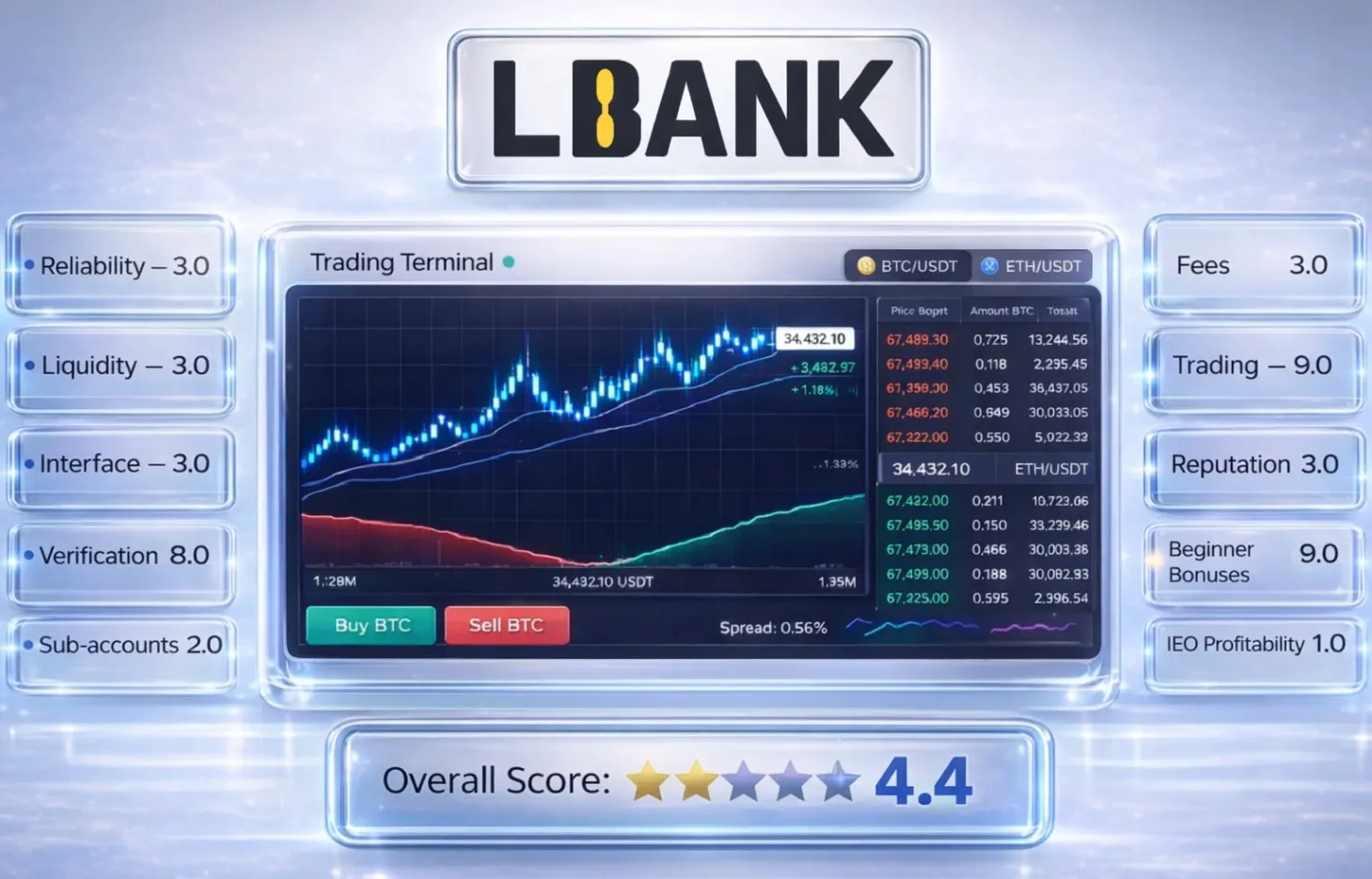
📘 General information about LBank: which features are available on the exchange
The analysis separates two things: which features the exchange offers and what users write about how those features work.
LBank is a cryptocurrency exchange that has operated since 2015. The platform offers spot trading — transactions with the actual purchase or sale of an asset, futures — contracts on changes in an asset’s price without direct ownership of it, copy trading — copying trades made by other traders, staking — allocating assets to receive network or platform rewards,
This set of features attracts different audiences. Some users come for rare assets and a quick start. Others come for low fees and access to futures. That is why reviews diverge: the same service is praised for fast market access and criticized for withdrawal issues or account restrictions.
Methodology and review date
The analysis includes public user reviews on Trustpilot that describe cases involving account restrictions, withdrawal delays, support, interface and fees. Discussions about the availability of LBank data in TradingView and the exchange’s response to events around the LBK token were also considered separately. The material records recurring themes available as of the review date through September 1, 2025, without claiming to be a full export of all publications about the exchange; the shares below are used as an approximate editorial grouping of the reviewed set, not as an exact statistical measurement of the entire review history.
- 🔹 What was considered: reviews about withdrawals, support, transparency of disputed decisions, interface and fees, as well as specific cases and public responses from the exchange.
- 🔹 What was not included: isolated reviews without a description of the situation, transaction amount or dispute outcome. Without these details, a case does not make it possible to understand the mechanism of the problem.
The number of reviews and the ratio of ratings change over time. The material shows the picture as of the review date, not a permanent exchange rating.
Quick review snapshot
- 🔹 Trustpilot shows a strong predominance of negative reviews. The most frequent complaints involve withdrawal delays, account restrictions after profitable trades and slow support responses.
- 🔹 Positive reviews most often mention quick movement between trading sections, interface speed, low fees and access to new tokens at an early stage.
- 🔹 TradingView does not have an official LBank rating. At the same time, LBank data is available for chart analysis, and the exchange itself uses an interface similar in logic to TradingView. The availability of market data simplifies technical analysis, but does not remove questions about withdrawals and trust.
⭐ Ratings and score distribution: why reviews differ so sharply
Ratings alone explain little. The difference between 1★ and 4–5★ reviews is more often shaped by the reasons users connect with withdrawals, support, fees and the trading scenario.
On Trustpilot, the average score is low, and negative reviews noticeably outnumber positive ones. The main complaints repeat: withdrawal delays, withdrawal refusals without a clear explanation, account restrictions after profitable trades and long exchanges with support without a clear resolution timeframe.
Positive reviews describe a different experience. Users with small and medium balances more often mention quick movement between sections, fast listings of new tokens and relatively low fees. For this group, LBank provides access to basic trading scenarios: buying altcoins, early listings and working with standard order types.
The difference in ratings is tied to different risk points. A user who buys altcoins on spot and rarely withdraws large amounts may avoid serious problems for a long time. A user who actively trades futures — contracts on changes in an asset’s price without direct ownership of it — and withdraws profit is more likely to fall under an automated security review. This increases the likelihood of a sharply negative review. Events around the LBK token in 2025 also affected the overall assessment.
🧩 Review topic map: what users write about most often
Complaints and praise repeat across several main topics. These themes shape the overall tone of the reviews.
- Withdrawals and account restrictions: most complaints are tied to situations where a withdrawal request gets stuck, the account receives an account abnormal status, meaning an internal flag for suspicious activity, and the exchange asks for additional checks.
- Support: some users receive a response within a few hours. In complex cases, complaints often mention template-style emails without a clear explanation of reasons or timeframes.
- Interface: this part is more often treated as a strength. Users note quick movement between the main sections of the terminal, familiar chart presentation and fast access to core actions.
- Fees: there are fewer complaints about base rates than about withdrawals and security. Complaints appear where a user expected one fee but saw another in a specific pair or promotional condition.
- Trust and transparency: the most sensitive topic is not the check itself, but the lack of a clear answer about why the account is restricted, which documents are needed and how long the review will take.
📊 Review distribution: why users give 1, 3 and 5 stars
1–2 stars
- 🚫 A withdrawal request is marked as completed, but the funds do not arrive in the wallet or on the receiving exchange.
- 🚫 After profitable trades, the account is restricted and requires additional checks.
- 🚫 Support responds slowly or sends generic wording without a specific case status.
- 🚫 Trust declines because of the history around the LBK token and the exchange’s response to that crisis.
3 stars
- 😐 The interface and base fees are acceptable, but some operations are unstable.
- 😐 Deposits and withdrawals are sometimes processed quickly and sometimes take longer.
- 😐 Support responds substantively, but does not always meet expected timelines.
4–5 stars
- 👍 The interface provides quick access to charts and core trading actions for users already familiar with TradingView logic.
- 👍 Base trading fees are perceived as low.
- 👍 A broad coin selection and fast access to new listings make the exchange more visible in the early-listing segment.
- 👍 For some users, trading and withdrawals proceed without delays or additional checks.
| ⭐ Rating | 📊 Approximate editorial grouping | 💬 Main reason |
|---|---|---|
| 1–2 stars | about 7 out of 10 | Withdrawal issues, account restrictions, weak support transparency |
| 3 stars | about 1 out of 10 | Mixed experience: quick movement between sections and fees, but unstable timelines and service complaints |
| 4–5 stars | about 2 out of 10 | Fast access to trading actions, low fees, quick listings, successful trading and withdrawal experience |
👥 Experience of beginners and active traders: where expectations diverge
Beginner scenario: quick entry and later restrictions
Beginners often note that funding an account, buying coins and placing basic orders do not require long training. The strongest attractions are quick movement between trading sections, a large coin selection and the ability to start trading quickly.
Active trader scenario: where real friction begins
Reviews regularly describe cases where, after a series of profitable trades, the system marks the account as abnormal, and withdrawals are blocked until additional checks are completed. This situation causes the strongest negativity because the problem appears at the moment of withdrawing profit. There are also opposite reviews: some users trade for years without serious disruptions and note liquidity on major pairs and a small difference between the buy and sell price.
As transaction volume and withdrawal frequency increase, dependence on
🔐 Trust and security: where the main conflict with users appears
LBank has a standard set of protection mechanisms. The main complaint in reviews is not about their existence, but about how they are applied in disputed cases.
The exchange states that it has PoR — Proof of Reserves, meaning cryptographic confirmation of reserves at the time of verification. It also states that it uses risk funds, compensation mechanisms, two-factor authentication (2FA), anti-phishing codes and withdrawal address whitelists. For some users, this creates a sense of basic account protection.
Negativity appears at another point. Users complain not only about the fact of the check, but about the lack of transparency around account restrictions. The decision has already been made, the withdrawal is stopped, but there is no clear explanation of the reason, list of steps or review timeframe. This is what most often leads to accusations of arbitrary decisions and reduces trust in the exchange.
The crisis around the LBK token in 2025 played a separate role. After trading and withdrawals for this asset were halted, the exchange announced a buyback program at a 1.2× premium to the user’s average purchase price. The execution period stretched over several months. For token holders, this became a direct question of access to the value of their asset.
Key limitations of disputed cases
- Withdrawal restrictions cause the strongest negativity where there is no clear communication on review timelines and steps.
- Events around LBK intensified the overall negative backdrop and affected perception of the exchange even among users who did not hold the token.
- PoR shows reserves at the time of the snapshot, but does not replace licensing and does not provide regulatory protection.
💸 Withdrawals and deposits: where typical failures appear
Operations involving funds most often turn a neutral experience into a negative review. Specific delay and restriction scenarios therefore matter most.
The same problems repeat in reviews: delayed withdrawals or deposits, a requirement to complete KYC, meaning identity verification, when withdrawing a large amount, and account restrictions after profitable futures trades. At the same time, not all experience is reduced to complaints. In positive stories, users write that withdrawals were processed quickly and without additional questions. The difference is linked to the amount, account status, selected network and whether the operation triggered an additional review.
Typical reasons for a stuck withdrawal case
- 🔹 Network and payment details: an error in the address, tag or
MEMO , meaning an additional transfer identifier, remains one of the most common reasons for a stuck withdrawal or uncredited deposit. - 🔹 Account status: an account abnormal flag, additional verification request or security notification can temporarily stop a withdrawal until the internal review is complete.
- 🔹 Transaction data: in a dispute, the exchange usually checks the request ID,
TXID , meaning the transaction hash on the blockchain, the request creation time and the operation status inside the account. - 🔹 Case communication: repeated messages without new data rarely speed up the review if support still lacks the full picture of the operation.
- 🔹 Review threshold: large amounts and atypical activity are more likely to trigger additional risk control than ordinary small withdrawals.
The review speed depends on correct payment details, verification status and completeness of request data, not only on the fact of contacting support.
📞 Support and communication: how disputed cases are reviewed
The support rating for LBank depends less on the communication channel and more on the complexity of the case and the completeness of the initial data.
Support reviews diverge. In positive stories, users write about an issue being resolved within a few hours and about clear instructions. In negative ones, they mention long response times, repeated templates and a lack of clarity on disputed cases. The difference is most often visible by problem type: a minor technical issue may be resolved quickly, while an account restriction or withdrawal review almost always requires more time and additional confirmations.
The main communication channels are tickets and email. Complaints appear where, instead of a specific status, the user receives a formal reply without an explanation of what has already been checked, what is missing and when to expect the next step.
Which data most often becomes the subject of a support dispute
Situation 1 — the deposit is confirmed on-chain but has not appeared in the balance
- 🔹 In these cases, the transfer network, presence of a tag or
MEMO ,TXID and internal crediting status are usually checked. If the data differs between the blockchain and the account, the user more often perceives this as an exchange failure.
Situation 2 — the account is restricted and withdrawals are unavailable
- 🔹 With Account abnormal status, the dispute centers on the reasons for the restriction, the list of documents and the review timeline. The main source of negativity here is connected not only with the block, but with the lack of a clear case explanation.
Situation 3 — access to 2FA — two-factor authentication — has been lost
- 🔹 When access to 2FA, meaning two-factor authentication, is lost, the dispute usually shifts toward re-identifying the account owner and checking login history, rather than the speed of an ordinary support response.
🖥️ Interface and functionality: where practical usability appears
The interface is treated as one of LBank’s stable strengths, but this part of the product appears differently across usage scenarios.
Users often describe the LBank interface as clear and logical. The main strength is the familiar presentation of charts, indicators and drawing tools. It is close to what traders see in TradingView. On mobile devices, the app works steadily, although during peak hours some users note minor delays when switching between sections or updating data.
Inside the exchange, there are almost no social features: forums, built-in chats, copied market discussions or a developed social feed. For a scenario where only a terminal and market access are needed, this does not interfere. For a scenario where additional context and guidance are needed, it becomes a limitation.
Scenarios where the interface is perceived as convenient
- 🔹 Beginner scenario: quick entry into spot trading and basic order types without a long study of the terminal.
- 🔹 New token scenario: a large coin selection and early listings, where the risk of choosing the wrong asset increases.
- 🔹 Futures trading scenario: market data and familiar chart logic, which does not remove possible friction around security and withdrawals.
🌍 Regulation and availability: how features depend on jurisdiction
The availability of operations depends not only on exchange policy, but also on which features are permitted for a specific jurisdiction and account status.
LBank uses an offshore structure with an address in the British Virgin Islands and operates as a global service, but with restrictions for certain jurisdictions. Some countries and regions are officially unavailable. Therefore, access and the feature set are determined by account conditions and restrictions in a specific jurisdiction.
This affects more than registration itself. Jurisdictional restrictions may affect the availability of
🛡️ Account security in reviews: which settings appear in disputed cases
In complaints and positive reviews, protection measures appear not as a general checklist, but as part of specific conflicts around account access and withdrawals.
Which settings are more often linked to disputed situations
- 🔹 2FA — two-factor authentication through an authenticator app: this mechanism is more often mentioned in cases involving lost account access or an additional login check.
- 🔹 Address whitelist: linking approved withdrawal addresses appears in disputes about changing payment details and checking a new address before withdrawal.
- 🔹 Login history and active sessions: this data becomes a subject of review where the exchange links an account restriction to atypical activity or a new device.
⚖️ Pros and cons from reviews: where LBank performs well and where it creates risk
✅ Pros
- Low trading fees in the basic spot and futures modes.
- Fast movement between sections and familiar chart logic for users who work with technical analysis.
- A broad coin selection and fast access to new listings.
- On popular pairs, users often note good order execution.
- There is a
P2P area and basic account protection mechanisms.
❌ Cons
- Recurring complaints about account restrictions and long checks during withdrawals.
- Support in complex cases is often perceived as slow and insufficiently specific.
- The level of trust declines because of the lack of transparency in some risk-control decisions.
- The case involving the LBK token in 2025 intensified complaints about the exchange’s policy toward user assets.
- The available feature set depends on jurisdiction and verification status.
❓ FAQ about LBank reviews
Is KYC required for withdrawals?
Why is a deposit confirmed on-chain but not shown in the balance?
What is Proof of Reserves and why is it not enough for full trust?
Can trading be done through TradingView?
Why does LBank have so many negative reviews?
What risk mechanism applies in P2P on LBank?
🧾 LBank review: key features and limitations
LBank offers low fees, fast access to new tokens and familiar terminal logic for technical analysis. For spot trading without frequent withdrawals of large amounts, the exchange covers basic operations and access to a wide range of markets.
The main weak point begins where a user encounters not the interface, but access to funds and the review of a disputed case. Withdrawal delays, account restrictions and insufficiently transparent support communication pull ratings down the most.
In spot trading scenarios with infrequent withdrawals, LBank’s key advantages are tied to fees, access to new listings and the breadth of available markets. In scenarios involving frequent profit withdrawals, the final assessment depends more strongly on the transparency of account checks and the speed of disputed case review.