GameFi: when a game turns into an economy
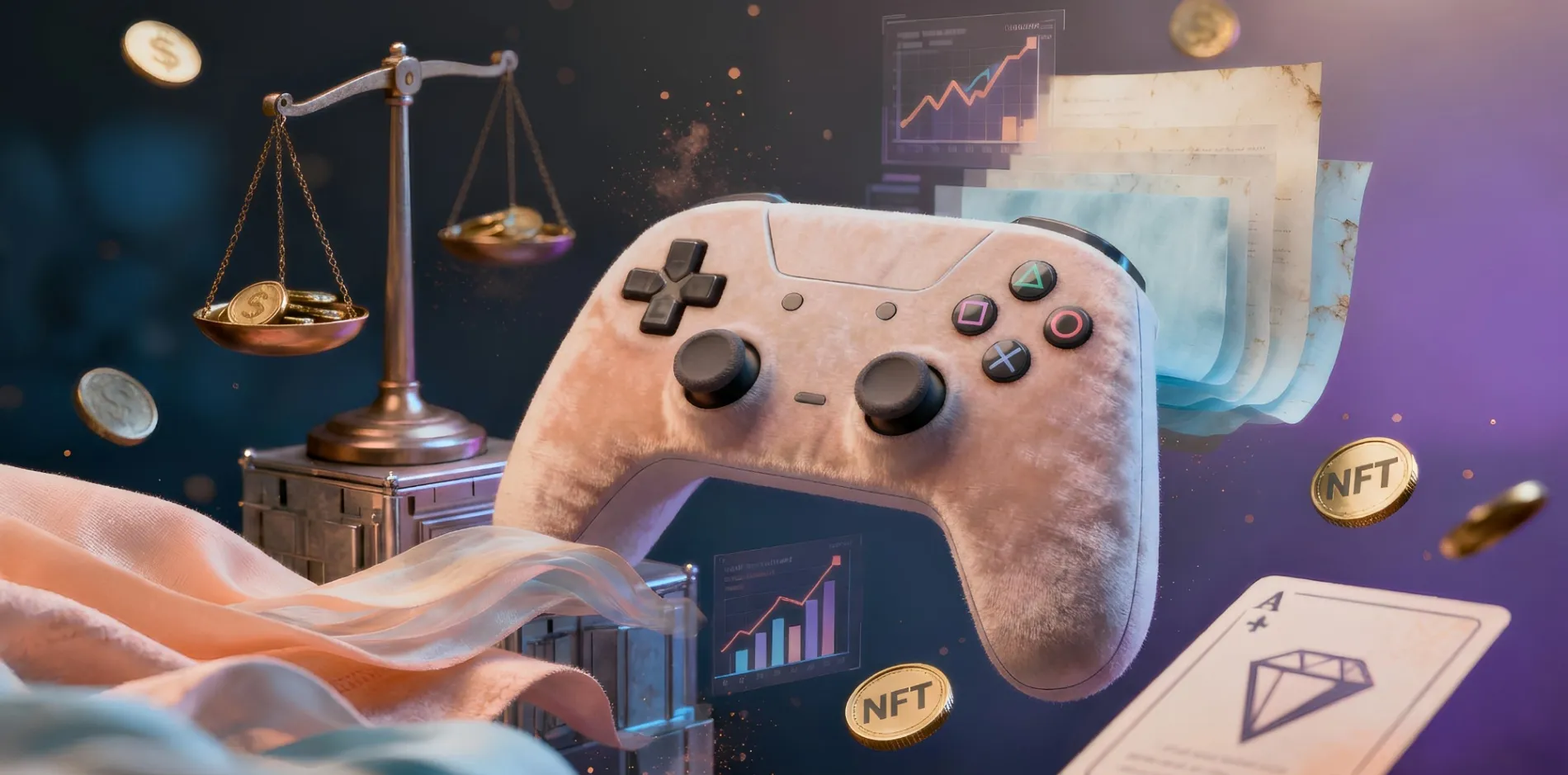
In GameFi, a rare sword can exist as an NFT, and a tournament win can pay tokens that trade on exchanges or are spent in-game. In this model, an item stops being just a server record and becomes a digital asset with a market price and ownership verified through a wallet.
This guide explains GameFi in clear, practical terms: how P2E and P&E differ, how tokens and NFTs work, where income comes from in blockchain games, and why even popular projects often lead to losses.
Disclaimer: this material is educational and is not investment advice. GameFi is a high-risk environment: token and NFT prices can move sharply, and game rules, rewards, and withdrawal terms can change.
What is GameFi, and how it differs from regular games
Three things matter in GameFi: where an asset gets a price, who owns that asset, and whether it can be moved outside the game itself.
Definition: GameFi refers to games where tokens and NFTs can be held in a wallet and sold on an open market. The price of such assets exists only as long as there is demand.
GameFi (Game + Finance) refers to blockchain games where in-game assets spill into an external market. Tokens can be exchanged on exchanges, NFTs can be sold on marketplaces, and ownership is verified not by a game account but by a record on the blockchain. This creates the fundamental difference from regular Web2 games and the on-chain ownership model.
- Regular online games: an item exists inside the publisher’s database. If the server shuts down or an account is banned, access to the item disappears.
- GameFi: a token or NFT is stored in a wallet and can be used outside the game interface — for example, for selling, transferring, or holding.
The core difference: in a regular game, an item belongs to the publisher’s infrastructure, while in GameFi the ownership right is recorded on the blockchain. That record provides the basis for an external market, exchange, and speculative pricing.
Web3: an access model where entry and asset ownership are tied to a crypto wallet rather than an internal game account.
Smart contract: code on a blockchain that automatically enforces predefined rules — for example, mints NFTs, credits rewards, or transfers tokens once conditions are met.
Key idea: an ownership record on the blockchain does not create value by itself. Token and NFT prices are supported by gameplay, player activity, market liquidity, and in-game demand for those assets.
P2E vs P&E: what the difference is, and why it matters
The names look similar, but the economic foundation differs: in one case players arrive for payouts, in the other they arrive for the game, with rewards as an add-on.
P2E (Play-to-Earn) is a model where earning becomes the main motivation. Players show up for a token, an NFT, or yield, and interest in gameplay is often secondary. Such systems can grow quickly, but when yield drops, participants leave, sellers increase, and the token and NFT market contracts.
P&E (Play-and-Earn) is a model where the main value is built around gameplay, progression, content, and competition, with rewards as a bonus. These games typically limit emissions more tightly, include more in-game spending, and make fewer promises of quick payback.
Practical difference: in P2E, players often show up to farm and leave after realizing rewards. In P&E, players return for matches, rankings, upgrades, events, or progression, while the token mainly boosts motivation.
Emissions: the release of new tokens into circulation. If rewards increase while demand does not, the token faces sell pressure.
Burn: a supply-reduction mechanism where a portion of tokens is permanently removed from circulation — for example, via fees, crafting, or upgrades.
In practice, many projects use a hybrid approach: they keep the earning idea but do not build the entire economy purely on reward emissions. The key test is simple: if interest disappears immediately after payouts fall, the economy relied on farming. If the game remains attractive without generous rewards, the project has a better chance of sustainability.
| Model | Main motive | Main source of income | Typical risk |
|---|---|---|---|
| P2E | Earning | Reward emissions and NFT trading |
Reward inflation and fast player churn |
| P&E | Gameplay | In-game spending fees, content, events |
Weak demand for assets when game interest is low |
Tokens in GameFi: types, and why there is often more than one
A GameFi token is not a “bonus” or a points counter. It is an economic component: rewards, spending, governance, and price pressure flow through it.
Key idea: the token set in a GameFi project determines who benefits, who funds the system, and where inflation appears.
Most GameFi projects use at least two token types: utility and governance. The split exists because one token handles three jobs poorly at once: paying rewards, serving as “fuel” for gameplay actions, and preserving governance value.
| Token type | Role in the ecosystem | Main use | Typical risk |
|---|---|---|---|
| Utility | In-game economy | Crafting, upgrades, fees, mode entry | Inflation from rewards |
| Governance | Project governance | Votes, economic parameters, treasury | Declining interest in the project |
Simple model: the utility token powers in-game actions, while the governance token reflects participation in governance and trust in the project.
The reason multiple tokens are common is economic math. If a single token pays rewards, collects fees, and governs the project, it either gets diluted quickly by emissions or becomes too expensive for everyday gameplay operations. Splitting roles separates governance price from day-to-day usage price.
Red flag: if a token is easy to earn but is barely needed for crafting, leveling, mode entry, or services, the main flow is selling rather than using.
A common evaluation mistake is focusing only on the size of the daily reward and ignoring its source. If rewards come almost entirely from emissions while the game has few costs and sinks, new tokens flow to the market and push the price down. That is why it helps to separately review GameFi economics: emissions, sinks, and unlocks.
Practical scenario: a project issues 1,000,000 tokens as rewards, while only 300,000 are burned or spent in-game. The remaining 700,000 tokens become excess supply. Without growing demand, the price starts to fall.
What this means: even a fair reward system loses sustainability when token issuance consistently exceeds token spending and token buying.
That is why more sustainable models continuously encourage token spending on repairs, crafting, upgrades, event participation, fees, and NFT trading. These costs are not “complexity for its own sake” but a way to reduce excess market supply.
Vesting also requires attention. Even with limited current circulation, large unlocks for the team, investors, and early participants can hit the market. Such events do not always break the price, but they often increase volatility and sell pressure.
Vesting: a token-unlock schedule for the team, funds, investors, and early participants.
Liquidity: the ability to buy or sell a token without sharp price movement due to insufficient depth in an order book or pool.
NFTs in GameFi: asset types, and why losses happen
An NFT in GameFi proves ownership of an asset, but it does not guarantee demand, liquidity, or an exit price. Value depends not on the NFT token itself, but on in-game utility and market conditions.
Key idea: an NFT records ownership rights, but it does not lock in an exit price.
In GameFi, an NFT usually represents a specific game object: a character, an item, a skin, a land plot, a pet, a vehicle, or a mode pass. The asset is stored in a wallet, can be transferred between addresses, and can be listed on a marketplace, so it is not formally tied to an account’s internal inventory.
For the project economy, NFTs often serve two roles at once: an entry ticket and a market for scarce assets inside the ecosystem.
Practical classification: required NFTs grant access to gameplay or earning, booster NFTs increase efficiency, and cosmetic NFTs sell appearance and status.
The riskiest option for beginners is an expensive required NFT. In this setup, demand for the asset is supported not by the NFT’s utility alone, but by the flow of new participants who also need the entry item to farm or participate.
Red flag: if playing and earning are impossible without buying an NFT, exiting the position usually depends on whether the next buyer arrives for that specific entry asset.
Another common trap is liquidity. A marketplace may show a “floor” — the lowest listed price — but with weak demand the asset may not sell at that price for weeks. Network and platform fees further reduce the outcome.
A separate segment is rentals and scholarship models. NFT owners lend assets to other players and take a share of rewards. This lowers the entry barrier for renters, but makes owners dependent on reward stability and renter interest in the game.
Practical scenario: an NFT owner rents out a character and receives a percentage of earned tokens. After rewards are cut, the renter stops playing. The NFT produces no income, and a new renter appears only if terms or the asset’s overall price drop.
What this means: rentals reduce upfront costs for players, but do not eliminate the main risk — declining demand for the game and its profitability.
Most losses in the GameFi NFT segment come not from hacks or scams, but from flawed expectations. NFTs are bought as investment assets, but in practice they function as gameplay tools whose price depends on player activity, updates, utility, and market liquidity.
Where the money comes from in GameFi, and why that is the key question
Before estimating income, the money source must be identified: who pays for the token, NFTs, or content access, and what sustains demand.
Definition: in GameFi, money comes either from emissions or from player spending. Emissions jump-start activity, while voluntary spending supports the economy after launch.
Every GameFi economy contains multiple value flows. The most visible flow is token emissions as rewards. Emissions can create early income, but do not create sustainability on their own: if a token is only printed and distributed, supply grows faster than real demand.
Main limitation: emissions can spark interest, but cannot support token price indefinitely without buyers and spending inside the ecosystem.
Sources of sustainable demand:
— cosmetics, appearance, rare items, and status assets;
— seasons, passes, tournaments, event access, and new content;
— crafting, upgrades, repairs, fees, trading, and services inside the market.
These expenses create value buyers — players who spend money for progression, convenience, status, or enjoyment of the game itself. If there are few such participants, the system is dominated by reward sellers, and tokens and NFTs face constant price pressure.
The more voluntary spending a game has, the more resilient the economy is to reward cuts.
Stress test: if the reward token drops 5x tomorrow, will interest in the game, tournaments, content, and in-game spending remain? If not, income depended on payouts rather than on demand for the game itself.
If a project stays interesting without generous rewards and income feels like an extra bonus, the economy has a better chance of surviving market downturns, reward redesigns, and the exit of a speculative audience.
Where income is made in GameFi: real revenue models
Income in GameFi typically falls into two groups: income from gameplay participation and income from the asset market. In many projects, the second matters more than the first.
The basic fork is simple: income is built either on time spent or on understanding economics and liquidity.
| Model | What happens | Where money comes from | Main risk |
|---|---|---|---|
| Active income | Completing activities and matches | Rewards, prizes, events | Price drops and rule changes |
| Market income | Trading NFTs, resources, and items | Price differences and liquidity | Illiquidity and spread |
| Production | Crafting, upgrading, in-game services | Demand for consumables and services | Declining player activity |
| Rentals and guilds | Lending an asset to another player | A share of rewards or income | Renters leave first |
| Passive mechanics | Staking tokens or NFTs | Platform fees or emissions | Inflation and vanishing demand |
How to read this block: each model has three questions — where income comes from, what sustains that flow, and what breaks it first.
🎯 Active income: gameplay and rewards
The most direct path is to perform in-game actions and receive compensation: quests, PvP, rankings, tournaments, resource farming, and seasonal events. In P2E, payouts are more often regular; in P&E, they are more often tied to performance, rarity, or ranking placement.
Where the money comes from: token emissions, a prize pool, a share of fees, or in-game charges.
What matters most: the reward-token price and distribution rules.
Active income depends not only on reward quantity but on what rewards are worth after selling.
🛒 Market income: trading NFTs and resources
In many projects, the main income goes not to “farmers,” but to participants who understand the market: buying assets before demand spikes, selling after a patch, season, tournament, or update, and estimating exit liquidity in advance.
Where the money comes from: the difference between entry and exit price, plus the speed of exiting the position.
What matters: trading volumes, spread, fees, buyer activity, and market depth.
The visible listed price is not the real exit price. With weak demand, a position closes only through a discount or a long wait.
Here, income depends not on time in the game but on accurate demand and liquidity assessment.
🏗️ Production income: crafting, upgrades, and services
Games with deeper economies create demand for consumables, upgrades, character leveling, rare items, and in-game services. In Web3 games, that demand can also be monetized through NFTs, tokens, and open-market trading.
Where the money comes from: other players spending to speed up progression, improve builds, and access useful items.
What breaks the model: declining player activity, lower reward value, and disappearing need for consumables.
Who it fits: participants who can estimate resources, crafting cycles, and demand for in-game services.
🤝 Shared models: rentals and guilds
If entry is expensive, role-splitting schemes appear: one participant buys the asset, another plays, and profits are split by agreement. This expands the audience but increases the owner’s dependence on game economics and renter motivation.
Where the money comes from: a share of rewards or income earned by a renter using someone else’s asset.
What to watch: split terms, fees, withdrawal rules, agreement transparency, and organizer reputation.
Practical risk: when rewards are cut, renters leave first, so the asset can lose yield immediately.
🧊 Passive mechanics: staking and seasonal payouts
Some projects offer income for holding tokens or NFTs. Sometimes payouts come from fees and real turnover, but often they are simple emissions marketed as “passive income.” The key question remains unchanged: who buys the reward flow.
Where the money comes from: either real platform fees or newly issued tokens.
Main risk: if payouts rely only on emissions, token supply grows and value becomes harder to sustain.
Check: whether the token has buyers beyond reward recipients.
The further income is from real demand, the faster it turns into inflation.
Where losses happen most often: GameFi traps missing from landing pages
Losses in GameFi usually come from three sources: inflated expectations, weak understanding of the economy, and security mistakes. Below are common scenarios that repeat from project to project.
Scenario #1: “Payback” depends on a flow of newcomers
If returns look like a stable payout scheme for all participants, the money source must be checked: who buys the token from those already exiting with profit, and what happens after new-player growth slows.
- A new participant buys an NFT or token to enter and start farming.
- A portion of rewards reaches the market, and the price holds due to new buyers.
- Audience growth slows, sellers increase, price falls, and interest in the game disappears.
Risk core: if game value takes a back seat to “payback,” returns depend on audience expansion rather than on sustainable in-game demand.
Scenario #2: reward inflation destroys token price
Even a technically strong project can devalue its own token if reward issuance consistently outpaces in-game spending and market demand.
- Rewards are credited regularly, but the token has few in-game uses.
- Most participants sell immediately after receiving the token.
- Price falls, real income drops, and both player activity and the NFT market contract.
Risk core: what matters is not reward size but the ratio between emissions, sinks, and real token demand.
Scenario #3: expensive entry and an illiquid NFT
Buying an NFT to start is often seen as an investment, but in practice it can be a slow, loss-making entry that is hard to exit without a discount.
- The floor looks convincing, but actual buyer volume is low.
- Selling takes time, a discount, or precise timing.
- When player activity falls, NFT utility drops and the market narrows faster than expected.
Risk core: an NFT is a market-risk asset, not a liquidity guarantee. Checking requires more than listing price: deal volume, utility, and buyer count matter.
Scenario #4: wallet and approval security mistakes
Even with a workable economy, losses often come from careless wallet connections and transaction signing. One approval mistake or a fake site can lead to losing tokens and NFTs.
- Phishing sites, fake accounts, and bait disguised as an airdrop.
- Dangerous approvals that allow a contract to spend tokens or transfer NFTs.
- Storing a seed phrase in notes or screenshots, or sharing it with “support.”
Security rule: a seed phrase is never entered on a website and is never shared with “support.” Any such request is a scam. The same rule applies to basic storage: a seed-phrase handling mistake is most often irreversible.
Project examples: what real cases show
Real cases matter not because of names, but because of recurring logic: what triggered growth, where the economy failed, and which models look more sustainable over the long run.
How to read this block: each case has three key points — what supported demand, what broke the balance, and what practical takeaway the scenario provides.
🐉 Axie Infinity: a symbol of the P2E boom and its limits
What worked: fast audience growth, mandatory entry via pet NFTs, active trading, and strong expectations of income.
What broke: sell pressure on the reward token and slower new-player inflow reduced returns and collapsed asset prices.
Lesson: if demand for NFTs and tokens relies on audience expansion, growth stalling makes the economy fragile. The Ronin case also showed that infrastructure security directly affects project sustainability.
👟 STEPN: narrative power and mathematical limits
What worked: a clear move-to-earn model, entry via sneaker NFTs, mass interest, and fast demand expansion.
What broke: when growth slowed, reward inflation started pressuring the token faster than expected, and payback deteriorated sharply.
Lesson: a strong marketing narrative does not override emissions math. If income depends on continuous audience expansion, the model weakens after the first growth wave.
🌍 The Sandbox and Decentraland: NFT land and the attention economy
What worked: the idea of digital real estate, brand interest, events, metaverse hype, and land trading as a scarce NFT asset.
What broke: land value proved tightly linked to player activity, audience attention, and platform utility. As activity fell, trading volumes fell too.
Lesson: scarcity alone does not create liquidity. An attention-tied asset loses price as interest declines in the environment where it is used.
🎯 The new wave of GameFi: focus on the game, not payouts
What works: emphasis on combat systems, progression, seasons, competition, social mechanics, and content that remains engaging without generous payouts.
How economics change: less regular emissions, more rewards tied to events, achievements, cosmetics, tournaments, and player activity.
Lesson: the more reasons there are to spend money inside the game and the less reliance there is on daily payouts, the weaker reward-inflation pressure becomes on the token.
Main takeaway from cases: a model that depends on constant inflow and emissions starts working against players once growth slows. More resilient economies are built on content, competition, cosmetics, services, and other reasons to spend inside the game.
Checklist: how to evaluate a GameFi game before entering
This checklist helps filter out projects where tokens and NFTs rely on emissions, expensive entry, and weak liquidity.
Reading rule: if two or more red flags from the tables below appear in one project, entry risk rises significantly.
1) Economics: where value comes from in the game
| Check | Baseline | Red flag |
|---|---|---|
| Reward source | Rewards are supported by player spending: content, passes, fees, events | Most of the flow comes from emissions |
| Sinks | The token is spent regularly on progression and services, with part removed from circulation | The token is mostly accumulated and sold, with little spending |
| Token role | The token is needed for crafting, upgrades, modes, fees, and gameplay actions | The token functions almost only as a withdrawal vehicle |
| Vesting | The unlock schedule is clear and avoids unexpected large releases | Unlocks are opaque or aggressive and can sharply increase supply |
| Liquidity | Trading volume exists and exiting is possible without heavy discounts | Price is visible, but selling is difficult due to a thin market |
Stress test: if rewards are cut 3x, will demand for the token, NFTs, and content remain, or will interest disappear with profitability?
2) Gameplay and demand: why people play and pay
| Check | Baseline | Red flag |
|---|---|---|
| Reason to play | Progression, challenge, social ties, and competition exist | Interest relies almost entirely on payouts |
| NFT utility | The NFT provides function, access, convenience, or cosmetic value | Mandatory expensive entry with little value after hype fades |
| Updates | Seasons, events, and patches support player return | Content ships rarely, player activity falls, demand disappears |
| Community | The community discusses mechanics, builds, tournaments, strategies, and patches | Most discussion is about price, listings, and “multiples” |
| Voluntary spending | Spending exists for comfort, status, content, and enjoyment | Payments are made only for expected payback |
Sustainable demand appears where spending is not driven only by future reward selling.
3) Risks: liquidity, security, and control
| Check | Baseline | Red flag |
|---|---|---|
| Exit path | Where and how to sell is clear: volumes, fees, spread, venue | Evaluation relies only on “floor” without buyer analysis |
| Approvals | Approve is granted consciously and only for the needed amount | Approvals are signed without understanding contract permissions |
| Wallets | A gaming wallet is separated from the main asset wallet | Main funds are connected to gaming sites |
| Domain and links | Connections are made only to the project’s verified domain | Links from chats, comments, and “airdrop” messages are used |
| Project transparency | The team explains changes, rewards, incidents, and withdrawal rules | Issues are hidden and rules change without clear explanations |
Security rule: a seed phrase is never entered on a website and is never shared with “support.” Any such request is a scam.
Practical approach: a small entry provides more information than an expensive start. Testing gameplay, withdrawal rules, and liquidity with a small amount first is often more useful than increasing risk immediately.
Practical beginner strategies: reducing risk without burning out
In GameFi, risk usually grows not from one mistake but from a combination of inflated expectations, weak control, and misreading the economy. These principles reduce that specific bundle of vulnerabilities.
- Separating gameplay from the investment calculation. Stronger models typically start with gameplay, demand, retention, and token utility, and only then present potential income. If interest disappears without rewards, the economy tends to rely on expectations rather than on value.
- Fully pricing entry. NFT price alone does not reflect the real cost of a position. Total evaluation usually includes network fees, marketplace fees, spread, potential discount for a fast sale, and thin-liquidity risk.
- Limiting concentration in one asset. One token or one NFT set creates dependency on one economy, one patch, and one buyer circle. Even basic risk distribution reduces exposure to a single negative scenario.
- Realizing results by rules, not impulse. Partial exits reduce dependence on sharp price moves and prevent a model built on the expectation of endlessly rising yields.
- Prioritizing economics over noise. Outcomes are usually driven more by changes in rewards, sink mechanics, fees, withdrawal rules, and liquidity than by loud announcements, partnerships, or external hype.
- Security as part of the strategy, not a separate step. In GameFi, wallet risk, approval risk, and fake-link risk belong in the same evaluation model as tokenomics, liquidity, and entry price.
Working principle: in GameFi, the advantage more often goes not to the participant with the highest advertised yield, but to the one who understands economics, limits risk, and does not build a model on the expectation of endless payouts.
FAQ on GameFi, P2E games, and NFT economies
What is GameFi, and how do blockchain games work?
GameFi refers to blockchain games where tokens and NFTs exist not only inside the interface but also outside the game: held in a wallet, transferred between addresses, and sold on the market. The key difference from a regular game is that an asset is not tied only to the publisher’s account.
What is the difference between Play-to-Earn (P2E) and Play-and-Earn (P&E)?
In P2E, earning often becomes the main motive, so the economy depends more on new-player inflow and reward stability. In P&E, the game must hold interest through gameplay, while income remains a bonus. Because of that, P&E models often look more sustainable when a project does not rely only on regular payouts.
Why can a reward token fall even with many players?
Player count is not the same as token buyers. If a token is distributed regularly as rewards but has few in-game spending paths, supply grows faster than demand. In that model, even high activity does not protect price from sell pressure.
Is an in-game NFT really player-owned?
An NFT in a wallet confirms technical ownership of the token, but does not guarantee market price or liquidity. Asset value depends on game rules, demand for its function, player activity, and buyer activity in the market.
How can a GameFi economy be recognized as too risky?
Key warning signs include expensive mandatory entry, promises of fast payback for a broad audience, rewards funded almost entirely by emissions, weak sink mechanisms, opaque vesting, low liquidity, and token dependence on constant new-player inflow.
How can wallet use be made safer in GameFi games?
The most vulnerable areas in GameFi are wallet connections to game sites, unnecessary approvals, fake domains, and mishandling a seed phrase. Separating a gaming wallet from the main storage often reduces risk scale, while verifying the domain and transaction content reduces the chance of losing assets.
Is it possible to earn in GameFi without an upfront investment?
Sometimes this is possible in free-to-play models or via starter assets, but income is usually limited. More often, “no-investment” participation comes through rentals and guilds, where results depend on revenue-split terms and the project’s economic health.
Final takeaways: what works in GameFi, and what most often leads to losses
The core GameFi question is always the same: does real demand for tokens, NFTs, and in-game spending remain after rewards drop and the speculative audience leaves?
GameFi brought something rarely seen at mass scale: external ownership of digital assets, an NFT market, and a way to monetize gameplay through tokens. Along with that came market risk: tokens and NFTs follow demand, supply, liquidity, and attention cycles, so prices can move sharply and against players.
Practice shows a simple pattern. Income more often goes to participants who treat GameFi as a mix of game and economy: distinguishing P2E from P&E, tracking the balance of emissions and sinks, assessing liquidity, understanding NFT roles, and not ignoring wallet security. Losses more often happen where the bet is fast payback, expensive entry, weak token utility, and expectations of constant payouts.
Key idea: GameFi is best evaluated as a market with game mechanics, not as an automatic income scheme. Stronger projects stand on gameplay, voluntary spending, clear tokenomics, and controlled entry risk.