What a seed phrase is and why it’s the main security rule
A seed phrase is 12–24 words and the core secret of a non-custodial wallet. It encodes the source data used to generate keys: BIP-39 (a mnemonic) maps cryptographic randomness to words. BIP-32/BIP-44 define how private keys and addresses are derived from that base.
Knowing the seed phrase makes it possible to restore a wallet on any device and sign transactions with the same authority as the owner.
A seed phrase matters more than a password or a device: a password and a phone protect the device, while a seed phrase defines access to the wallet. Below is the difference between loss and compromise, plus a storage scheme that preserves recovery for the owner and prevents access by outsiders.
Seed phrase: a mnemonic set of words that encodes the source data used to generate a wallet’s keys (BIP-39).
Recovery phrase: the same thing as a seed phrase; different wallets use different names.
Non-custodial wallet: a wallet where the seed phrase and private keys are controlled by the owner; the service cannot “restore access” if they are lost.
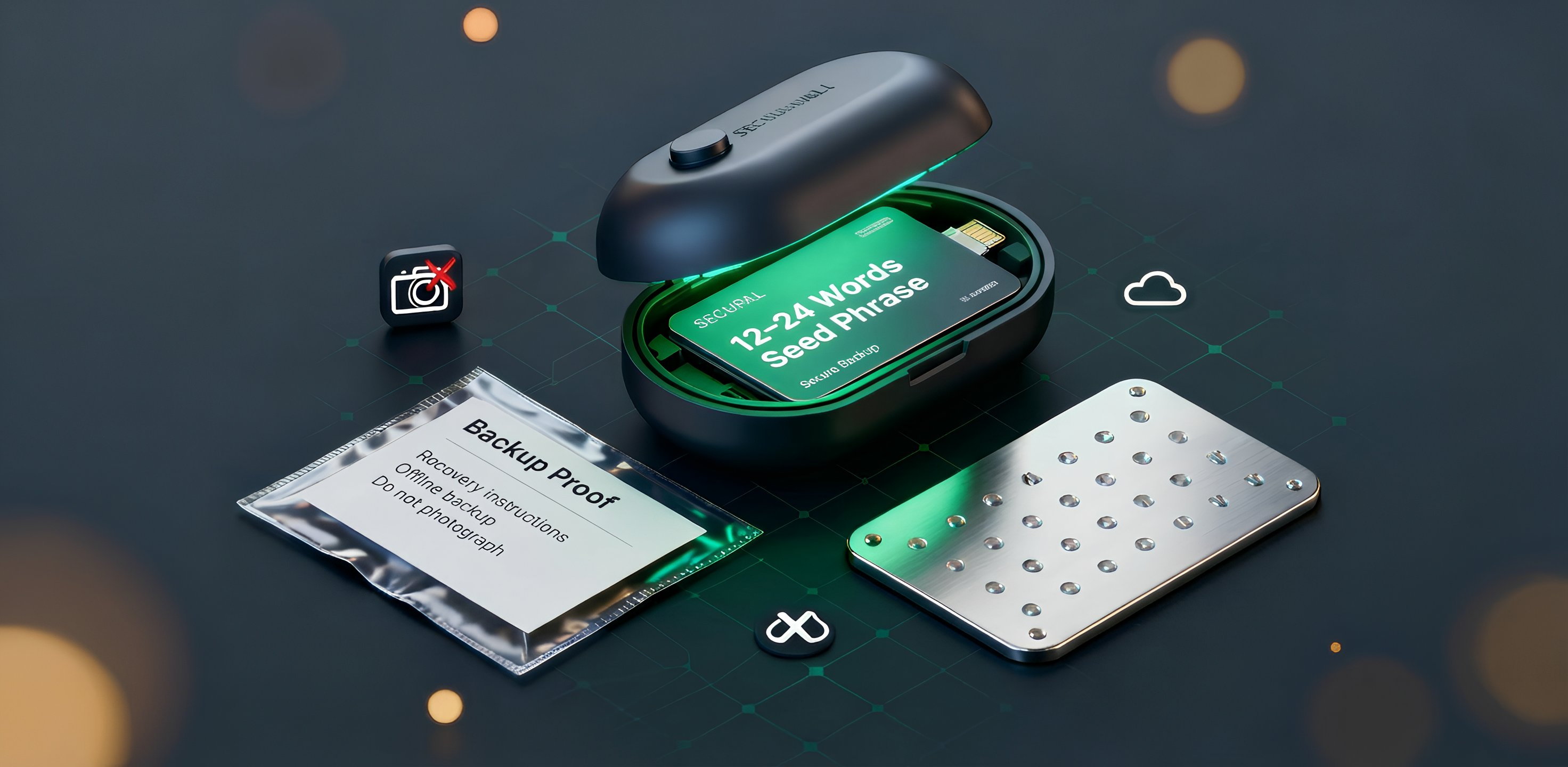
How a seed phrase protects assets
Key idea: control over assets is defined by control over the signature: a transaction is authorized with a private key. As long as the seed phrase remains secret, wallet recovery and transaction signing are available only to the owner.
A seed phrase is the foundation of an HD wallet: private keys and addresses are derived from it deterministically. Sending assets requires a private-key signature; without the seed phrase (or the required private key), a transaction cannot be signed on the owner’s behalf. The main practical risk is not “brute force,” but leakage: phishing, social engineering, and storage mistakes.
A nuance: assets do not “live on a phone.” They are recorded on the blockchain, and the device is an interface. Losing a phone or deleting an app does not mean losing funds: the wallet can be restored on another device by entering the seed phrase.
What a seed phrase consists of and how it’s generated (BIP-39)
What’s inside: a wallet generates cryptographic randomness (entropy) and encodes it as words from a fixed list. This produces a secret format that is convenient to write down and enter.
When a new wallet is created, entropy is generated and converted into a mnemonic under the BIP-39 standard. A checksum is added to the phrase: it helps detect input errors (for example, a wrong word or order), but it does not “restore” the phrase automatically.
Most often, 12 or 24 words are used. Both options provide an enormous search space, so the main risk is leakage — when the phrase is seen, extracted, or stored insecurely.
Entropy: cryptographic randomness from which a seed phrase is produced.
BIP-39: a standard that defines the word list and the mnemonic encoding method.
HD wallet (BIP-32/44): a hierarchical scheme where many private keys and addresses are derived deterministically from one seed.
Important: a seed phrase is not an app password, but the source secret for keys. 12/24 words create a massive search space, but the biggest risks are almost always human: photos in the cloud, entering the seed phrase on a phishing site, storing it in an unencrypted file or notes.
Where a seed phrase appears
A seed phrase is shown when a non-custodial wallet is created and is entered to restore access. A request for a seed phrase outside the recovery flow in a wallet or on the screen of a hardware device is a sign of fraud.
A seed phrase is entered only into a wallet during recovery on a trusted device. Support services, chats, and websites should not request these words.
Seed phrase, private key, and loss of access: what is actually at risk
A private key controls one address, while a seed phrase restores the entire HD wallet. That is why “leakage” and “loss” of a seed phrase are more critical than the compromise of a single key or a device failure.
A private key is the ability to sign transactions for one specific address. A seed phrase is the wallet’s source secret: all private keys and addresses are derived from it deterministically, so it restores the wallet as a whole.
What must never be done with a seed phrase
These mistakes end in leakage or an irreversible loss of access. The basic principle: a seed phrase must not appear in digital form and must not be shared with third parties.
Red flag: a request to enter or send a seed phrase “for verification/support/unlocking” indicates a theft attempt. A seed phrase is entered only into a wallet during recovery on a trusted device.
- Do not photograph it or take screenshots: images can end up in cloud backups and synced galleries.
- Do not store a seed phrase in plain text in files/notes on a PC, phone, or in the cloud.
- Do not enter a seed phrase on “verification/support” websites and do not send it in chat or email.
- Do not “make up” a seed phrase: it must be generated by the wallet from the standard word list (BIP-39), otherwise the secret can be predictable or invalid.
- Do not keep a single paper copy without a backup and protection from water/fire.
Secure storage methods
There is no universal “best” medium: the choice is a balance between durability (water/fire/wear), secrecy (protection from being read), and ease of recovery. A common failure mode is one copy or too many copies without control over locations and access.
Choosing by situation:
Paper (handwritten)
Basic offline backup: the words are written clearly and stored outside digital devices. The main risk is elements and wear.
✅ Pros
❌ Cons
Bottom line: paper works with two separated copies and protection from elements.
Metal (steel/titanium)
Protection from elements: the words are engraved/stamped onto a plate or assembled in a capsule. Metal improves durability, but does not conceal the secret.
✅ Pros
❌ Cons
Bottom line: metal solves fire and water; secrecy is provided only by location and discipline.
“Multi-safe” (multiple identical copies in different places)
Protection against losing one hiding place: 2–3 identical copies are made and spread across locations. Durability improves, but leakage risk also increases.
✅ Pros
❌ Cons
Bottom line: a “multi-safe” improves durability but does not protect against reading. For secrecy, a passphrase or sharding is needed.
Sharding (Shamir’s Secret Sharing, Seed XOR)
No single point of compromise: the secret is split into parts; recovery requires a threshold (for example, 3 of 5). One fragment on its own is useless.
✅ Pros
❌ Cons
Bottom line: protection against theft of one copy at the cost of stricter tracking and recovery tests.
Encrypted backup on microSD (via a hardware wallet)
A convenient offline duplicate: the device saves an encrypted backup to a memory card; recovery requires a compatible device and a password.
✅ Pros
❌ Cons
Bottom line: microSD speeds up recovery; a readable copy (paper/metal) is still required.
Ready storage schemes: choosing by amount and risk
A scheme is not a “medium,” but a set of rules: how many copies, where they are stored, who has access, how often recovery is checked, and what is done during a move or after device loss.
Passphrase: an extra word/phrase on top of the seed phrase. Without the passphrase, the seed phrase will not restore the intended wallet, but the passphrase also becomes a key — it is stored separately and just as securely.
Scheme 1 — Beginner / small amount
Scheme 2 — Medium amount / long-term holding
Scheme 3 — Large amount / protection against theft of one copy
Scheme 4 — Fast recovery is needed
A scheme is not considered reliable without a recovery test. At least once, recovery should be verified using the copies (ideally offline on a “clean” device).
Summary table of storage methods
The comparison follows two axes — medium resilience (water/fire) and protection from reading (what happens if a copy is found). “Recovery convenience” is often higher where risk is higher, unless a passphrase or sharding is used.
| Method | 💧 Water resistance | 🔥 Fire resistance | 🕵️ Protection from reading | ⏳ Longevity | 🧭 Recovery convenience | ⚙️ Complexity | 💵 Cost |
|---|---|---|---|---|---|---|---|
| Paper handwritten |
Low | Low | Low copy found → access |
Low | High easy to read |
Low | Low |
| Metal steel/titanium |
High | High | Low found → readable |
High | High | Low–medium | Medium–high |
| “Multi-safe” multiple copies |
Medium depends on the medium |
Medium depends on the medium |
Low any copy → access |
Medium depends on the medium |
High | Low | Low–medium |
| Sharding Shamir / Seed XOR |
High fragments are separated |
High | High 1 fragment is useless |
Medium depends on the medium |
Medium quorum required |
High | Medium |
| microSD backup encrypted file |
Low medium is vulnerable |
Low medium is vulnerable |
Medium–high depends on the password |
Medium | High on a compatible device |
Medium | Low–medium |
How to read this
“🕵️ Protection from reading”: low — a found copy almost immediately grants access (paper/metal/multi-safe). high — one find is not enough: a quorum of fragments is required (sharding) or an extra condition is required (a strong password for an encrypted backup).
Recommended schemes for a beginner
Three routes: a basic scheme → a recovery test → stronger protection as needed.
1 — Starter
2 — Durability and protection from elements
3 — Protection against theft of one copy (family/team, large amounts)
Change a scheme one parameter at a time. First — a basic scheme and a recovery test, then — a passphrase, sharding, or additional copies.
Ready-made solutions for storing words (3 options)
Below are popular form factors. The choice is based on material and recording method, as well as two criteria: medium resilience (fire/water/mechanical damage) and reading risk with physical access.
Perforated titanium plate
Medium resilience: titanium resists corrosion and high temperatures; the words are marked using a template so the record stays readable for years.
✅ Pros
❌ Cons
Main point: the medium is designed for long-term storage. The risk is unchanged: if the plate is found, the phrase can be read.
Steel capsule with letter tiles (constructor)
A compact format: letters are assembled inside the case; the capsule protects from impacts and moisture and hides contents from casual view, but it does not replace protection from reading.
✅ Pros
❌ Cons
Main point: a compromise between size and durability; a passphrase or sharding is needed for protection from reading.
Steel plate with engraving/stamping
A practical option: cheaper than titanium and often durable enough. The key is engraving depth and quality so the record remains readable years later.
✅ Pros
❌ Cons
Main point: a predictable durable medium; secrecy depends on the hiding place and discipline.
Common beginner mistakes
Top mistakes that are easy to avoid
Backup and verification tips
A backup is reliable only after recovery has been tested. The scheme should be simple and repeatable: copies, locations, verification.
- Write the words down clearly right away and double-check the order without rushing (one wrong word = recovery failure).
- Make at least 2 copies and store them in independent locations (for example, metal + paper).
- Protect media from moisture and damage (container/bag/safe); metal is better for fire resistance.
- Run a test recovery on a “clean” device: minimal software, no suspicious extensions, ideally offline.
- Create a “how to restore” note (which wallet, where to enter the phrase, what to click) — without the seed phrase and without the passphrase.
- Schedule a check every 6–12 months: media integrity, record readability, and instruction freshness.
When to use additional protections
Layers are added as the amount and control requirements grow. First, a basic backup is created and a recovery test is completed using the copies; then the scheme is made more complex.
Passphrase (BIP-39)
When to use: when the “one copy was found” scenario is critical.
Multisig (2 of 3)
When to use: shared ownership or very large amounts.
Geographic separation
When to use: when the “everything in one place” scenario is unacceptable.
Encrypting copies
When to use: when an electronic duplicate is needed (as an add-on).
Any extra protection increases the chance of locking out the owner. Complexity makes sense only after a recovery test and fixed rules (what is enabled and where it is required).
What to do if a seed phrase is lost
If the seed phrase is gone, recovery is impossible. Access is possible only when wallet access remains on one device and a transfer can be sent.
This is prevented only in advance — with backups, a recovery test, and storage discipline.
Questions and answers (FAQ)
Short answers to common questions: 12 vs 24 words, where to store copies, why photos are unsafe, how to test recovery safely, plus passphrases and multisig.
How many words should a seed phrase have — 12 or 24?
Can a seed phrase be made up to make it easier to remember?
Where is it safer to store copies — at home or in a bank safe-deposit box?
Why should a seed phrase never be photographed?
Is it safe to test recovery?
What is a passphrase and why is it used?
When is multisig actually justified?
Is one metal plate/capsule with a seed phrase enough?
Final checklist: the minimum that actually saves access
A quick summary: these points cover the main reasons for losing access — leakage, a single copy, and no recovery verification.
Complex schemes often fail due to human error. First — a recovery test, then — added complexity.