📖 How to Choose a Crypto Exchange in Mexico: Key Factors
Goal of this article: pinpoint the exchanges that are most convenient for people in Mexico. We compare international and local platforms, detail fees, MXN on‑ramp methods via SPEI and OXXO, app quality, and security. By the end, you’ll be able to choose a platform for your goals—from a first BTC purchase to active altcoin trading.
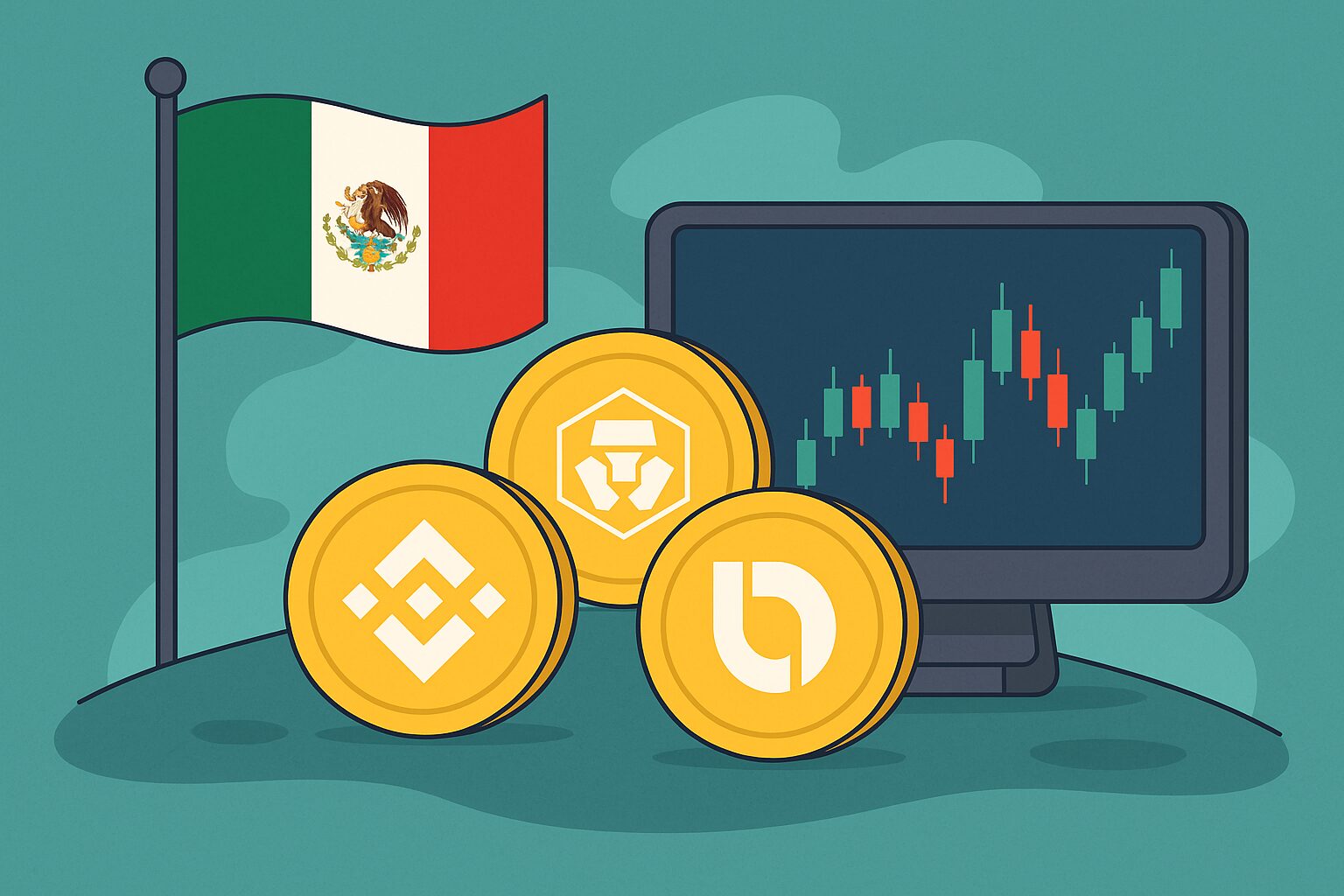
🇲🇽 Local Mexican Crypto Exchanges (MXN, SPEI, OXXO)
Bitso
México
Bitso is Mexico’s largest platform (founded in 2014) with native MXN support and a polished mobile app. It excels at “quick buy/sell” flows and transfers within its ecosystem.
“I topped up pesos via SPEI on Bitso and bought ETH in just a couple of minutes—fast and without extra fees.” — user review from Mexico City
- Who it suits: beginners and anyone who wants direct MXN ⇄ crypto without detours (SPEI, cash via OXXO/7‑Eleven).
✅ Pros
- Direct MXN on/off‑ramp: SPEI transfers; cash top‑ups via OXXO/7‑Eleven (where available).
- Regulation: operates under Mexico’s Fintech Law with KYC/AML procedures.
- Convenience: Spanish interface; Bitso Transfer for instant in‑ecosystem transfers.
- Custody: emphasis on segregating client funds and operational security.
❌ Cons
- Modest catalog: roughly 50+ core assets; rare altcoins are usually missing.
- Higher fees vs. global CEX: for small volumes, the effective rate is noticeably above 0.1%.
- No advanced trading: no derivatives or margin; geared toward buy‑and‑hold.
 3.8 based on 1,200 ratings
Volabit
México
Volabit is one of Mexico’s earliest services (since 2014), focused on basic MXN “buy/sell” transactions. It stands out for an ultra‑simple interface.
“Volabit was my first exchange: I sent MXN via SPEI and bought bitcoin without complex forms or extra costs.” — beginner from Mexico City
- Who it suits: newcomers who want to buy BTC or USDC in MXN with minimal steps.
✅ Pros
- Direct MXN: deposits and withdrawals via SPEI.
- Minimal friction: clean web interface—convenient for one‑off BTC/USDC buys.
- Local focus: tailored to Mexico’s market and basic needs.
❌ Cons
- Very few coins: only four core assets (BTC, LTC, XRP, USDC).
- No mobile app: web only.
- Low liquidity: large orders and spreads can be noticeable.
3.5 based on 800 ratingsTauros
México
Tauros is a local “crypto neobank”: an MXN and crypto wallet, buy/sell flows, and an everyday spending tool (a debit card linked to your account).
“Tauros is straightforward: it feels like a normal bank—just with crypto. I moved MXN, got BTC, and can spend with Visa—even my mom figured it out.” — customer review
- Who it suits: people who want to spend crypto in daily life (via the card) and quickly swap MXN ⇄ crypto without complex screens.
✅ Pros
- Deep MXN integration: top up in pesos; quick MXN ⇄ USDT/BTC switching.
- Payments out of the box: the debit card lets you cover everyday expenses from the wallet.
- Simple for beginners: “wallet + card” logic, Spanish interface, low barrier to entry.
❌ Cons
- Limited trading: fewer tools and markets than global CEX.
- Small coin catalog: rare altcoins typically aren’t listed.
- Fees and limits: depend on the scenario (conversion, withdrawals, card payments); review terms in advance.
3.6 based on 500 ratingsTruBit Pro
México
TruBit Pro (formerly Mexo) is a local exchange with a broader coin list than “classic” Mexican on‑ramps. Its ecosystem includes the MMXN stablecoin, closely pegged to the peso.
“Through TruBit Pro I deposited pesos and immediately bought USDT on P2P—SPEI settlement took under five minutes with no extra fees.” — user from Monterrey
✅ Pros
- Broader selection: more assets than Bitso or Volabit—easier portfolio diversification.
- Spot and P2P: buy for MXN via card or transfers; peer‑to‑peer deals.
- Localization: fully Spanish interface tailored to Mexico.
- MMXN: peso‑pegged stablecoin that simplifies settlement and MXN‑denominated storage.
❌ Cons
- Lower liquidity vs. global CEX: large orders can move the price.
- Smaller ecosystem: fewer products than on top global exchanges.
- KYC and limits: full verification required for MXN use and withdrawals.
3.7 based on 900 ratings🧾 Takeaways on Mexico’s Local Exchanges
- Choose a local exchange if your priority is fast, transparent MXN on/off‑ramps with no workarounds.
- Combine local + global when you want both convenient fiat and a wide range of altcoins/tools.
- Keep reserves in a wallet and only a working balance on exchange for trading and payments.
| 🏦 Exchange | 💰 Coins | 💳 MXN Deposits | 📱 App | 🛡️ Highlights |
|---|---|---|---|---|
| Bitso | ≈50+ BTC, ETH, USDT, etc. | SPEI, OXXO/7‑Eleven cash and transfers | iOS, Android | Fintech Law compliance Bitso Transfer |
| Volabit | 4 BTC, LTC, XRP, USDC | SPEI | ❌ web only | Simple exchange low liquidity |
| Tauros | ≈10+ major coins | SPEI, card fast MXN ⇄ crypto | iOS, Android | Debit card wallet + payments |
| TruBit Pro | ≈70+ incl. MMXN | SPEI, card, P2P | iOS, Android | P2P platform local stablecoin |
🌍 Global CEX Exchanges Available in Mexico
- Broad asset selection: from BTC/ETH to rare altcoins.
- High liquidity: tight spreads and deep order books.
- Trader tools: futures, copy trading, NFTs, and Earn products.
- Localization: Spanish interface; deposits via card or P2P.
| 🏅 Exchange | 💰 Cryptocurrencies | 💵 Fees (spot) | 💳 Deposit Methods | 🔥 Highlights |
|---|---|---|---|---|
| Bybit | 1700+ including top‑20 coins | 0.1% (maker/taker) | Bank transfer (SPEI); Visa/Mastercard, P2P | Derivatives up to 100×; copy trading, AI analytics |
| MEXC | 2000+ altcoins, DeFi tokens | 0%–0.02% on spot (promos) | Visa/Mastercard; bank transfer | Leverage up to 300×; low fees, Launchpad |
| Binance | 350+ all top assets | 0.1% | Bank transfer; cards, P2P | Earn products; NFT, loans, Launchpad |
| Bitget | 800+ wide range of alts | 0.1% | Visa/Mastercard; crypto, P2P | Copy trading; futures up to 125× |
| Coinbase | 250+ major cryptoassets | 0.4%/0.6% maker/taker | Card, bank transfer, PayPal | Simple interface; U.S. regulation |
Bybit
Global
Bybit is one of the most popular global platforms in Mexico: low fees, a wide coin selection, and MXN funding via cards and P2P.
“Bybit just works: I on‑ramp MXN via P2P, fees are minimal, and there’s a huge choice of altcoins. For active trading there are futures and bots; if I want something more passive—copy trading and Earn. It covers everything in one place.” — composite feedback from Mexican users
- Who it suits: active traders seeking leveraged futures, copy trading, and rare altcoins.
✅ Pros
- Low trading fees (spot 0.1%, futures from 0.02%).
- ≈1,700+ cryptocurrencies on spot.
- Up to 100× leverage and deep liquidity.
- Advanced orders (TWAP, Iceberg) and Web3 services.
- Copy trading, trading bots, and TradeGPT AI analytics.
- Spanish‑language support and 24/7 customer service.
❌ Cons
- Regulatory uncertainty in the U.S. and EU.
- Interface can be complex for beginners.
- High risk due to volatility and leverage.
3.9 based on 6,400 ratingsBingX
Global
BingX is a global exchange with a strong social angle: copy trading, intuitive spot/futures, and a broad altcoin lineup. It performs well across Latin America.
“On BingX I combine everything in one place: on‑ramp MXN via P2P, copy experienced traders, and trade futures when needed—the interface is simple, fees are moderate, and there are plenty of alts.” — composite feedback from Mexican users
- Who it suits: those who want to start with copy trading and gradually move to independent spot/futures trading.
✅ Pros
- Social trading and a robust copy‑trading marketplace.
- Broad coin catalog and derivatives (spot/futures, isolated/cross margin).
- MXN via P2P and card purchases; capable mobile apps.
- Moderate fees and promos for active traders.
- Simple interface for beginners + enough depth for advanced users.
❌ Cons
- Not all fiat methods are available everywhere; P2P is often the primary MXN path.
- Some new listings carry elevated risk—do your own research.
- Full KYC is required for fiat features.
3.7 ~4,500 ratingsBinance México
Global / MX
Binance México is a global crypto platform with local support: convenient MXN on‑ramping via P2P and cards, a wide selection of coins, and a full product suite (spot, futures, Earn, NFT).
“Binance México works as a hub for me: I bring in MXN via P2P, trade hundreds of coins with high volumes, join Launchpad, and withdraw back to my bank account.” — composite feedback from Mexico City users
- Who it suits: users who want to combine local fiat convenience (MXN) with the advanced tools and liquidity of a global CEX.
✅ Pros
- Global liquidity and deep markets.
- 350+ cryptocurrencies and a complete product stack: spot, futures, NFT, Earn.
- Low fees (0.1% spot, discounts with BNB).
- MXN support via P2P and cards in local mode.
- Local registration via Bmex Techfin aligned with domestic requirements.
❌ Cons
- The interface can be complex for beginners due to the breadth of features.
- Not all MXN “deposit/withdraw” methods are direct—often via P2P or partner gateways.
- Regulatory constraints and requirements may change.
2.1 based on ~28,000 ratingsBitget
Global
Bitget is an international exchange (100+ countries) known for a clean interface and support for 800+ cryptocurrencies. It fits both beginners and experienced traders, especially thanks to copy trading.
“Bitget is handy: the UI is simple, I mirror top traders via copy trading, and I can trade futures with leverage when I want—all on one platform.” — composite user feedback
- Who it suits: those who want to combine learning and practice: beginners through a demo account and copy trading; experienced users via futures and a wide altcoin list.
✅ Pros
- 800+ cryptocurrencies listed.
- Transparent fees (spot 0.1%).
- Simple interface, demo account, and copy trading.
- Support for multiple fiat currencies (EUR, USD, RUB, etc.).
- 24/7 support (chat and email).
- Protection Fund for added security.
❌ Cons
- Unavailable to U.S. users.
- Missing some advanced order types (e.g., TWAP).
- Mandatory KYC for new accounts.
3.0 based on 2,300 ratingsCoinbase
Global
Coinbase is one of the most reputable exchanges: a U.S. public company with a strong compliance culture and an extremely simple interface. An excellent choice for a first crypto purchase.
“Coinbase is the easiest on‑ramp: a couple of taps in the app and the trade is done, with protections and compliance comparable to a bank.” — composite user feedback
- Who it suits: beginners and investors who value simplicity, regulatory clarity, and strong protections—even at higher fees.
✅ Pros
- Ideal for starting out: a “couple of taps” interface.
- Regulated and licensed in the U.S./EU.
- High security: cold storage, insurance arrangements, 2FA.
- Multiple fiat methods: cards, bank transfers, PayPal (in supported regions).
- Web3 ecosystem: Coinbase Wallet and dApp integrations.
❌ Cons
- Fees are noticeably higher than on many Asian CEX.
- Fewer advanced trader tools.
- Liquidity and selection trail Binance/Bybit/OKX.
- No direct MXN on‑ramp (use a card or crypto deposits).
4.0 based on ~19,000 ratingsMEXC
Global
MEXC is known for market‑low fees (often 0% for makers) and one of the widest altcoin catalogs. It’s considered a haven for hunters of new tokens and minimal costs.
“In Mexico, MEXC is appreciated for its combo: thousands of altcoins, near‑zero fees, and MXN deposits via P2P in minutes. You can find rare tokens, trade with leverage, and avoid overpaying on fees.” — composite feedback from Mexican traders
- Who it suits: active day traders and altcoin hunters willing to take risk in exchange for low fees and early‑stage projects.
✅ Pros
- Some of the lowest fees on the market (often 0% for makers).
- 2,000+ cryptocurrencies; huge altcoin selection.
- Futures with leverage up to 300× and high liquidity.
- 24/7 customer support.
- Frequent listings of new tokens.
❌ Cons
- Unavailable to U.S. users.
- New tokens carry elevated risk (scam projects do occur).
- Mandatory KYC may be introduced or required.
2.0 based on 1,100 ratings🌍 Takeaways on Global Exchanges in Mexico
GlobalThese platforms provide a wide coin selection and advanced tools, and they also support MXN on‑ramping via SPEI, cards, or P2P services.
| 🌍 Exchange | 💰 # of Coins | 💲 Fees | 📥 MXN Deposits | 🛡️ Highlights |
|---|---|---|---|---|
| Bybit | ≈400+ | 0.1% spot 0.01% maker (derivatives) | ✔ SPEI card, P2P | Popular with derivatives traders |
| BingX | ≈600+ | 0.1% spot 0.02% derivatives | ✔ P2P card | Copy trading and LATAM localization |
| Binance México | ≈350+ | 0.1% spot discounts with BNB | ✔ SPEI card, P2P | Local version of Binance with MXN support |
| Bitget | ≈500+ | 0.1% spot 0.02% derivatives | ✔ P2P card | Strong focus on copy trading |
| Coinbase | ≈250 | ~0.5%+ up to 4% by card | ✖ none direct card/crypto only | Public company, U.S. license |
| MEXC | ≈1,600+ | 0% spot 0.02% derivatives | ✔ P2P card (via partners) | Huge selection of tokens and alts |
🧾 Final Takeaways on Crypto Exchanges in Mexico
Let’s bring together the strengths and limitations of global and local platforms so it’s easier to pick what fits you.
Mexico’s crypto market today is served by two types of platforms. Global exchanges—such as Bybit, MEXC, or Coinbase—offer access to hundreds of assets, derivatives, and innovative products. They’re convenient for active trading and long‑term investing, though fees and KYC requirements can be stricter. Local services, like Bitso, focus on MXN: fast deposits via SPEI or cash at OXXO, but with a more limited lineup of coins and features. So the choice depends on your goals. For first steps, simplicity and strong protection matter most; for experienced users—low costs and liquidity; and for those who want the most convenient peso on/off‑ramp, local players make the most sense.Main point: decide on your priority. Need maximum liquidity and tools? Choose Bybit or MEXC. Value simplicity and regulatory clarity? Go with Coinbase. Want the smoothest MXN on/off‑ramp? Bitso is a sensible pick. Ideally, combine both: a global exchange for trading and a local one for pesos.
❓ Questions & Answers (FAQ)
Is cryptocurrency legal and regulated in Mexico?
Are cryptocurrencies taxed in Mexico?
How can I buy cryptocurrency in Mexico?
How should I store crypto safely after buying?
- Trust Wallet: a free mobile wallet supporting thousands of coins and DeFi.
- MetaMask: a wallet for Ethereum and Web3; works with ERC‑20 tokens and dApps.
- Ledger Nano X: a hardware wallet for securing BTC, ETH, and other assets.
What fees should I expect on crypto exchanges in Mexico?
Do I need to pass KYC on Mexican exchanges?
Which MXN transfer methods are supported?
📖 How to Choose a Crypto Exchange in Mexico: Key Factors
Goal of this article: pinpoint the exchanges that are most convenient for people in Mexico. We compare international and local platforms, detail fees, MXN on‑ramp methods via SPEI and OXXO, app quality, and security. By the end, you’ll be able to choose a platform for your goals—from a first BTC purchase to active altcoin trading.
🇲🇽 Local Mexican Crypto Exchanges (MXN, SPEI, OXXO)
Bitso
MéxicoBitso is Mexico’s largest platform (founded in 2014) with native MXN support and a polished mobile app. It excels at “quick buy/sell” flows and transfers within its ecosystem.
“I topped up pesos via SPEI on Bitso and bought ETH in just a couple of minutes—fast and without extra fees.” — user review from Mexico City
- Who it suits: beginners and anyone who wants direct MXN ⇄ crypto without detours (SPEI, cash via OXXO/7‑Eleven).
✅ Pros
- Direct MXN on/off‑ramp: SPEI transfers; cash top‑ups via OXXO/7‑Eleven (where available).
- Regulation: operates under Mexico’s Fintech Law with KYC/AML procedures.
- Convenience: Spanish interface; Bitso Transfer for instant in‑ecosystem transfers.
- Custody: emphasis on segregating client funds and operational security.
❌ Cons
- Modest catalog: roughly 50+ core assets; rare altcoins are usually missing.
- Higher fees vs. global CEX: for small volumes, the effective rate is noticeably above 0.1%.
- No advanced trading: no derivatives or margin; geared toward buy‑and‑hold.
3.8 based on 1,200 ratingsVolabit
MéxicoVolabit is one of Mexico’s earliest services (since 2014), focused on basic MXN “buy/sell” transactions. It stands out for an ultra‑simple interface.
“Volabit was my first exchange: I sent MXN via SPEI and bought bitcoin without complex forms or extra costs.” — beginner from Mexico City
- Who it suits: newcomers who want to buy BTC or USDC in MXN with minimal steps.
✅ Pros
- Direct MXN: deposits and withdrawals via SPEI.
- Minimal friction: clean web interface—convenient for one‑off BTC/USDC buys.
- Local focus: tailored to Mexico’s market and basic needs.
❌ Cons
- Very few coins: only four core assets (BTC, LTC, XRP, USDC).
- No mobile app: web only.
- Low liquidity: large orders and spreads can be noticeable.
3.5 based on 800 ratingsTauros
MéxicoTauros is a local “crypto neobank”: an MXN and crypto wallet, buy/sell flows, and an everyday spending tool (a debit card linked to your account).
“Tauros is straightforward: it feels like a normal bank—just with crypto. I moved MXN, got BTC, and can spend with Visa—even my mom figured it out.” — customer review
- Who it suits: people who want to spend crypto in daily life (via the card) and quickly swap MXN ⇄ crypto without complex screens.
✅ Pros
- Deep MXN integration: top up in pesos; quick MXN ⇄ USDT/BTC switching.
- Payments out of the box: the debit card lets you cover everyday expenses from the wallet.
- Simple for beginners: “wallet + card” logic, Spanish interface, low barrier to entry.
❌ Cons
- Limited trading: fewer tools and markets than global CEX.
- Small coin catalog: rare altcoins typically aren’t listed.
- Fees and limits: depend on the scenario (conversion, withdrawals, card payments); review terms in advance.
3.6 based on 500 ratingsTruBit Pro
MéxicoTruBit Pro (formerly Mexo) is a local exchange with a broader coin list than “classic” Mexican on‑ramps. Its ecosystem includes the MMXN stablecoin, closely pegged to the peso.
“Through TruBit Pro I deposited pesos and immediately bought USDT on P2P—SPEI settlement took under five minutes with no extra fees.” — user from Monterrey
✅ Pros
- Broader selection: more assets than Bitso or Volabit—easier portfolio diversification.
- Spot and P2P: buy for MXN via card or transfers; peer‑to‑peer deals.
- Localization: fully Spanish interface tailored to Mexico.
- MMXN: peso‑pegged stablecoin that simplifies settlement and MXN‑denominated storage.
❌ Cons
- Lower liquidity vs. global CEX: large orders can move the price.
- Smaller ecosystem: fewer products than on top global exchanges.
- KYC and limits: full verification required for MXN use and withdrawals.
3.7 based on 900 ratings🧾 Takeaways on Mexico’s Local Exchanges
- Choose a local exchange if your priority is fast, transparent MXN on/off‑ramps with no workarounds.
- Combine local + global when you want both convenient fiat and a wide range of altcoins/tools.
- Keep reserves in a wallet and only a working balance on exchange for trading and payments.
🌍 Global CEX Exchanges Available in Mexico
- Broad asset selection: from BTC/ETH to rare altcoins.
- High liquidity: tight spreads and deep order books.
- Trader tools: futures, copy trading, NFTs, and Earn products.
- Localization: Spanish interface; deposits via card or P2P.
🧾 Final Takeaways on Crypto Exchanges in Mexico
Let’s bring together the strengths and limitations of global and local platforms so it’s easier to pick what fits you.
Mexico’s crypto market today is served by two types of platforms. Global exchanges—such as Bybit, MEXC, or Coinbase—offer access to hundreds of assets, derivatives, and innovative products. They’re convenient for active trading and long‑term investing, though fees and KYC requirements can be stricter. Local services, like Bitso, focus on MXN: fast deposits via SPEI or cash at OXXO, but with a more limited lineup of coins and features. So the choice depends on your goals. For first steps, simplicity and strong protection matter most; for experienced users—low costs and liquidity; and for those who want the most convenient peso on/off‑ramp, local players make the most sense.Main point: decide on your priority. Need maximum liquidity and tools? Choose Bybit or MEXC. Value simplicity and regulatory clarity? Go with Coinbase. Want the smoothest MXN on/off‑ramp? Bitso is a sensible pick. Ideally, combine both: a global exchange for trading and a local one for pesos.
❓ Questions & Answers (FAQ)
Is cryptocurrency legal and regulated in Mexico?
Are cryptocurrencies taxed in Mexico?
How can I buy cryptocurrency in Mexico?
How should I store crypto safely after buying?
- Trust Wallet: a free mobile wallet supporting thousands of coins and DeFi.
- MetaMask: a wallet for Ethereum and Web3; works with ERC‑20 tokens and dApps.
- Ledger Nano X: a hardware wallet for securing BTC, ETH, and other assets.