If the liquidity pool — a smart contract on the blockchain that holds the reserves of a trading pair and executes swaps — loses the stablecoin or base coin from the pair, swapping the token back into that asset stops working at the expected price.
The reserve can disappear in one transaction or shrink in parts. In both cases, less of the paired asset remains available for the reverse swap.
Purpose of the material: to show why a reduction in pool reserves makes selling a token on a decentralized exchange (DEX) unprofitable or causes the transaction to revert.
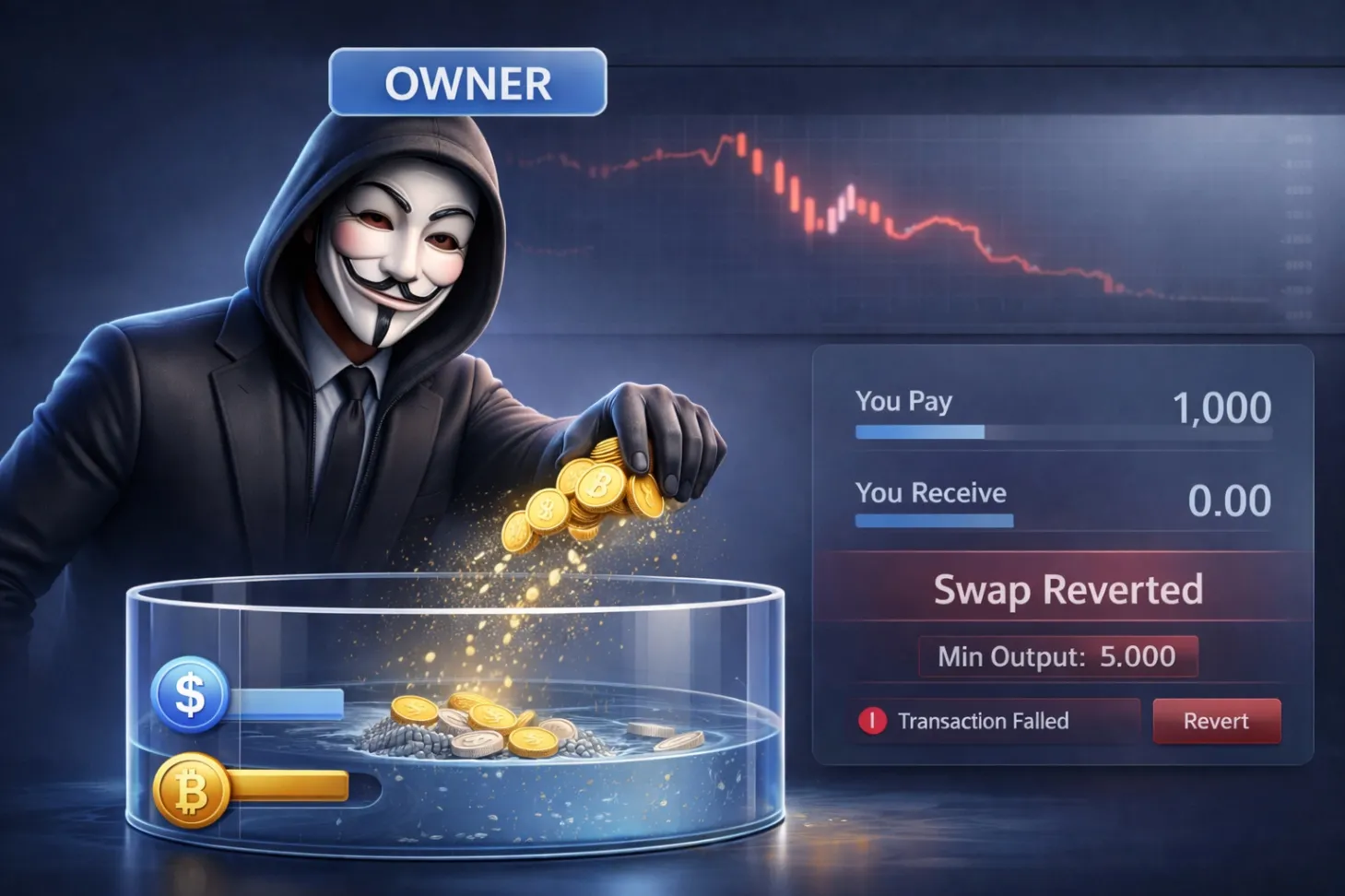
When there is little or no paired asset left in the pool, the smart contract returns an almost zero swap result or reverts the transaction if the calculated output is below the minimum output threshold (min output).
🧩 What changes in the pool after the paired asset is removed
On a DEX, the swap is executed by the pool smart contract. It calculates the swap result using the current reserves of the pair.
If the paired asset is removed from the pool (a stablecoin or base coin), the reserve used for the reverse swap decreases. The contract has no sufficient paired asset left to issue when the token is sold.
The less paired asset remains in the pool, the smaller the calculated output becomes during a sale (sell), and the more often the swap becomes unprofitable or fails.
⚙️ Why selling becomes unprofitable or non-executable
In pools with automated pricing, the price depends on the reserve ratio. When the paired asset is scarce, even a small sell moves the price more sharply, and slippage — the difference between the expected and calculated swap result — increases.
With an almost empty reserve, the swap calculation produces a very small output. If min output is set, the transaction reverts because the calculated result is below the threshold.
- Sell on a DEX is executed from the pool reserves inside the smart contract.
- After the paired asset is removed, the reserve for the reverse swap drops sharply.
- The calculated output during sell becomes very small because of the reserve ratio and slippage.
- If the calculated output is below min output, the contract reverts the transaction (revert), and the swap is not executed.
“Unsellability” on a DEX appears when almost no paired asset remains in the pool smart contract for the reverse swap.