ℹ️ General Overview of the Bitget Crypto Exchange
Bitget is a centralized crypto exchange: the platform records balances and trades, while access to funds is managed through the Bitget account. The platform has operated since 2018. Its services include spot trading, margin trading, futures, Copy Trading, trading bots, Earn, P2P, on-chain deposits and withdrawals, as well as integration with Bitget Wallet and Bitget Wallet Card.
This review covers the main sections of the Bitget interface: Spot, Margin, Futures, Copy Trading, Bots, Earn, P2P, deposits and withdrawals, Bitget Wallet, Bitget Wallet Card, fees, and security settings. Each section explains how the interface works, along with typical costs and key usage risks.
Bitget Profile and Core Features
- Platform type — a centralized exchange with separate Web3 services (tools for working with blockchain applications and on-chain assets) through Bitget Wallet and Bitget Wallet Card
- Product range — Spot and Futures markets are available in market lists and in the app trading terminal
- Derivatives — perpetual and delivery futures; available leverage depends on the pair and position size
- Copy Trading — copy selected trader positions in spot and futures; key metrics are shown on the trader card
- Services — Earn, P2P, and network selection for on-chain deposits and on-chain withdrawals
- BGB token — fee discounts and access to Launchpad/Launchpool programs (mechanisms for distributing and launching new tokens) and selected Earn products
Jurisdiction and KYC Requirements
Bitget states that the company is registered in the Seychelles and serves users across multiple markets. The availability of P2P, derivatives, promotions, and limits depends on the account jurisdiction and KYC status (identity verification in the exchange profile).
🔥 Bitget reviews and the official exchange page
Explore the review breakdown and visit the official exchange page
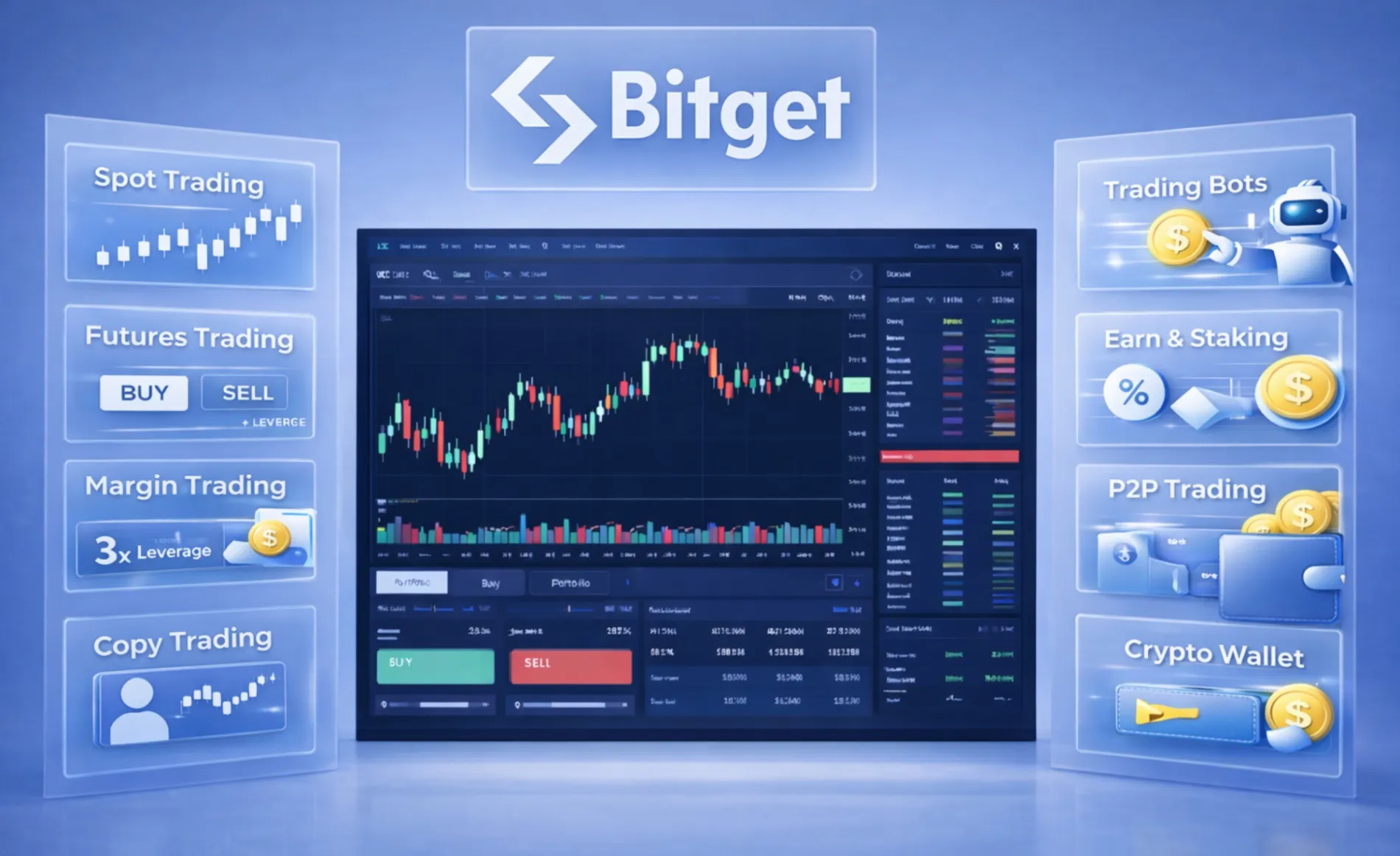
💠 Trading Modes and Market Access on Bitget
Spot Trading on Bitget
Bitget spot market — buying and selling coins without leverage. Total trading costs are shaped by the order execution price, trading fee, and the spread in the order book for the selected pair.
The Bitget Spot Markets list displays trading pairs, including BTC/USDT and ETH/USDT, as well as pairs against USDT (a stablecoin pegged to the US dollar) and selected base assets. The terminal includes a chart, order book, and market depth.
- Order types — market, limit, stop-limit/stop-market, and OCO orders (a take-profit and stop-loss combination where execution of one order cancels the other)
- Convert mode — exchange one coin for another without using the order book; the Convert rate is set by the service’s internal pricing and may differ from the order book price for the same pair
- Favorites lists — a separate pair list for tracking spread, volume, and price movement
A market order is executed against limit orders in the order book, starting from the best available prices. If there is not enough volume at the best price, the remaining amount is executed at the next level. Execution continues until the order is fully filled.
On a pair with a thin order book, the final price is worse than the top line of the book: a buy executes at a higher price, while a sell executes at a lower one. A limit order is placed at a specified price. It is executed only if matching orders exist at that level and does not take volume from more expensive levels.
On pairs with a deep order book, spread and slippage are usually lower. For scheduled recurring purchases, DCA is used (regular buying with a fixed amount). After purchase, coins can be placed into Earn or withdrawn to an external wallet.
Margin Trading on Bitget
Margin trading on Bitget — spot trades made with borrowed exchange funds. A position is opened against collateral: the user deposits margin, takes a loan, and trades a volume larger than their own balance. Risk is tied to loan interest and forced closure when the margin ratio falls to the liquidation threshold.
Margin trading is available for selected spot pairs. Opening a position includes borrowing crypto or stablecoins against pledged assets and trading with leverage up to 5×, including short exposure through borrowing the base asset.
- Cross margin — shared collateral across the entire margin account; a loss on one position reduces the margin ratio for the whole account
- Isolated margin — separate collateral for a specific position; risk is limited to the amount allocated to that position
- Interest and margin ratio — interest accrues on the borrowed amount, while the margin ratio shows the remaining buffer before liquidation
The cost of a margin position consists of the trading fee, spread, and loan interest accrued during the holding period.
Futures and Perpetual Contracts on Bitget
Bitget futures — trades through a contract linked to the asset price without buying the coin on spot. Risk is determined by leverage, margin type (cross/isolated), and the distance to the liquidation price shown in the terminal.
Bitget offers perpetual and delivery contracts on BTC, ETH, and a range of altcoins. Margin can be posted in USDT/USDC (stablecoins pegged to the US dollar) or in the contract’s base coin (coin-margined, or COIN contracts): with USDT margin, PnL (profit and loss on the position) is accounted for in the stablecoin, while with coin-margined contracts it is accounted for in the base coin.
- Leverage up to 125× — the maximum leverage is available on selected liquid contracts and is limited by position size
- Cross and isolated margin — cross uses shared futures account collateral, while isolated assigns collateral to a specific contract
- Orders — limit and market orders, stop orders, take-profit/stop-loss, trigger orders, and reduce-only mode
Perpetual contracts have no expiry date: a position can be held without a fixed term. The price stays close to the spot market through funding payments (periodic payments between long positions, which bet on price growth, and short positions, which bet on price decline).
Delivery futures have a fixed expiry date. On expiry day, the contract closes at the settlement price and the profit or loss is realized. These contracts are used for hedging to a specific date and for calendar strategies across different maturities.
The terminal shows the liquidation price and current funding for the contract. When a position is held for days or weeks, funding costs and a tight liquidation price increase total costs and the risk of forced closure.
The exchange closes a position by force when losses and margin reach a threshold at which the collateral no longer covers the position obligations. High leverage shortens the distance to the liquidation price, so the position is closed after a smaller move against it.
Copy Trading on Bitget
Bitget Copy Trading — a mechanism for copying the trades of a selected trader in spot and futures. Copying risk depends on leverage, position size, and the drawdown of the strategy selected in the interface.
Copy Trading allows users to subscribe to a trader and automatically replicate their trades. The trader card displays return by period, maximum drawdown, follower count, and trade history.
- Trader card metrics — return over 30–90 days, maximum drawdown, track record length, and whether the equity curve shows large one-off spikes
- Strategy risk profile — high returns over a short track record with constant use of high leverage mean the outcome depends on one type of price movement and carries elevated risk when market conditions change
- Follower limits — amount per trade, leverage cap, daily loss cap, and maximum number of positions define the upper risk limit of copying
A follower can stop copying, change limits, and close positions manually. Using a separate small deposit isolates the risk of one strategy from the rest of the balance.
Copy Trading replicates the trades of the selected trader. With the same leverage and position size, the follower takes a comparable loss when the market moves against open positions.
Bitget Trading Bots
Bitget bots — tools for automatically placing orders based on predefined parameters such as grids, DCA, and signals. Risk depends on strategy settings and market behavior.
Bitget offers ready-made automation scenarios without coding: the user sets parameters, and the bot then executes trades according to the chosen logic.
- Grid bots — place a grid of limit orders within a range; if the price moves outside the range, an accumulated position is formed
- DCA bots — buy an asset on a schedule or under a condition; the result depends on the holding horizon and subsequent price movement
- Signal bots — open and close positions based on predefined conditions or signals; a series of losing entries is possible when rules are poorly configured
The scale of bot risk is defined by parameters such as position size, trade frequency, and loss limits. With the same logic, different settings can produce very different outcomes.
💰 Bitget Earn and Passive Income Options
Bitget Earn — placing assets on the exchange, where yield accrues under the product terms such as deposits, staking, or structured products. The risk of an Earn product depends on the lock-up period and the asset in which settlement is made.
Within Bitget Earn, funds remain on the exchange and are used across deposit, staking, and structured product formats. Yield accrual is determined by the product terms and may change due to market conditions and product demand.
- Flexible savings — the rate changes, and withdrawals are available at any time
- Fixed-term deposits — the rate is higher, while funds are locked for the period defined by the product terms
- Staking — reward accrual on Proof-of-Stake network coins through the exchange interface
- Dual Investment — a product with a fixed settlement date where the payout is made either in a stablecoin or in the base cryptocurrency, depending on the price of the base asset on the settlement date
Funds in Earn are usually allocated by liquidity needs and lock-up terms. Flexible products suit funds that need quick access. Fixed-term products are used for capital set aside for a defined period. Dual Investment is typically used for a portion of capital with settlement risk across different assets depending on a price condition.
Funds in Earn remain on the balance of a centralized exchange, so exchange infrastructure risk and the risk of losing account access still apply. The lock-up period, payout currency, and early redemption rules are defined by the product terms.
💳 P2P Transfers and Deposits/Withdrawals on Bitget
Deposits and withdrawals on Bitget include on-chain deposits and on-chain withdrawals, as well as P2P transactions for exchanging fiat for cryptocurrency and back. Risk is tied to network selection, address accuracy, and the presence of a memo/tag where required.
On-chain Deposits and Withdrawals
Funding with cryptocurrency is done through the Deposit section by selecting the coin and network. One token is often available across multiple networks, and the network must match on both Bitget and the sending wallet side. In the Withdraw section, the fee and minimum withdrawal amount for the selected network are shown.
- Network match — the deposit network on Bitget and the sending network in the wallet must match
- Minimum amounts — a transfer below the minimum deposit or withdrawal threshold may not be processed automatically
- Memo/tag — for some coins, a memo/tag is mandatory; sending without a memo/tag makes transfer identification more difficult
Standard transfer check: a small test transfer helps verify the network, address, and memo/tag before sending a larger amount of funds.
P2P Marketplace
P2P allows users to buy and sell cryptocurrency for fiat with other users. During a P2P order, Bitget locks the seller’s cryptocurrency and releases it to the buyer after payment is confirmed within the order.
- Final exchange rate — depends on the listing and payment method, not on the exchange order book price
- Filters — listings are filtered by currency and payment method
- Counterparty statistics — number of trades, completion rate, and reviews help assess transaction risk
In disputed situations, support relies on order statuses and the chat inside the transaction. Evidence is formed within the P2P interface, not through external channels.
Sending money outside the order and changing payment details after the trade starts leave the transaction without proof inside the order and increase the risk of fund loss in a dispute.
🧩 Additional Bitget Services: Web3 Wallet and Crypto Card
Bitget Wallet is a self-custody wallet (the keys are controlled by the seed phrase, the wallet recovery phrase), while the Bitget balance is custodial storage (operations are processed inside the exchange account). Bitget Wallet Card spends funds from the Bitget Wallet balance according to the card and conversion rules.
Bitget Wallet
Bitget Wallet, formerly BitKeep, is a multi-chain non-custodial wallet. Access to funds is controlled by the owner’s seed phrase and private keys. The wallet supports interaction with dApps (decentralized applications) and storage of assets separately from the exchange account.
- Difference from the exchange — on the exchange, operations are controlled by the Bitget account; in the wallet, operations are signed with the owner’s private keys
- Use cases — interacting with dApps and storing part of a portfolio outside the exchange balance
- Risks — phishing, malicious smart contracts, and token approval permissions (permissions that allow a smart contract to spend tokens)
Losses in self-custody are more often linked to phishing, signing transactions for malicious contracts, and granting broad approval permissions with large spending limits. In these cases, risk depends on the wallet owner’s operational security.
Bitget Wallet Card
Bitget Wallet Card is a debit crypto card linked to Bitget Wallet. When paying, the card converts stablecoins into fiat under the card provider’s terms and deducts funds from the wallet balance.
- Use cases — fiat spending while keeping a budget in stablecoins
- Terms check — supported markets, limits, fees, conversion rates, and promotion rules in the card dashboard
- Source of deduction — the card deducts funds from Bitget Wallet, not from the Bitget exchange balance
Card transactions may be subject to jurisdiction-specific requirements on limits, reporting, and taxes. Card availability depends on issuance terms and the rules of the market where it is used.
💸 Bitget Fees for Spot, Futures, and Margin Trading
Bitget fees include trading fees, order book spread, perpetual contract funding, margin loan interest, and network fees on withdrawals. Total costs depend on the order type (maker/taker), pair liquidity, and position holding time.
When calculating trading costs, users account for the entry fee, exit fee, spread, and slippage. For futures and margin, funding or loan interest must also be included.
Spot
On spot, the base fee is about 0.1% for maker and taker. Paying fees with the BGB token and the VIP level (an account tier with different rates depending on exchange terms) can change the rate according to the account fee schedule.
- Maker and taker — a limit order that adds liquidity to the order book falls under the maker rate, while an order that removes liquidity falls under the taker rate
- Fee and spread — on an illiquid pair, spread cost can be comparable to the trading fee
- BGB and VIP — the fee level depends on whether BGB fee payment is enabled and on the account’s VIP tier conditions
Futures
On futures, base fees are lower: about 0.02% for maker and 0.06% for taker. VIP tiers may also change the maker rate under the pricing terms.
- Two sides of the trade — the fee is charged when opening and when closing the position
- Funding — when holding a perpetual position, funding becomes a separate cost or income item
- Reduce-only — reduce-only mode limits the order to reducing a position and prevents accidental position increases
Margin Interest
When borrowing funds in margin trading, interest is charged on the borrowed amount. The rate is set separately for each asset and recalculated over time. When a position is held for a long period, total interest becomes a noticeable share of the cost.
- Short trades — when held for minutes or hours, loan interest usually remains a small part of total cost compared with the trading fee
- Longer positions — when held for days or weeks, loan interest becomes a noticeable part of total cost
- Rate display — the rate and accrued interest are shown in the margin account interface
Deposits and Withdrawals
Crypto deposits usually do not carry an exchange fee; the fee is paid on the network when sending. On withdrawals, Bitget shows the fee and minimum withdrawal amount for the selected network in the withdrawal form.
- Network selection — the withdrawal network must be supported by the receiving wallet
- One large withdrawal — with a fixed network fee, one transfer is often cheaper than a series of small transfers
- P2P rate — when exiting into fiat, the final rate depends on P2P listings and the payment method
Unified cost formula: entry trading fee + exit trading fee + spread/slippage + funding (for perpetuals) or loan interest (for margin) + network fees on withdrawal.
🎯 How to Lower Fees on Bitget
Reducing Bitget fees depends on account settings and order type. Paying fees in BGB reduces the rate. Limit orders increase the chance of maker execution. The selected withdrawal network determines the network fee.
- Paying fees in BGB — enabling BGB fee payment reduces the trading rate under the account terms
- Limit orders — limit orders are more often executed as maker orders and reduce slippage compared with market execution
- VIP level — the VIP level changes spot and futures rates according to the account fee schedule
- Promotional campaigns — temporary fee terms apply to selected pairs and products under campaign rules
- Withdrawal networks — the network fee depends on the selected network and current network load
🛡️ Bitget Security and Proof of Reserves Explained
Bitget security includes exchange-side measures such as cold wallets, multisignature, the Protection Fund, and Proof of Reserves, along with account settings such as 2FA, two-factor authentication, an anti-phishing code, a withdrawal address whitelist, and device control. Proof of Reserves reflects reserves as of a snapshot date and does not show liabilities between snapshot dates.
Asset Storage and Protection Fund
Bitget states that the main share of client assets is stored in multisignature cold wallets, while operational liquidity is kept on hot addresses. The Protection Fund is a reserve in liquid assets intended for compensation in exchange infrastructure incidents.
- Cold wallets — addresses used to store assets that are not used for daily withdrawals
- Multisignature — withdrawals from cold addresses require approval from multiple authorized parties
- Protection Fund — an exchange reserve for infrastructure incidents, not for user mistakes
An exchange balance serves as an operating account for trading and margin. A self-custody wallet is used to store assets outside exchange infrastructure.
Proof of Reserves
Bitget publishes Proof of Reserves: users can verify that their balance is included in the snapshot, while the exchange publishes reserve data for key assets as of the snapshot date.
- What PoR shows — the volume of reserves in the published snapshot on the publication date
- What PoR does not show — loans, debts, and exchange liabilities between snapshot dates
- How PoR is checked — the snapshot date, publication frequency, and whether the user balance is included in the snapshot
Proof of Reserves shows that on the publication date the exchange holds the stated volume of crypto assets in public wallets. This mechanism does not verify exchange debts and liabilities outside the snapshot, so funds held on an exchange balance still depend on the operator’s solvency.
Account Protection
Losses on exchanges are often linked to account compromise: phishing, password leakage, or email access. Bitget provides 2FA, an anti-phishing code, a withdrawal address whitelist, device control, and login and withdrawal notifications.
- Separate email and password — a separate email account and a unique password stored in a password manager
- 2FA — an authenticator app and backup codes stored offline
- Anti-phishing code — a code in Bitget emails used to verify message authenticity
- Withdrawal address whitelist — withdrawals only to pre-approved addresses
- Device control — a list of authorized devices and notifications for logins and withdrawals
The risk of losing funds after account compromise depends on enabled 2FA, withdrawal restrictions, and the amount held on the exchange balance.
⚖️ Bitget Compared with Binance, OKX, and Bybit
| Parameter | Bitget | Binance | OKX | Bybit |
|---|---|---|---|---|
| Spot pairs | 500+ major spot markets | 1500+ ⭐ wide pair selection | 600+ large- and mid-cap assets | 400+ main liquid pairs |
| Futures and leverage | up to 125× linear and COIN contracts | up to 125× wide contract selection | up to 125× futures and perpetual contracts | up to 100× main liquid contracts and HFT strategies (high-frequency trading) |
| Copy trading | ✅ spot + futures ⭐ built-in service with trader statistics | ⚠ limited some use cases through separate products | ➖ no built-in service requires third-party platforms | ✅ futures copying derivatives strategies |
| Native token | BGB discounts, Launchpad, Earn | BNB fees and ecosystem | OKB discounts and privileges | ➖ no fee-discount exchange token |
| Base spot fees | 0.1% ≈0.08% with BGB | 0.1% ≈0.075% with BNB | 0.1% ≈0.08% with OKB | 0.1% without a discount token |
| Usage profile | Bitget futures and copy trading | Binance wide selection of coins and services | OKX trading and an integrated CEX + DeFi services model (decentralized finance applications) | Bybit derivatives and short-term strategies |
In this comparison, Bitget’s usage profile is built around copy trading in spot and futures, along with leverage of up to 125× on derivatives markets. This combination positions the platform as a venue for futures trading and trade copying alongside the parallel use of other platforms.
The parameters in the table are approximate and may change; current conditions are defined by the pricing pages and product sections of the respective exchanges.
✅ Pros and Cons of the Bitget Crypto Exchange
✅ Pros
- Futures and terminal — leverage, cross/isolated margin, stop orders, reduce-only mode, and liquidation price display
- Copy Trading — copying spot and futures trades with follower risk limits
- Unified ecosystem — Spot, Margin, Futures, Earn, and P2P in one account
- BGB and VIP — fee adjustments according to the account fee schedule
- PoR and Protection Fund — Proof of Reserves publications and an exchange reserve for infrastructure incidents
❌ Cons
- KYC — full access to products and limits often requires identity verification
- Fiat — fiat deposits and withdrawals often go through P2P and third-party providers, and the final rate depends on listings
- Microcaps — some niche tokens may be unavailable in Spot/Futures markets
- Dense interface — a large number of features increases the risk of errors when choosing a market, leverage, or order type
- Centralized custody risk — funds held on the exchange balance depend on exchange infrastructure and access rules
❓ FAQ About the Bitget Crypto Exchange
How reliable is Bitget as a crypto exchange?
Bitget states that it uses cold storage, multisignature protection, a Protection Fund, and Proof of Reserves publications. Cold wallets and multisignature make unauthorized withdrawals from exchange reserves more difficult, while Proof of Reserves shows reserves based on a snapshot taken on a specific date. Centralized custody risk still remains, so long-term assets are often moved to self-custody.
What trading and account fees does Bitget charge?
The base spot fee is about 0.1% for both maker and taker, while futures fees are approximately 0.02% and 0.06% respectively. Paying fees with BGB and the VIP level changes the rates according to the account fee schedule. The final cost of a trade also depends on spread, perpetual funding, and margin loan interest.
Do you need verification to use Bitget?
KYC (identity verification) is often required for access to P2P, derivatives, higher limits, and some bonus programs. Without KYC, the range of available products and limits depends on the exchange rules and the account jurisdiction.
How does Bitget handle fiat deposits and withdrawals?
Fiat deposits and withdrawals are often processed through P2P and payment providers: buying cryptocurrency with fiat is done through a P2P order or provider, while withdrawal is done by selling cryptocurrency through P2P with fiat received to a bank account or payment service specified in the order.
What is the BGB token used for on Bitget?
BGB is used for fee discounts and participates in selected Bitget programs, including Launchpad/Launchpool and Earn products. The effect of BGB depends on whether BGB fee payment is enabled in account settings and on trading volume.
Does Bitget offer bonus campaigns for new accounts?
Bitget runs campaigns for new users: rewards may be issued for registration, the first deposit, and completing trading volume tasks. Campaign terms and the list of rewards are displayed in the Rewards section on the Bitget website and app.
🧾 Bitget Use Cases and Key Risks
Choosing Bitget depends on the task: futures trading, Copy Trading, P2P exchange, or placing part of funds into Earn. For each scenario, it is important to consider fees, margin terms, and the risks of holding funds on a centralized exchange.
Bitget combines Spot, Margin, Futures, Copy Trading, Earn, and P2P in one account and complements the exchange model with a self-custody wallet through Bitget Wallet. The platform’s core profile is tied to derivatives and trade copying: these products have dedicated interface settings for leverage, margin, and risk limits.
Three typical Bitget use cases:
— Main exchange — futures and Copy Trading as the main trading flow within one account
— Working hub for futures — a separate exchange deposit for trades and margin while storing long-term assets off-exchange
— Additional platform — Copy Trading and P2P alongside the parallel use of other platforms
Centralized custody risk remains even with Proof of Reserves and the Protection Fund. Risk reduction is tied to 2FA, the anti-phishing code, the withdrawal address whitelist, and limiting the share of funds held on the exchange balance.
Check before transferring: the deposit and withdrawal network, memo/tag requirement, and withdrawal fee depend on the selected network and are shown in the deposit and withdrawal forms for the specific asset.
Bitget is mainly used for futures and Copy Trading, while long-term holdings are often kept outside the exchange balance.