📘 Binance overview: markets, products, and platform scale
Binance is an international cryptocurrency exchange launched in 2017. It ranks among the largest platforms by daily trading volume and total user base: in 2025, the number of registered accounts exceeded 250 million.
The platform supports more than 500 cryptocurrencies and 1,500+ trading pairs (combinations of two assets where one is bought or sold for another), covering everything from classic spot trading (direct buying or selling of an asset without leverage) to futures and options, as well as Binance ecosystem services (BNB Chain is Binance’s blockchain for transfers and smart contracts, Earn is a section for earning yield on deposited assets, Launchpad is a platform for launching new tokens through the exchange, P2P enables direct transactions between users, and NFT refers to non-fungible tokens tied to unique digital items).
- Spot, margin trading, futures, and options
- P2P exchange, staking, and Earn products
- Interface modes and API (a programming interface for connecting external applications) for automated operations
Binance combines trading markets, ecosystem products, and several terminal modes, from Convert (a simplified exchange mode without using the order book) to an advanced interface with TradingView charts (a charting and technical analysis platform with indicators and markup tools).
Its security framework includes 2FA (two-factor authentication), cold storage, anti-phishing mechanisms, and SAFU (Secure Asset Fund for Users, a reserve fund used for compensation in the event of incidents).
User feedback most often focuses on fees, withdrawal speed, document requests for KYC (Know Your Customer, identity verification through documents), and the quality of support in disputed transactions.
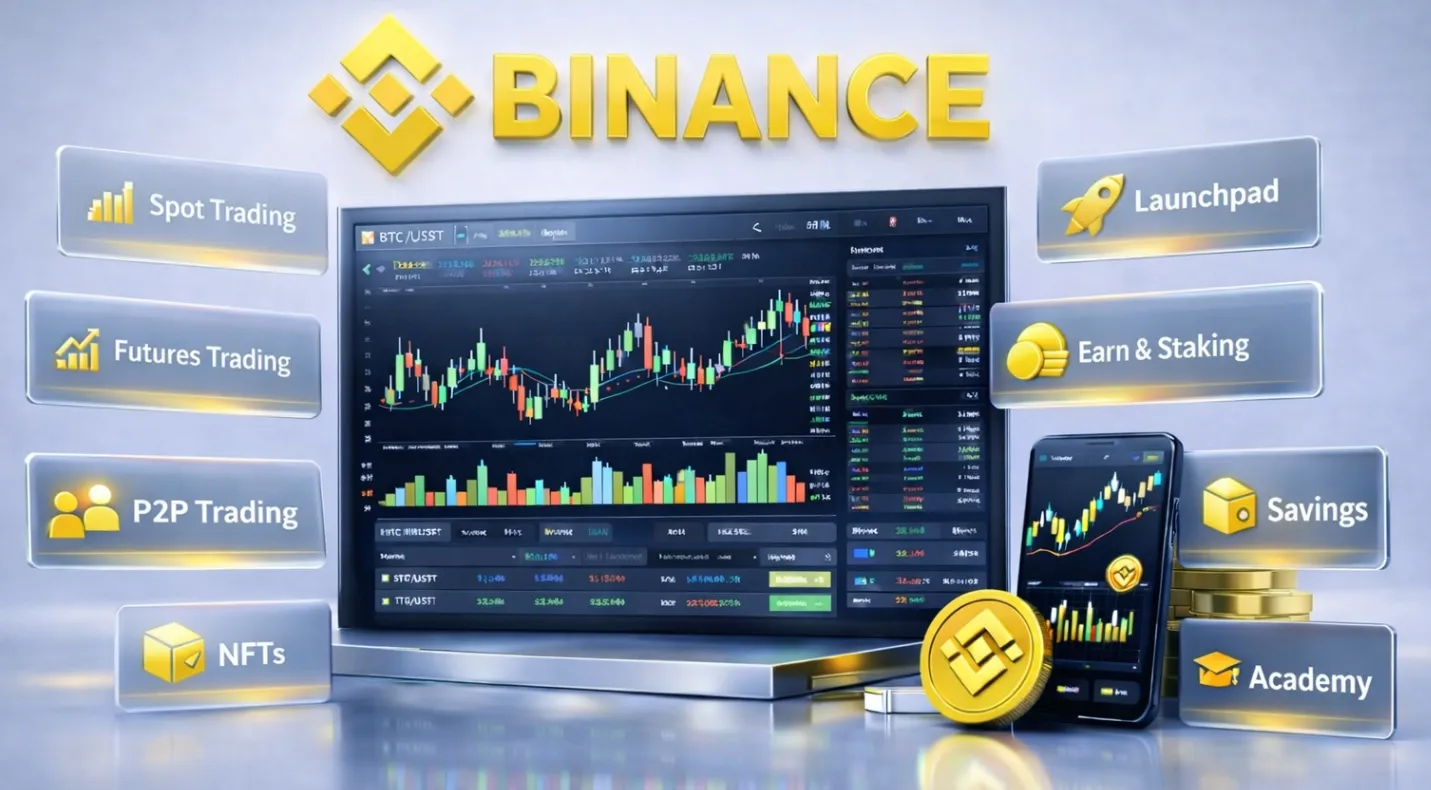
📊 Binance trading modes: spot, derivatives, and automation tools
📊 Margin trading
Binance supports margin trading with leverage of up to 10x (a mechanism that increases position size through borrowed funds). Two modes are available.
- Isolated margin: collateral and risk are limited to one trading pair
- Cross margin: one shared margin balance is used for all positions
- Auto-borrow and auto-repay simplify the management of borrowed assets
Borrowing interest accrues daily, and the rate depends on the currency and current market conditions. Margin trading increases position size relative to your own collateral, so profit and loss change faster when the market moves.
Isolated margin limits risk to the collateral of one pair, while cross margin spreads risk across the total margin balance.
💱 Spot trading
On the spot market, Binance offers more than 500 cryptocurrencies and 1,500 trading pairs. Fees are charged under the maker/taker model.
- Base fee: 0.1% for maker and 0.1% for taker
- 25% discount when paying fees with the BNB token
- 0% fee on selected pairs during promos (for example, BTC/TUSD)
The Binance terminal offers several modes, from the simplified Convert to an advanced interface with TradingView charts. Limit, market, and stop orders are available, along with a range of indicators for analysis.
Paying trading fees in BNB provides a spot discount when the exchange-token fee payment option is enabled.
📈 Futures and perpetual contracts
Binance derivatives (contracts whose price depends on an underlying asset) include futures with an expiration date (the contract’s settlement date) and perpetual contracts with leverage of up to 125x. Two settlement formats are available.
- USDT-margined: collateral and settlement in a stablecoin
- Coin-margined: collateral and settlement in the base cryptocurrency (BTC, ETH, and others)
- Fees: from 0.02% (maker) and 0.05% (taker), with lower rates at higher VIP levels
- Funding fee: a payment between long positions (a bet on price growth) and short positions (a bet on price decline) every 8 hours
Risk-management tools include ADL, an insurance fund, and stop orders. In derivatives, position size and margin level directly affect how quickly results change and how close a position is to liquidation.
Leverage above 20x increases the risk of fast liquidation during normal price fluctuations; the risk depends on position size and margin level.
🧮 Options
The Binance options platform offers trading in European options (contracts that can be exercised only on the expiration date) on BTC and ETH with settlement in USDT.
- Fees: fractions of a percent of notional value
- Premium: locked in when the trade is opened
- Tools: Delta (the option price’s sensitivity to movements in the underlying asset), Gamma (the rate of change of Delta), Theta (the effect of time to expiration), Vega (sensitivity to changes in volatility), and payout charts
Options are used for hedging and volatility trading. Correct interpretation of results requires accounting for premium calculation and the maximum possible loss.
Options trading on Binance launched in 2020 and remains a separate tool for volatility-based strategies.
🤖 Copy trading and trading bots
Copy Trading (automatic copying of a selected trader’s positions according to preset parameters) on Binance allows users to mirror selected traders with defined limits.
- Available on futures and spot
- Supports loss limits and proportional copying
- Trader metrics and result history are visible before connecting
- Spot Grid: buys and sells across a price grid
- Futures Grid: similar logic for derivatives
- TWAP (executing a large order in parts over time to reduce market impact): splitting order execution over time
- Iceberg (splitting a large order into a series of smaller visible orders): dividing an order into several parts
API integration makes it possible to connect third-party solutions, including HFT (high-frequency trading) and rule-based order execution systems.
Copy trading and automated trading do not remove market risk; volume and risk parameters are set in the configuration before launch.
🖥️ Binance interface: trading modes and workflow setup
Binance offers several interface formats for different trading and asset-management scenarios:
- 🌐 Web platform: Classic and Advanced (a terminal with TradingView charts)
- 📱 Mobile apps: iOS and Android, including trading, Earn, and NFT
- 💻 Desktop and MT5 (MetaTrader 5 is a trading terminal for manual and algorithmic trading): separate solutions for trading and integrations
Users can customize panels, switch themes, save order templates, and move between modes with one click. Interface modes are switched manually: the app offers Lite for basic operations and Advanced for a full-featured terminal.
The interface also includes prompts for new features, hotkeys in the web version, and API-based tools for trading automation and monitoring.
💸 Binance fees: trading, deposits, and withdrawals
Binance uses different fees for spot, derivatives, and deposit and withdrawal operations. The final rate depends on the product, trading volume, and the VIP level (a user tier based on trading activity that affects fees).
| Operation type | Maker | Taker | Comment |
|---|---|---|---|
| Spot | 0.1% | 0.1% | Base rate for all users |
| Futures | 0.02% | 0.05% | Reduced as volume increases |
| Options | ~0.02% | ~0.03% | Depends on the instrument and liquidity |
| Deposit | 0% | The exchange usually does not charge a fee for cryptocurrency deposits | |
| Withdrawal | Network fee | The amount depends on the selected network (for example, TRC-20 or ERC-20) | |
Fee reductions on Binance depend on the payment method, trading volume, and active promotional terms.
- Paying fees with the BNB token (up to 25% discount on spot and 10% on futures)
- VIP status linked to trading volume
- Promotions and referral terms, if active
💳 Binance Card: spending crypto within the Binance ecosystem
Binance Card is a Visa debit card linked to a Binance account. It allows users to spend cryptocurrency on everyday purchases, while conversion into fiat happens automatically at the time of payment.
🔑 Key benefits
- 💰 Cashback up to 8% credited in BNB on every purchase
- 🌍 Works wherever Visa is accepted
- ⚡ Automatic conversion of cryptocurrency into fiat at payment
- 🧾 Spending history and reports in the app
- 💳 Virtual and physical card, with delivery in supported regions
Users can set the asset spending order: purchases may be paid with USDT, BTC, BNB, or other supported coins. All transactions are displayed in a separate card section.
Binance Card is available in a number of countries. Card issuance is usually free, while service terms depend on the region and the issuer’s rules.
🎨 Binance NFT: the marketplace inside the Binance ecosystem
Binance NFT is a platform for working with NFTs (non-fungible tokens, unique digital assets) integrated into the exchange interface. It combines collectible and gaming NFTs, including major collections and creator drops.
📋 What is available on Binance NFT
- 🖼️ Buying, selling, and auctions in USDT, BNB, and ETH
- 🪙 Supported networks: BNB Chain, Ethereum, Polygon
- 🎮 NFTs for games (GameFi refers to gaming projects with blockchain-based assets), Metaverse (virtual worlds with digital objects), and collectible assets
- 🔥 Mystery boxes with random NFTs inside
- 🚀 Launchpad and Featured Drops with selections and drops from projects and brands that the platform highlights separately in the catalog
Binance charges a marketplace fee (for example, 1% for the seller), provides filters by price and collection, and applies internal moderation measures to reduce the risk of counterfeits.
Buying, storing, and displaying NFTs on Binance are built into the internal account infrastructure and the platform interface.
- ✅ Buying NFTs from the Binance balance
- 🔐 Storing NFTs in a Binance account
- 💸 In some operations, the fee is displayed inside the platform without separate display of the gas fee (the blockchain network fee)
- 📲 Access through the web and mobile app
👥 Binance sub-accounts for strategy and access management
The sub-account feature allows users to create several auxiliary accounts inside one main account. It is used to separate strategies, manage team access, and delegate trading. Binance allows verified users to open up to 5 sub-accounts (VIP clients can get more).
The main account (Master) manages balances, access rights, and the actions of sub-accounts.
- Distribute funds between sub-accounts
- Assign permissions: view access, trading, API, and other rights
- Track the trading results of each sub-account
- Block and delete sub-accounts
Sub-accounts cannot withdraw funds directly: transfers to an external address are made through the main account, so control over the withdrawal point remains with the owner of the Master profile.
- ⚡ Transfers between accounts without fees
- 🎖️ Sub-accounts inherit the VIP status of the main profile
- 🚀 Participation in Launchpad, Launchpool, and campaigns on behalf of the Master account
A sub-account is created in Binance profile settings through the Sub-Account section. A separate email can be linked for login, and access can be managed from the Master profile.
🛡️ Binance verification: access limits with and without KYC
Full access to Binance features requires KYC (Know Your Customer, identity verification through documents). Without KYC, only a limited set of operations is available: cryptocurrency deposits, limited trading, and withdrawals of up to 0.06 BTC per day.
- 📥 No access to fiat deposits and withdrawals
- 🚫 Futures, Launchpad, Earn, and P2P are unavailable
- 🎁 Bonuses and promos are usually available only with confirmed identity
After completing KYC, the full set of Binance products becomes available, and withdrawal limits for verified users can reach 100 BTC per day.
- 💱 Fiat deposits and withdrawals through cards and banks
- 🤝 Use of the P2P platform
- 📈 Access to futures, staking, and Launchpad
The KYC process usually takes 5–15 minutes and includes uploading a document, taking a selfie, and waiting for verification, which in rare cases can last up to 24 hours.
- Uploading a document (passport, driver’s license, or ID card)
- Selfie in the app or on the website following the interface instructions
- Waiting for automated or manual verification
Verification status is displayed in the profile. After approval, products and limits tied to the account level become available.
💳 Deposits and withdrawals: fiat and cryptocurrency methods
Binance supports deposits and withdrawals in cryptocurrencies and fiat currencies. The available methods depend on the selected asset and region.
📥 Cryptocurrency deposits
Deposits are made by transfer to a unique Binance deposit address. For popular assets, several networks are available; funds can be credited only if the sending network matches the deposit network on Binance.
- USDT: ERC-20 (the token standard on the Ethereum network), BEP-20 (the token standard on BNB Chain), TRC-20 (the token standard on the Tron network), Polygon (a separate blockchain network), and others
- BTC, ETH, BNB, and other major cryptocurrencies
Deposit fees are usually absent, while the sender pays the network fee on the sending side. On withdrawal, a network fee (the fee of the selected blockchain network) is charged, and its amount depends on the network and current load.
💸 Fiat payments
Binance supports more than 40 national currencies, and the set of methods depends on the region:
- Bank cards: Visa, Mastercard
- Bank transfers: SEPA (the European euro transfer system), SWIFT (an international interbank transfer network), Faster Payments (a fast bank transfer system), and others
- Local payment services, where supported
Funding through Buy Crypto (an instant cryptocurrency purchase service for fiat) allows users to convert funds immediately into USDT, BTC, or other assets. Deposit fees often fall in the 0–2% range, while withdrawal fees depend on the payment system.
💳 Binance Card
In some countries, Binance Card is available as a Visa debit card linked to the account. Payments are made from the Binance balance, and conversion into fiat happens automatically; separate cashback and limit terms may also apply.
🤝 P2P platform
For buying and selling cryptocurrency directly between users, the Binance P2P platform is available:
- 60+ currencies: UAH, KZT, USD, EUR, and others
- Dozens of payment methods: transfers, wallets, and payment services
- 0% fee from Binance for users
- Escrow: the crypto asset is locked until payment is confirmed
On P2P, the exchange rate is set by the counterparties, while Binance provides the escrow mechanism and basic dispute rules.
💰 Binance Earn: yield products and asset allocation tools
In addition to trading, Binance combines products for placing assets and receiving accruals in the Binance Earn section:
- Flexible & Locked Savings: placing cryptocurrency for yield; flexible deposits can be withdrawn at any time, while fixed deposits usually offer a higher rate
- Staking: locking assets for a period with accruals; both fixed and DeFi staking (placing assets in decentralized finance protocols to earn rewards) are available
- Liquid Swap: an AMM (automated market maker) with liquidity pools; yield is generated from trading fees
- Dual Investment: a product with fixed terms where the result depends on whether a target price is reached
- Auto-Invest: recurring purchases using DCA (dollar-cost averaging, averaging the entry price through scheduled purchases)
Earn terms depend on the coin and product type, and higher rates may be available only for a limited time. Accruals can be paid in the deposit token or in the project token, depending on the product.
In Earn products, yield can change, and some assets remain volatile. Product parameters include the lock-up period, early-withdrawal rules, and the payout currency.
🎁 Binance bonuses and promotions for new users
Binance regularly launches promos for new users. Terms change, but bonuses are most often tied to registration and completing basic actions on the platform.
- Welcome Bonus: tasks for registration, KYC, deposit, and the first trade
- Referral bonuses: fee cashback or a bonus for registering through an invitation
- Learn & Earn (educational modules with token rewards after meeting the conditions): completing learning modules with token rewards
Rewards may be provided as fee-discount coupons, trial funds for derivatives, or a bonus in a specific asset if the promo includes it.
Current offers are usually displayed in the Rewards Center. Many campaigns are time-limited (for example, 7–30 days from registration) and require the conditions to be met within the specified period.
🚀 New token access: Binance Launchpad and Launchpool
Binance develops Launchpad and Launchpool as tools for gaining access to new tokens at an early stage.
📈 Launchpad
Launchpad is a platform for IEO (Initial Exchange Offering, a token sale conducted through an exchange). Participants lock BNB for the subscription period, and the size of the allocation depends on campaign terms.
- Participation is usually available only after KYC
- The amount of staked BNB affects the possible participation share
- A maximum token limit per user may apply
After the campaign ends, tokens are distributed under the Launchpad rules. Binance has conducted more than 60 launches, and sharp price moves were observed after listing for such tokens, but this does not define the expected behavior of new launches.
🌱 Launchpool
Launchpool allows users to receive tokens without buying them: it is enough to stake BNB, TUSD, or other supported assets.
- Accruals are distributed daily and depend on stake size
- A minimum threshold may be absent if the campaign terms allow it
- Funds remain under the user’s control and can be withdrawn according to campaign rules
Launchpool rewards are calculated in proportion to stake size and participation time, not on a “first come, first served” basis.
💧 Liquidity on Binance: depth, spreads, and execution quality
Binance is one of the largest crypto exchanges by trading volume, so high order-book depth is usually maintained across its main markets.
On popular pairs (for example, BTC/USDT and ETH/USDT), the spread (the difference between the best buy and sell price) often remains minimal, and large orders can usually be executed with lower slippage (execution at a worse price than expected) than on less liquid platforms.
🔍 Why Binance often maintains high liquidity
- 🌍 Large user base
- 🏦 Activity from market makers and institutional participants
- 🪙 A broad range of markets, from BTC to DeFi and memecoins (tokens that grew out of internet memes)
High liquidity makes it easier to enter and exit positions in markets where execution speed and price accuracy matter.
- 🔁 Arbitrage strategies
- 🤖 Algo trading and HFT
- 💼 OTC deals (OTC, over-the-counter, large off-exchange transactions)
During periods of sharp volatility, order-book depth and spreads can worsen even on large exchanges, so liquidity should be assessed for the specific pair and current market conditions.
🔒 Binance security: account protection and asset storage
Protecting funds and accounts is a key criterion for any crypto platform. Binance uses a set of technical and organizational measures designed to reduce the risk of account compromise and fund loss.
- Cold storage: a significant portion of funds is held in offline wallets, while hot wallets are used for withdrawals
- SAFU: a reserve fund created in 2018 and used for compensation in incidents
- Proof-of-Reserves: publication of reserve wallet addresses and reports that make it possible to verify reserves on-chain
- 2FA: Google Authenticator, SMS, an anti-phishing code, email confirmations, and a withdrawal address whitelist (a list of pre-approved addresses for fund withdrawals)
From a regulatory perspective, Binance states that it operates in multiple jurisdictions and holds registrations or licenses (for example, in France, Italy, the UAE, and Kazakhstan), but product access conditions and restrictions depend on local rules.
For fiat tools and certain products, the requirements of the relevant jurisdiction and regional availability restrictions remain important.
📚 Glossary of key Binance terms
Brief definitions of the terms that shape trading mechanics, fees, and access to Binance features.
🔑 Main terms
The list includes only the concepts without which part of the Binance interface and platform terms may be misread.
- Maker / Taker: a fee model where the maker adds liquidity with a limit order, while the taker executes against the market
- Funding fee: a periodic payment between long and short positions in perpetual futures
- ADL: auto-deleveraging, a mechanism for automatic position reduction when the derivatives system is overloaded
- KYC: Know Your Customer, identity verification required for full access to exchange features
- SAFU: Secure Asset Fund for Users, Binance’s reserve fund for compensation in selected incidents
- Launchpad: a platform for participating in new token offerings through the exchange
- Launchpool: a service where tokens are distributed through staking assets without purchasing them
- P2P: direct deals between users using Binance’s escrow mechanism
- API: programmatic access to Binance features for automating trading and account management
- Liquid Swap: a liquidity-pool service where yield is generated from trading fees
- DCA: a strategy of buying an asset on a schedule to average the entry price
❓ FAQ about Binance exchange features and limits
Can you trade on Binance without completing verification?
Yes, but with limitations. Without KYC, cryptocurrency deposits, limited spot trading, and withdrawals of up to 0.06 BTC per day are available, while futures, Earn, Launchpad, P2P, and fiat operations are usually unavailable.
How long does Binance KYC verification usually take?
Document checks usually take 5–15 minutes in automatic mode. In some cases, manual review may be required, which can take up to 24 hours.
What trading fees does Binance charge?
The base spot fee is 0.1% for both maker and taker. On futures, fees start at about 0.02% (maker) and 0.05% (taker). Rates may be reduced when paying fees with the BNB token and when the VIP level increases.
How can you deposit and withdraw funds on Binance?
Deposits are possible in cryptocurrency through a deposit address or in fiat through bank cards and transfers. When withdrawing cryptocurrency, a network fee is charged, and its size depends on the selected blockchain network.
Are there welcome bonuses for new Binance users?
Promotions may include welcome bonuses, referral programs, and Learn & Earn tasks. To receive rewards, registration, KYC completion, and meeting campaign conditions are usually required.
🧾 Binance: core strengths and key limitations
Binance combines a broad range of markets, a developed ecosystem, and a toolkit for different scenarios, from spot and derivatives to Earn, P2P, and NFT.
The main limitations are usually tied to KYC requirements, product-access rules across different regions, and market risk when trading with leverage or participating in early token launches.
Binance is most relevant in scenarios where priority is given to