📘 Yobit: what the exchange offers and what traders use it for
Yobit has been operating since 2014 and remains one of the older crypto exchanges in the market. The platform focuses on spot trading, quick access without mandatory KYC (identity verification), and listings for rare tokens.
Yobit offers hundreds of coins and thousands of trading pairs. It is more often used to buy lesser-known assets that are not always available on larger CEXs (centralized exchanges), as well as to access internal services such as InvestBox, YoFarm, FreeCoins, YoDice, and YoStep.
- 🔸 400+ cryptocurrencies and 4000+ trading pairs, including BTC, ETH, USDT, and rare tokens
- 🔸 Spot only: the exchange does not offer margin, futures, or options
- 🔸 No mandatory KYC: basic trading access opens after registration by email
- 🔸 Internal services: the platform includes InvestBox, YoFarm, FreeCoins, YoDice, and YoStep
- 🔸 YO token: used across internal activities and promotional mechanics
Yobit is typically used when spot trading, rare listings, and access to internal services matter more than the legal safeguards and withdrawal predictability offered by regulated exchanges.
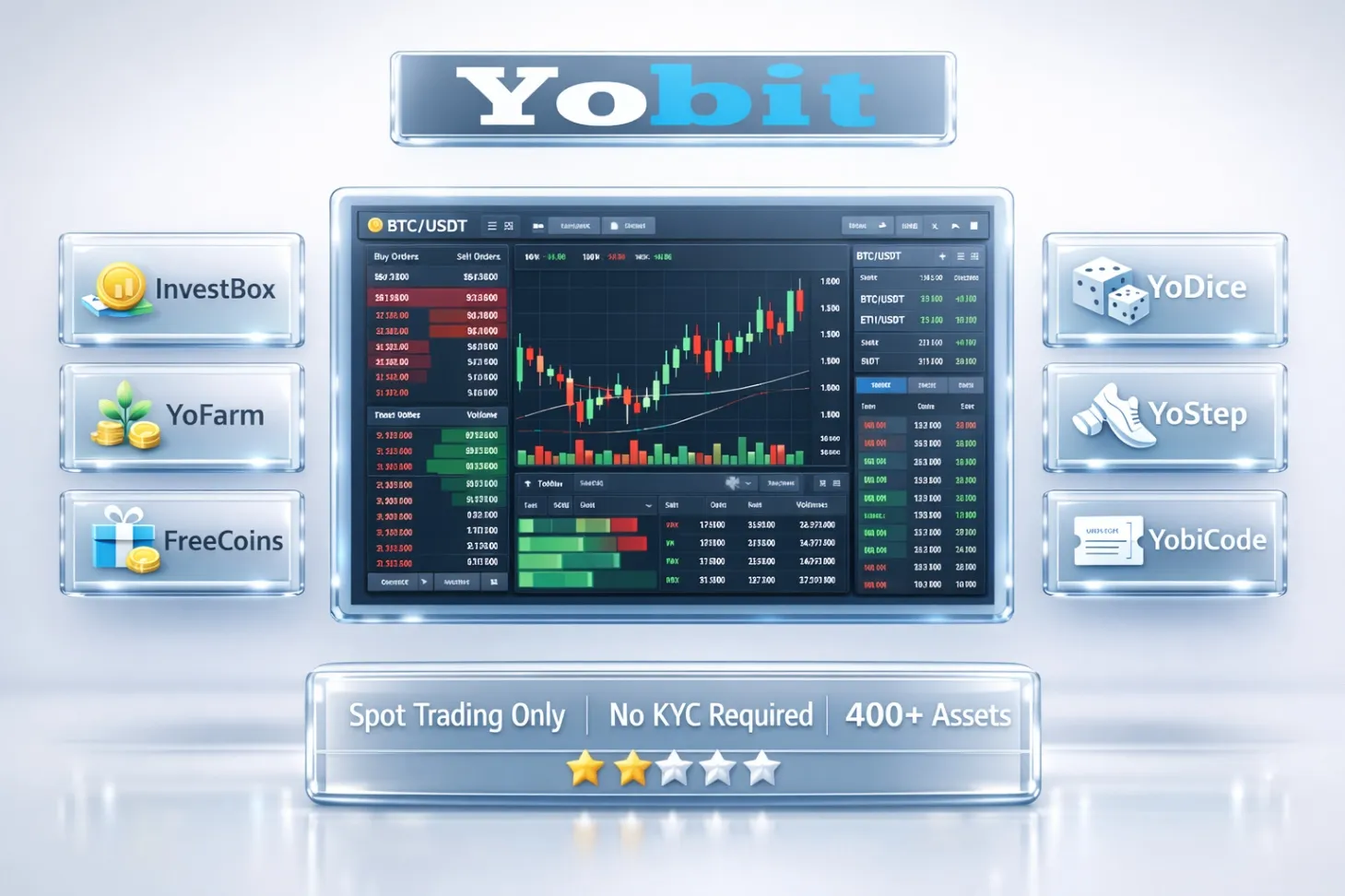
🖥️ Yobit interface: where to find markets, orders, and wallet functions
The Yobit interface looks dated, but its structure is straightforward. The main elements sit on a single screen: the market list, chart, order book, and order form. As a result, there are relatively few transitions between sections.
What the interface includes:
- 🗂️ Top menu: Trade, Market, YoFarm, YoDice, InvestBox, YoStep, Wallets, Support
- 💬 Built-in chat often referred to as the “trollbox”
- 🌐 A unified interface layout across the platform
- 📉 Basic charts and standard order forms without advanced analysis tools
- 🖥️ The main working format is the desktop browser version
In functional terms, the Yobit interface includes fewer trading modules and settings than major exchanges. Its direct layout makes basic actions easier to follow, including buying, storing, and withdrawing an asset.
💱 Spot trading on Yobit: limits, order types, and market depth
Yobit supports only spot trading, meaning standard buying and selling of an asset without leverage. The exchange adds rare coins quickly, so unusual trading pairs appear here more often than on more conservative platforms.
What matters for trading:
- 💱 0.2% fee applies equally to the maker (the trader placing an order in the book) and the taker (the trader executing an already placed order), both when placing an order and when filling someone else’s
- 📊 Many pairs: liquidity is stronger on major markets, while the order book for rare tokens is often thin
- ⚡ No derivatives: margin trading, futures, and options are not supported
- 🧰 Basic order set: simple orders are available without OCO (linked orders where execution of one cancels the other) and without built-in stop-losses
Yobit is more often used for targeted purchases of rare assets than for complex trading strategies with advanced risk management.
💲 Yobit fees: trading costs, deposits, and withdrawals
Yobit uses a simple fee model. The exchange does not apply a volume-based fee schedule and keeps the same rate for all users. Costs are easy to calculate, but there are no discounts for high trading turnover.
- 💱 Trading: 0.20% for maker and taker
- 💰 Crypto deposit: 0% on the exchange side
- 💸 Crypto withdrawal: a fixed fee that depends on the asset and network
- 💳 Fiat gateways: fees are set by external payment providers, so the final cost is usually higher than for crypto withdrawals
The fee rate and minimum withdrawal amount for a specific coin should be checked on the Fees page. These parameters can change for individual assets.
🏦 Deposits and withdrawals on Yobit: funding methods and payout flow
Yobit accepts deposits in cryptocurrency and through external payment services. Crypto deposits depend on network confirmations. Fiat deposits and withdrawals go through third-party operators, so speed and final fees depend not only on the exchange itself.
- 🔑 Crypto deposit: the address is created in the Wallets section, and funds are credited after network confirmations
- 💵 Fiat methods: external gateways are used, and they charge their own fees
- 🎟️ YobiCode: an internal voucher for transferring funds between users without the standard network fee
- ⏱️ Timing: regular crypto deposits often arrive within 5–30 minutes, but large withdrawals may be reviewed manually
A typical workflow on Yobit involves depositing a liquid cryptocurrency, converting it internally, and withdrawing the selected asset through an available network with a transparent fee.
💰 InvestBox, YoFarm, and gaming services: how Yobit’s internal products work
Beyond standard spot trading, Yobit promotes internal yield and engagement mechanisms. Their logic is not limited to holding an asset on balance, but extends to participation in separate accrual schemes, pools, or gaming-style scenarios.
Which services are available:
- 💰 InvestBox: plans with daily accruals in a selected coin; yield and terms depend on the specific plan
- 🎲 YoDice: a betting game in BTC where part of the activity is tied to the YODICE token
- 👟 YoStep: a mechanic with virtual sneakers bought for USDT and rewards in YOSTEP when conditions are met
- 🌾 YoFarm: liquidity pools where the user deposits assets under the rules of a specific pool and receives yield
- 🎁 FreeCoins: micro token distributions for basic activity inside the platform
Yobit’s internal activities form a separate product class with their own accrual logic. They do not replace standard asset storage in an external wallet.
🎁 Yobit referral program and bonuses: how internal promotions are structured
Yobit uses referral payouts, token bonuses, and periodic promo campaigns to keep activity inside the platform. For the exchange, this works as a separate engagement mechanism tied to trading, purchases of internal products, and participation in promotions.
- 🤝 Referral program: 20% of trading fees from invited users and 5% of their purchases of the platform’s internal products
- 🎁 Trade Bonus: the exchange may return part of the fee on BTC pairs in internal tokens; terms depend on account status
- 📢 Airdrops and contests: periodic token distributions and trading activities with a limited participation window
- 💎 YO token: used inside the ecosystem and linked to specific platform activities
Yobit’s bonus system makes sense mainly alongside existing trading or service activity inside the platform.
🛡️ Yobit security and user feedback: the risks mentioned most often
The absence of licenses from major jurisdictions limits the level of legal protection usually expected by users of regulated exchanges. This becomes especially visible when storing larger amounts or trying to withdraw assets quickly.
At the account level, the exchange provides basic security tools: 2FA (two-factor authentication), email confirmations, address whitelists, and separate withdrawal restrictions. No public data is stated on an insurance fund, external audits, or a bug bounty (a reward program for discovered vulnerabilities).
⚠️ Which complaints appear most often in user reviews
- 🔻 Frozen accounts and long unlock times
- 🔻 Withdrawal delays or unavailability of specific coins in Maintenance status
- 🔻 Weak support quality and slow responses to tickets
- 🔻 Controversial reputation of some token-based activities inside the platform
The main Yobit risk lies not in opening an order, but in the speed and predictability of withdrawing the required asset at the required moment.
📝 Yobit use cases: common trading and transfer scenarios
Buying a rare altcoin
Buying a token that is not listed on major exchanges.
- Funding: deposit BTC or USDT through Wallets
- Pair selection: search for the required token in the Trade section
- Order: enter the price and quantity
- Result: the token appears in the balance
On rare pairs, liquidity can be limited, which means the price may shift during execution.
Exchanging one coin for another
Converting assets within the exchange.
- Market selection: for example BTC/USDT
- Trade: buy or sell through an order
- Execution: the order is filled in the order book
- Balance: the asset is updated in the wallet
The final price depends on the active orders currently available in the book.
Participating in InvestBox
Placing a coin into a plan with accruals.
- Plan selection: check the terms and rate
- Placement: transfer the amount into the selected plan
- Accruals: payouts under the plan terms
- Exit: return of funds after completion
The outcome depends on the plan terms and on how the coin price changes over time.
Participating in YoFarm
Adding assets to a liquidity pool.
- Pool selection: asset pair and terms
- Deposit: add funds
- Yield: accruals under the pool rules
- Exit: withdraw the share from the pool
The final result depends on price changes affecting the assets inside the pool.
Transfer through YobiCode
Sending funds between accounts inside the exchange.
- Code creation: choose the amount and asset
- Transfer: send the code to another user
- Activation: enter the code in the account
- Credit: the funds arrive in the balance
The transfer takes place within the exchange and does not require a standard network fee.
Each scenario depends on liquidity, fees, and whether the selected asset can be withdrawn when needed.
🔖 Yobit pros and cons: key strengths and core limitations
✅ Pros
- Quick start without mandatory identity verification
- Wide selection of rare tokens and non-standard trading pairs
- Simple spot model without an overloaded toolset
- Internal services for activity within the platform
❌ Cons
- No regulation in major jurisdictions and weaker legal protection
- Regular complaints about support and some withdrawals
- No advanced orders, margin trading, or derivatives
- Rare pairs can have weak liquidity and noticeable slippage
Yobit is more often used for markets with rare tokens and non-standard trading pairs. The platform’s weaker points become more visible where fund protection, support speed, and a more developed trading infrastructure matter most.
❓ FAQ about Yobit: account setup, fees, and withdrawals
How do you open an account on Yobit?
What trading and withdrawal fees does Yobit charge?
How do withdrawals work on Yobit?
What does FreeCoins mean on Yobit?
How does InvestBox operate on Yobit?
🧾 Yobit: key features, risks, and practical limits
Yobit remains a niche spot exchange with fast access to rare tokens, simple registration, and a set of internal services built around trading and platform activity.
The main limitations are tied to the absence of regulation in major jurisdictions, the disputed reputation of some internal mechanisms, complaints about support, and the risk of delays on certain withdrawals. The platform is used more often for operational amounts and targeted tasks than for long-term capital storage.
Access to rare spot pairs without mandatory KYC on Yobit comes with weaker