📘 Kraken: how this exchange works and what it offers
Kraken combines spot trading, fiat funding, and a separate Kraken Pro terminal. Access to some products depends on the country and account status.
Kraken is a centralized cryptocurrency exchange that has been operating since 2011. The platform focuses on spot trading, fiat funding, a professional interface, and products that become available after verification and other formal checks.
- The operator is Payward and related Kraken legal entities.
- The exchange places strong emphasis on fiat transfers, risk controls, and customer verification.
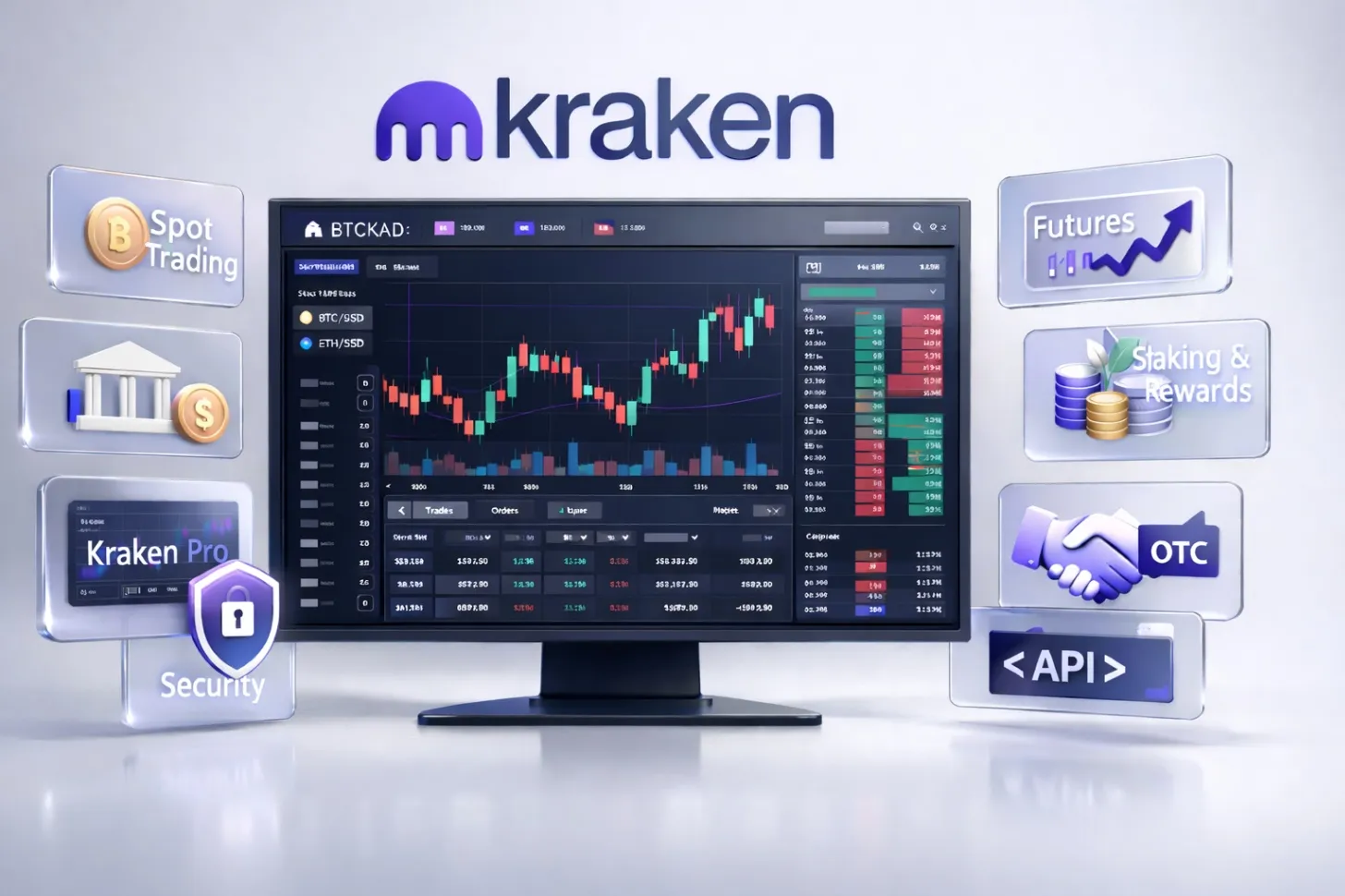
- Kraken offers Kraken Pro, OTC, Prime, API access, and separate services for larger trading volumes.
- Kraken publishes Proof of Reserves. This report confirms that client liabilities are included in the reserves verification process.
🔍 Kraken regulation: licenses, jurisdictions, and access restrictions
For Kraken, the structure of the group matters, but product availability matters just as much. Spot, fiat, Rewards, margin, and derivatives are opened under different rules depending on the jurisdiction.
Kraken operates through several companies across different jurisdictions. To access key functions, the exchange uses KYC/AML procedures. These include identity, address, and source-of-funds checks. The set of available products depends on the country and customer type.
- United States: Kraken operates through Money Services Business registration with FinCEN, and through Kraken Financial uses the Wyoming SPDI model for part of its custody services.
- European Economic Area: the group holds Irish licenses for e-money and CASP services under MiCA. As a result, part of its fiat services and regulated crypto services in the EEA is structured through the group’s Irish legal entities.
- Other regions: in some countries, Kraken operates through local registrations and separate eligibility rules. The same account does not provide identical access to every function in every jurisdiction.
- Product restrictions: margin, Rewards, and derivatives are not opened under a single rule. Access depends on the country, product type, and customer status.
💼 Kraken products: spot, derivatives, Rewards, and services for larger clients
Kraken gives users access to fiat purchases, active trading, OTC deals, API connectivity, and yield tools. Some products remain country-dependent.
💱 Spot trading
On the spot market, pairs are available against cryptocurrencies and fiat currencies. Kraken Pro uses a maker/taker model. If an order adds liquidity to the order book, a maker fee applies. If an order is filled against existing orders, a taker fee applies.
- Interfaces: a basic mode for simple purchases and Kraken Pro for full-featured trading.
- Tools: limit and stop orders, advanced order types, the order book, trade feed, and charts.
- Fiat operations: bank funding and withdrawal methods for supported currencies and jurisdictions.
📊 Margin trading
Margin trading is available for selected pairs and approved countries. In Kraken Pro, users can open spot positions with leverage of up to 5×.
- Fees: in addition to the trading fee, there is a charge for opening and holding a position.
- Access: margin trading is not available in all countries or for all trading pairs.
- Risk: using leverage increases both potential profit and potential loss.
📈 Futures and derivatives
Kraken Derivatives provides access to perpetual contracts and other derivatives in approved regions. For U.S. clients, a separate Kraken Derivatives US service is used.
- Leverage: leverage of up to 50× is available for international perpetual contracts.
- Fees: futures use a separate maker/taker fee schedule.
- Regional restrictions: derivatives are not available in every country.
🌱 Rewards and staking
Kraken uses the Rewards product line and supports on-chain staking for selected crypto assets. Yield depends on the network, the asset, and Kraken’s fee.
- Payout model: the fee is deducted from network rewards.
- Withdrawals: some assets support flexible withdrawals, while others come with an unlocking period.
- Regional restrictions: Rewards availability depends on the country.
🤝 OTC and Prime
For larger volumes, Kraken uses an over-the-counter OTC format and separate services for institutional clients.
- OTC: used for large trades without putting pressure on the public order book.
- Prime: infrastructure for large clients and funds.
- API: REST, WebSocket, and FIX connectivity for algorithmic trading.
📱 Apps and trading interfaces
Kraken uses several interfaces for different types of activity.
- Kraken: a mobile app for simple operations.
- Kraken Pro: a professional trading terminal.
- Kraken Desktop: a desktop interface for traders.
🧩 Additional services
Kraken also develops educational and infrastructure-focused services.
- Education: articles and materials about cryptocurrency and trading.
- NFT: the Kraken NFT marketplace has been closed.
- Additional services: the availability of some products depends on the country.
💸 Kraken fees and limits: how pricing and access levels are structured
On Kraken, it is important to separate trading through Kraken Pro, simple purchases in the basic interface, and trades involving margin or derivatives. These modes follow different pricing models.
Trading fees
- Kraken Pro, spot: a 30-day maker/taker schedule applies. At the base level for most spot markets, rates start at about 0.25% maker and 0.40% taker. At the top levels, they fall to 0.00% maker and 0.05% taker.
- Futures: derivatives use a separate schedule. Starting rates are around 0.0200% maker and 0.0500% taker.
- Simple purchase: the basic interface costs more because it is designed for fast execution rather than for the lowest trading fee.
- Margin: margin charges are added on top of the standard trading fee and depend on the asset and market conditions.
Funding and withdrawals
- Cryptocurrencies: the network fee depends on the blockchain and the withdrawal method. There is no single fixed rate across all assets.
- Fiat: cost and speed depend on the currency, bank, and payment method.
- Temporary holds: some funding methods may temporarily block withdrawals. This restriction can appear after ACH Plaid or card purchases.
Verification and limits
- Verified individual account: the base level for most retail clients. It unlocks key account functions.
- Verified individual with higher limits: this level provides higher funding and withdrawal limits.
- Business account: this format is intended for companies, funds, and clients that need business procedures and expanded API limits.
🛡️ Kraken security: asset custody, account protection, and change controls
Kraken’s security model includes several layers: asset custody, infrastructure protection, reserve verification, and account-level controls.
Kraken uses cold and hot storage, physical infrastructure protection, encryption of sensitive data, and separate tools for account protection. The exchange also publishes Proof of Reserves to confirm that client liabilities are included in the reserve verification.
Asset storage and infrastructure
- Cold storage: a significant part of the crypto infrastructure is isolated from regular online access.
- Physical protection: infrastructure is placed in secured facilities with continuous monitoring.
- Information security: sensitive data is encrypted, and access is restricted by role.
- Formal standards: Kraken states that it holds ISO/IEC 27001:2022 certification and has completed SOC 2 Type 1.
Account protection
- 2FA: authenticator apps and hardware security keys are supported.
- Master Key: this is a separate protection layer. It blocks critical account changes and allows immediate GSL disablement.
- Global Settings Lock: GSL blocks changes to key settings. This mechanism is designed for situations where the password and sign-in 2FA have already been compromised.
- Withdrawal controls: the exchange uses confirmations, delays, and additional checks for sensitive actions.
Proof of Reserves
- What is checked: the report records the inclusion of client liabilities in the dataset used for reserve verification.
- The role of Proof of Reserves: the verification confirms that liabilities are included in the report’s cryptographic model.
- What Proof of Reserves does not replace: PoR does not replace an assessment of liquidity, jurisdiction, or the platform’s operational risks.
🎧 Kraken support: routine requests and more complex reviews
Kraken support separates quick questions from more complex reviews. Simple requests go through the help center and guided support, while more difficult cases move to manual review.
Kraken support operates through the help center, guided support requests, tickets, and a 24/7 service. This setup resolves standard questions more quickly than disputed cases that require document review, source-of-funds checks, or product access validation.
- Typical requests: funding, withdrawals, 2FA, and basic account navigation are usually handled through the help center and standard support flows.
- Complex cases: checks related to KYC, source of funds, and product access take more time because they go through internal compliance procedures.
- Interface: Kraken and Kraken Pro have a restrained design and avoid a gamified presentation.
- UX logic: the platform separates a simple purchase interface from a professional interface for active trading.
🗣️ Kraken reputation: where the exchange earns praise and where it draws criticism
Kraken’s reputation is built on a long operating history, strong fiat infrastructure, and strict compliance standards.
The market generally views Kraken as an exchange with a conservative profile. Positive feedback is tied to security, fiat channels, and the trading terminal. Negative feedback is tied to delays in document checks, source-of-funds requests, and temporary withdrawal restrictions.
- What gets praise: a functional terminal, fiat transfers, strong security settings, and clear trading rules.
- What gets criticized: compliance checks, additional document requests, and slower access to some operations.
- What these complaints show: complaints about KYC and source of funds are often tied to the control model used by a regulated exchange.
🤝 Kraken and alternatives: differences in products, access, and regulation
Kraken, Binance, LBank, and BingX differ across several factors. The contrast shows up in product range, access rules, listing policy, and the role of fiat services.
| Criterion | Kraken | Binance | LBank | BingX |
|---|---|---|---|---|
| Main profile | Fiat, compliance, functional terminal | Ecosystem with a broad mix of services and trading modes | Fast listings and a broad range of new assets | Social trading and retail derivatives |
| Typical priority | Fiat channels and formal access rules | Spot, derivatives, Earn, and payment services within one ecosystem | Wide altcoin selection and early listings | Copy trading and an active retail focus |
| Fiat infrastructure | Bank transfers and fiat channels | Fiat channels depend on the country | Fewer fiat channels | Depends on the region and payment partners |
| Listing approach | More selective asset screening | Broad spot and derivatives listing | Fast listing of new and low-cap assets | Listing focused on spot and perpetual instruments |
| Derivatives profile | Derivatives are available, but geography matters | Broad derivatives lineup | Retail futures and active altcoin listings | Focus on perpetuals and copy trading |
| Main limitation | Strict compliance and slower access to operations | Jurisdictional risks and changing country restrictions | Fewer licensed structures and less strict compliance | Less focus on fiat services and institutional infrastructure |
✅ Kraken pros and cons: core strengths and practical limitations
Kraken’s strengths and weaknesses stand out most clearly against exchanges with broader listings and a lighter onboarding process.
✅ Pros
- Strong fiat infrastructure and a clear framework for bank funding and withdrawals.
- A functional professional terminal with a maker/taker model and API access.
- Strong security settings, including 2FA, Master Key, GSL, and Proof of Reserves.
- Separate products for larger clients, including OTC, Prime, and expanded infrastructure.
❌ Cons
- Strict verification and tighter source-of-funds checks.
- Simple purchases cost more than trading through Kraken Pro.
- New asset listings are less aggressive than on more retail-focused competitors.
- The availability of Rewards, margin, and derivatives depends on the country and customer type.
Kraken’s strengths are closely tied to fiat access, security, and trading infrastructure. Its main limitations are stricter compliance, product availability by jurisdiction, and a more selective listing approach.
🛠️ Using Kraken: simple transactions and active trading workflows
The Kraken workflow depends on the interface. The basic mode is designed for simple operations, while Kraken Pro is intended for active trading.
Basic operations
Kraken’s basic mode is used to buy, hold, and withdraw cryptocurrency through the exchange’s standard interface.
- Use typically starts with account verification and enabling two-factor protection (2FA).
- The standard Kraken interface is designed for simple purchases.
- For withdrawals, the selected network and address accuracy both matter.
- Some funding methods can trigger temporary withdrawal restrictions.
Active trading
The Kraken Pro interface is designed for active trading. It provides a trading terminal, an order book, and advanced order types.
- Trading uses a maker/taker model with a separate fee schedule.
- Futures, margin trading, and OTC operate as separate trading modes.
- The availability of some products depends on the user’s country.
- For larger trades, market liquidity and withdrawal rules both matter.
❓ FAQ on Kraken: verification, fees, Rewards, and derivatives
Can you use Kraken without completing verification?
What affects fee levels on Kraken?
Does Kraken offer futures, and how much leverage is available?
How do Rewards and staking work on Kraken?
What security mechanisms protect a Kraken account?
How is Kraken different from Binance, LBank, and BingX?
Why do some users face withdrawal delays on Kraken?
Does Kraken support fiat deposits and withdrawals?
🧾 Kraken: key features and platform profile
Kraken is an exchange built for spot trading, fiat operations, and a professional trading terminal. The platform emphasizes infrastructure and risk controls rather than the broadest possible listing or the simplest onboarding.
Kraken’s main limitations are tied to strict compliance, country-based availability of some products, and more expensive instant purchases compared with the Pro interface. Its profile is shaped not by a single fee, but by the combination of fiat access, security, terminal quality, and access rules.
Kraken is strongest in spot trading, fiat operations, and professional trading. It is less compelling where the main priority is the broadest possible listing with minimal compliance controls.