📘 General Overview of the MEXC Exchange
MEXC is a cryptocurrency exchange launched in 2018.
MEXC reports support for more than 2,800 cryptocurrencies and around 3,000 trading pairs. The platform serves users across more than 170 countries and jurisdictions. In its public materials, MEXC also mentions an audience of around 30 million users.
- Futures with leverage of up to 200x, margin trading, and ETF tokens (exchange-traded tokens with built-in leverage or inverse exposure to the underlying asset’s price)
- P2P platform (trades between users), staking (Earn products), and copy trading (automatic copying of trades from a selected trader)
- Spot trading with a broad range of altcoins and fast listings of new coins
MEXC combines spot trading, margin trading, futures, P2P deals, Earn products, Launchpad (a platform for listing and distributing tokens from new projects), and Copy Trading (a mode for copying trades from selected traders) within a single account.
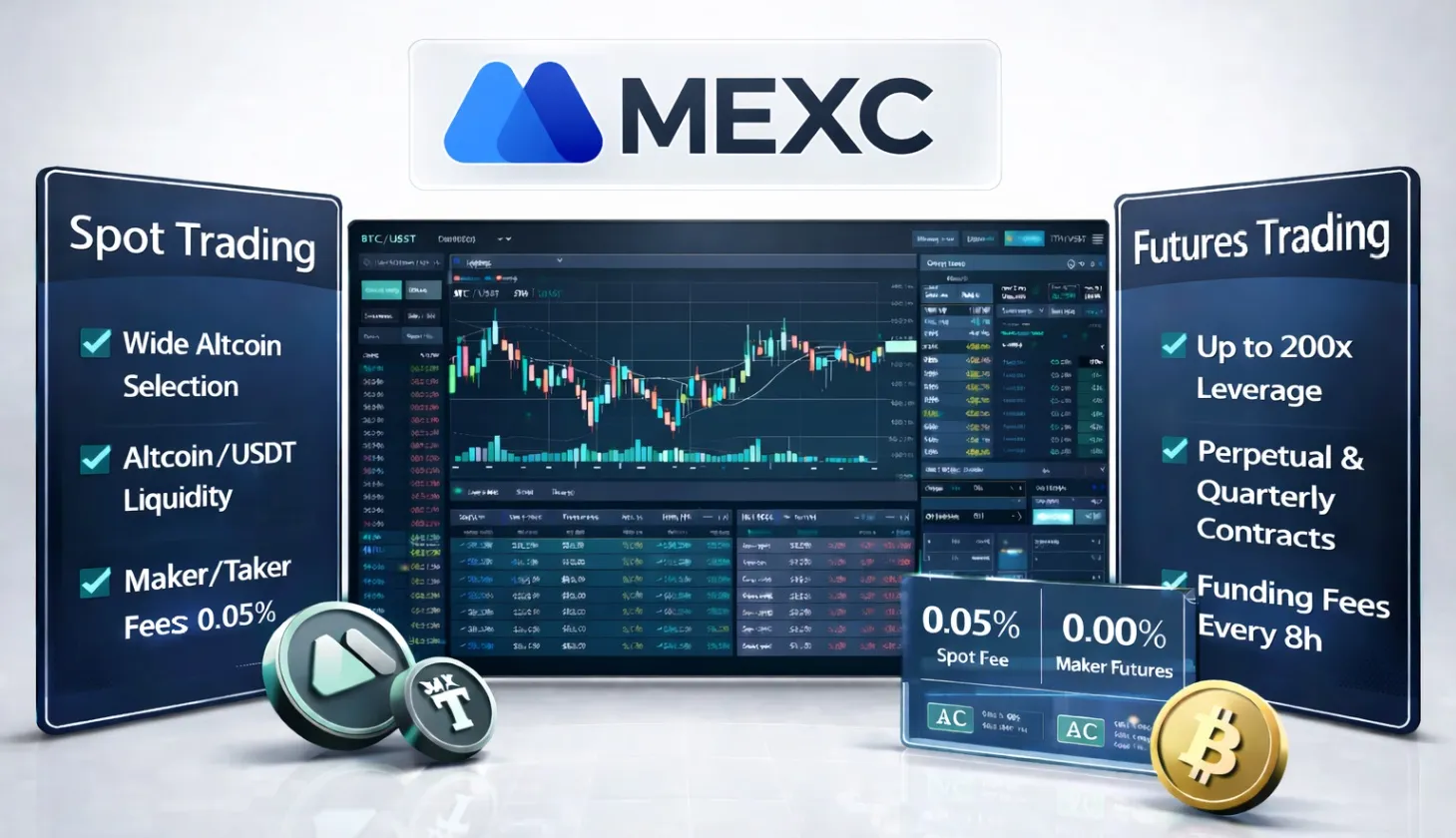
💱 MEXC Trading Products and Market Tools
💱 Spot Trading
- More than 2,800 cryptocurrencies and nearly 3,000 trading pairs, including major coins and altcoins
- Most trading volume is concentrated in “altcoin/USDT” pairs, where liquidity and order book depth are strongest
- Maker/taker model: a base fee of 0.05%, with a possible reduction to 0.025% when holding MX
- Periodic promotions with 0% fees on selected trading pairs
- Support for limit, market, and stop orders, along with built-in charts and indicators
📊 Margin Trading
- Isolated and cross margin modes are available, with different approaches to risk allocation
- Leverage for major pairs is usually 3x–5x, and for selected assets up to 10x
- Positions are opened after funds are transferred to the margin account
- The terminal shows the margin level and liquidation price in real time
- Liquidation risk depends directly on leverage size and market volatility
📈 Futures and Perpetual Contracts
- Perpetual and quarterly contracts, including USDT-M and Coin-M formats
- Up to 200x leverage on selected markets
- Around 400 available futures markets
- Fees: 0.00% (maker) and 0.02% (taker), with possible reductions
- Funding fee every 8 hours to keep contract prices aligned
🤖 Copy Trading and Trading Bots
- Copy Trading automatically mirrors the trades of a selected trader in the user’s account
- Trader selection is based on returns, drawdown, and other risk metrics
- Settings include position size and loss limits through stop-loss controls
- Available bots include Spot Grid, Futures Grid, DCA, and Infinity Grid
- Bots run on predefined parameters and manage orders automatically
📉 Fee Reduction Factors on MEXC
- ✅ VIP level: higher trading volume reduces commission rates according to the tier schedule.
- 🪙 MX token: holding MX in the account balance activates a 50% discount on trading fees under the exchange’s terms.
- 📈 Maker role: limit orders are more often counted as maker orders; on futures, the maker fee is listed as 0%.
- 🤝 Coupons and promotions: some promo campaigns temporarily reduce fees to zero on selected trading pairs.
Lower trading fees do not remove network withdrawal fees or funding fee charges on perpetual contracts.
👥 Sub-Accounts on MEXC
A sub-account on MEXC separates balances and order history within one main account. MEXC describes two types of sub-accounts:
- Internal: no separate login, managed through the main account or API
- Standalone: a sub-account with its own login credentials
📌 Internal Sub-Accounts
- Login is handled through the main account in the web interface or through API keys
- Orders are placed by the main account or programmatically through the API
- Direct withdrawal from an internal sub-account is unavailable — withdrawals go through the main account
- The VIP status and discounts of the main account apply to internal sub-accounts
- Creation is available in the “Sub-Account Management” section without linking a separate email
🔑 Sub-Accounts With Separate Access
- The sub-account uses its own email and password to log in through the website
- The main account can view the sub-account balance and transaction history, and transfer funds between accounts
- Balance separation reduces the impact of higher-risk strategies in the sub-account on the main account balance
- Creation is done in the personal account area by selecting the “with login” type and entering the email for the new sub-account
A sub-account separates balances and trade history across strategies, so the risk and results of one strategy do not affect other positions within the main account.
🖥️ MEXC Interface: Where to Trade and How the Modes Work
MEXC provides access to trading through a web terminal and apps, so one account can be used across different devices.
- 🌐 Web platform (browser): trading terminal and personal account area without installing separate software
- 📱 Mobile apps (iOS and Android): trades and notifications through the app, with login confirmation available through device biometrics (Touch ID/Face ID)
- 💻 Desktop app (PC): a dedicated client for trading on a computer
Favorite pairs and workspace settings are synchronized across devices, so one profile can be used in both the web version and the app.
Two Modes in the MEXC Mobile App
- “Lite”: a simplified mode for exchanges and basic operations
- “Pro”: a terminal with a chart, order book, and advanced order types
Functions highlighted in the MEXC interface:
- Hotkeys to speed up work in the terminal
- Saved custom profiles and workspaces
- Technical analysis tools in both the web version and the app
The “Lite” mode is designed for exchanges and simple trades, while the “Pro” mode is built for terminal trading with a chart and order book.
🎁 New User Bonuses on MEXC
Welcome bonuses on MEXC are credited through tasks completed during the first weeks after registration. The list of tasks and the bonus amount depend on the terms of the specific promotional campaign:
- Registration bonus: a coupon or reward for creating an account through a referral link and logging in through the mobile app
- Verification bonus: a reward credited after completing KYC
- Deposit and trading bonuses: tasks tied to the first deposit and the first spot and futures trades
- Futures activity bonus: rewards for derivatives trading volume under the campaign terms
MEXC promotional offers mention bonuses and coupons of up to $8,000. These bonuses are not paid as cash, but as futures credits, fee discount coupons, and other internal rewards that work only within the platform.
🛂 Identity Verification (KYC): Limits and Service Access
KYC (Know Your Customer) is identity verification through documents. On MEXC, spot and futures trading is available without KYC, but limits and access to services vary by account status:
- Without verification: withdrawals are limited to around 10 BTC per day (or the equivalent), while P2P trades, Launchpad, and some Earn products are unavailable
- Primary KYC: basic verification increases the limit to 80 BTC per day and opens access to P2P and Earn products
- Advanced KYC: extended verification raises the limit to 200 BTC per day and unlocks full feature access, including OTC trading (over-the-counter deals directly between parties at an agreed price)
KYC on MEXC is described as uploading a photo of an identity document (passport or driver’s license) and a selfie. The exchange text mentions automated verification, which often takes 5–15 minutes.
MEXC’s security team may request additional checks in cases of suspicious activity, so KYC affects not only limits but also the speed of account review during withdrawal holds.
💧 Liquidity on MEXC: Trading Volume, Spreads, and Slippage
MEXC materials mention the exchange’s position among crypto platforms by daily spot volume, along with daily spot turnover of around $4.7 billion and 2nd place in spot trading by mid-2025. Higher turnover means more limit orders in the order book, so spreads are often narrower and slippage on large orders is lower.
- On liquid pairs, large orders are more often filled without a noticeable gap from the expected price.
- On low-liquidity tokens, volume is lower, spreads are wider, and slippage is higher.
In the altcoin segment, MEXC supports broad listings and active trading, so for some altcoins market depth, meaning the number of orders in the book, is higher than on exchanges with a shorter list of tickers.
- Altcoin trading is supported by an active user base and market makers that narrow the spread.
- Low fees and VIP tiers reduce trading costs at larger volumes.
- The exchange’s high liquidity is used in arbitrage and algorithmic trading, including HFT (high-frequency trading).
For trades in low-liquidity markets, traders assess order book depth and the current spread because these parameters determine slippage.
🛡️ Platform Security: Storage, Login, and Withdrawal Controls
- Fund storage
- Part of user funds is stored offline in cold wallets (offline wallets).
- Hot wallets are used for withdrawal operations.
- The exchange states that client funds and company funds are accounted for separately.
- Login and action confirmation
- Two-factor authentication (2FA) is supported.
- Additional factors (MFA), including device biometrics, are supported.
- An anti-phishing code can be set on the account. The exchange adds this code to its official email notifications to distinguish them from fake messages.
- Withdrawal control
- Withdrawals can be restricted to pre-approved addresses through a whitelist.
- Transfers to a new address are blocked until the address is added to the list.
- Reserve and risk controls
- The exchange states that it publishes Proof of Reserves through a Merkle Tree (a cryptographic structure used to confirm that balances are included in a consolidated ledger).
- An Insurance Fund is used to cover liquidation deficits in derivatives during sharp market moves.
The platform description mentions no major publicly confirmed hacks involving the loss of user funds during the exchange’s operating history.
⚖️ Regulation and Legal Status
MEXC is described as a global platform without a single primary regulator. The exchange text mentions registration in an offshore jurisdiction (Seychelles) and the absence of licenses from major financial regulators, including the SEC (United States), FCA (United Kingdom), and ESMA (EU).
If an exchange does not hold a license in a major jurisdiction, users cannot turn to a local financial regulator to file an official complaint or take part in investor protection procedures available for licensed brokers and exchanges.
Public statements from regulators and market news have mentioned warnings about operating without a license in certain jurisdictions:
- In 2023, Estonia’s financial intelligence authority revoked the license of the exchange’s local unit.
- Regulators in Hong Kong, Japan, Germany, and Canada published warnings about the lack of authorization.
- MEXC states service restrictions for the United States, Canada, the United Kingdom, China, Singapore, and other countries with stricter rules.
Bypassing restrictions through a VPN violates the exchange’s terms of service, so an account may be blocked if the country of residence is reviewed.
Regulatory risk appears through country-based access blocks, limits on banking payments, and more complex legal disputes when no license exists in the user’s jurisdiction.
🚀 Additional Services on MEXC
MEXC complements its trading markets with services for buying cryptocurrency, joining new token launches, and placing assets in yield products.
- P2P platform and fiat deposit options
- In the P2P section, users buy and sell USDT, BTC, ETH, and other assets directly with each other through merchant listings.
- For card purchases, the exchange may connect third-party providers such as Banxa, Simplex, Mercuryo, and others; the fee depends on the terms of the selected provider.
- Direct fiat withdrawal to a bank account is not stated by MEXC; reverse conversion is usually handled through P2P crypto sales.
- Launchpad & Kickstarter
- Launchpad distributes tokens from new projects among participants under campaign terms, often with a requirement to hold MX.
- Kickstarter uses voting for the listing of new coins; votes are submitted with MX tokens.
- If the listing is approved, token distribution to voting participants is possible.
- Earn products (staking and deposits)
- In the Earn section, the exchange pays interest on deposited assets according to product terms.
- Flexible deposits, staking, and pools with fixed terms or withdrawal options are available.
- MEXC examples mention annual returns on USDT of around 5% in selected offers.
- MEXC Launchpool (MX-DeFi)
- The user deposits MX or USDT tokens into a special pool on the platform.
- New project tokens are credited in return for the deposited funds.
- The final value of the received tokens depends on their market price after listing.
🛠️ Practical Trading Scenarios and Risk Control on MEXC
- Trading without leverage. Spot trades show profit and loss without liquidation risk, which appears in margin and futures trading.
- KYC verification. Verification raises withdrawal limits and unlocks access to P2P and some Earn products.
- Limit orders. A limit order fixes the price and adds an order to the book instead of executing at the current market price.
- Withdrawal network. The network fee for USDT withdrawals depends on the selected network, so TRC-20 and ERC-20 fees differ.
- Funding fee. Funding is charged every 8 hours, so the cost of holding a position changes along with the funding rate.
- Address whitelist. A whitelist limits withdrawals to pre-approved addresses.
- 2FA and anti-phishing code. 2FA adds a second layer of confirmation, while the anti-phishing code links exchange emails to a predefined identifier.
- Sub-accounts. A sub-account separates a strategy’s balance and trade history from the main account.
- Limits in Copy Trading. Stop-loss and position-size limits cap the maximum drawdown in auto-copy trading mode.
- Spread and order book depth. A wide spread and a thin order book increase slippage on entry and exit.
Risk on MEXC is shaped by leverage, position size, and protective limits because these parameters determine liquidation and the fee size for each trade.
❓ FAQ About Trading and Account Access on MEXC
Can you trade on MEXC without completing verification?
Spot and futures trading is described as available without KYC, but the withdrawal limit without verification is stated at up to 10 BTC per day. Without KYC, P2P trades, Launchpad, and some Earn products are unavailable.
How long does KYC verification usually take on MEXC?
The exchange description mentions a document review time of 5 to 15 minutes. In some cases, verification may take up to 24 hours.
How are welcome bonuses credited on MEXC?
Welcome bonuses on MEXC are credited as part of promotional campaigns for completing tasks defined by the offer terms: registration through a referral link, app login, KYC completion, deposit, and trading activity. These bonuses are not provided as freely withdrawable funds, but as coupons, futures credits, or fee discounts, and they work only inside the platform with withdrawal limits and expiration periods.
Does MEXC offer fiat deposits and withdrawals?
Direct withdrawal of fiat funds to a bank account is not stated. Cryptocurrency purchases are possible through P2P or card payments via third-party providers; fiat withdrawal is usually carried out through P2P sales of crypto assets.
What is the MX token used for on MEXC?
MX is the native token of MEXC. MX is used for fee discounts (up to 50% when holding ≥1000 MX), participation in Kickstarter, Launchpad requirements, and placement in Launchpool and Earn products.
🧾 MEXC Overview: Key Features and Constraints
A brief summary of MEXC’s trading conditions and the platform’s main regulatory constraints.
MEXC offers a broad altcoin listing, a spot market with a 0.05% fee, and futures contracts with fees of 0.00% (maker) and 0.02% (taker).
Regulatory risk on MEXC is tied to country restrictions and the absence of licenses from major financial regulators, so access to some use cases depends on the account’s jurisdiction.
MEXC combines spot trading, derivatives, and a broad altcoin listing, while its overall risk profile depends on leverage, withdrawal limits, network fees, and country-based regulatory restrictions.