📘 LBank overview: business model, jurisdictions, and exchange profile
LBank is an international cryptocurrency exchange focused on early listings, a broad token selection, and a wide range of trading services within a single platform. Its profile is geared toward active trading and access to new assets, but it carries higher operational risk than the largest tightly regulated CEXs.
LBank’s legal structure is spread across several companies and countries. The exchange description mentions Superchains Network Technology, registration in the British Virgin Islands, ties to PT LBK Technology in Indonesia, and operational activity in Lithuania, Canada, and Singapore.
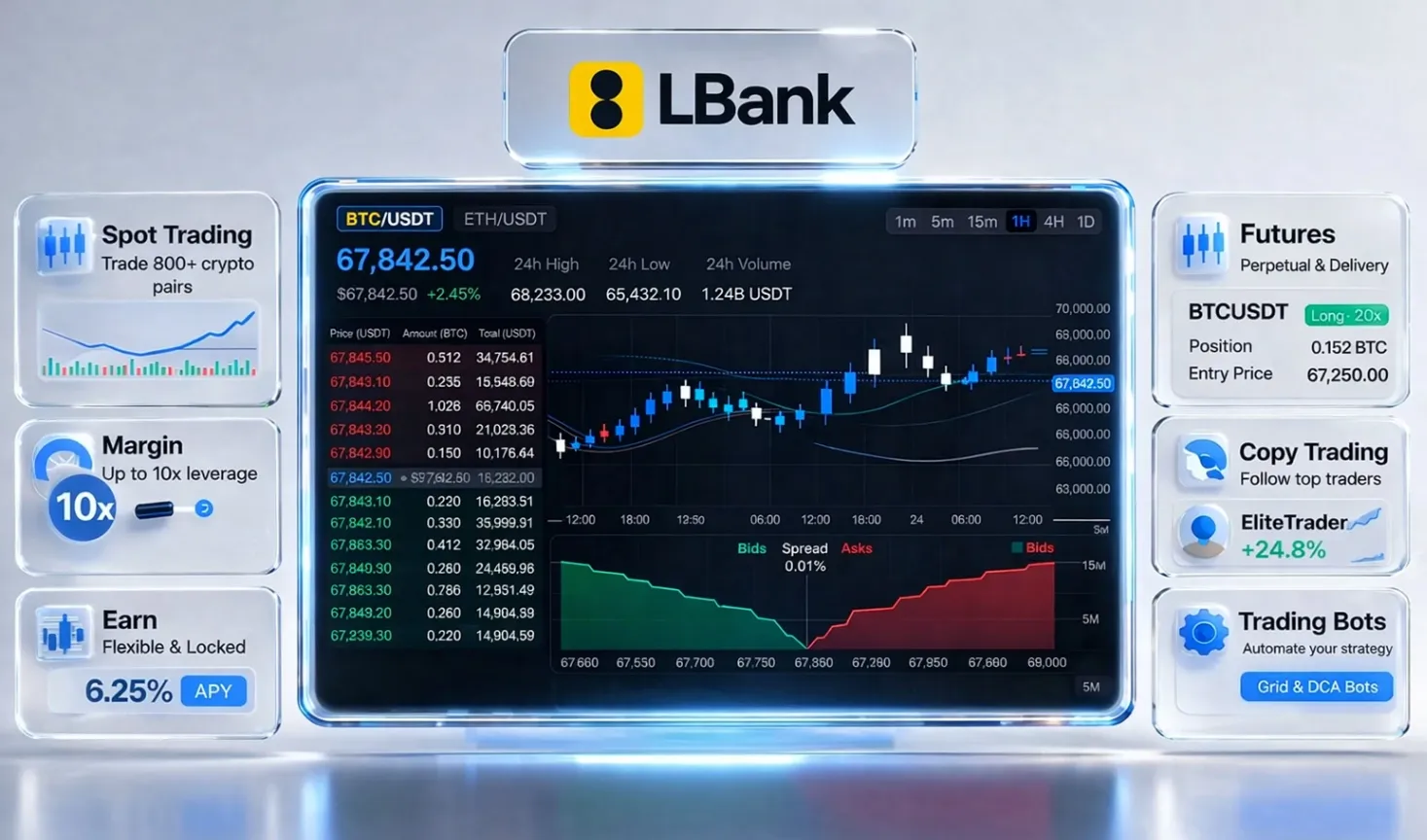
- More than 800 cryptocurrencies and thousands of trading pairs, including BTC, ETH, altcoins, and meme tokens
- Spot and margin trading, perpetual futures, copy trading, Earn products, Launchpad, and Launchpool
- Additional services: an NFT segment, the educational hub LBank Academy, and its own venture division
LBank emphasizes fast listings of new coins. The platform often adds low-cap tokens and meme coins earlier than larger exchanges with stricter listing standards.
Fast listings provide early access to new assets. At the same time, they increase exposure to coins with high volatility, thin order books, and a short trading history.
According to the exchange, the platform operates in more than 210 countries and serves over 15 million users. Third-party reviews sometimes suggest a lower active user base, at roughly 9–12 million.
LBank reports daily turnover of about $3 billion. That figure points to an exchange built for active trading in major pairs, but on its own it does not confirm equal execution quality across all markets.
Beyond its trading markets, LBank has developed related services that broaden the range of use cases within one platform and reinforce the role of its internal ecosystem.
- 🌱 LBank Labs — a division focused on investing in blockchain projects and bringing some of them to the exchange
- 🎓 LBank Academy — materials on trading, blockchain, and the platform’s products
- 💳 Crypto Card — an announced direction for spending through an exchange balance
LBank’s profile is closely tied to early access to new tokens. The exchange is also associated with higher operational risk than large, tightly regulated platforms.
📚 Glossary
Wash trading means trades between a trader’s own orders or related accounts. In the interface, this can look like high volume. In reality, there is no genuine demand or supply behind it.
Liquidity is the amount of orders in the order book and the speed of execution. High liquidity means a trade can be completed without a noticeable price shift.
Order book is the list of buy and sell orders at different price levels. It shows where the nearest volumes are concentrated.
Slippage is the difference between the expected trade price and the actual execution price. It appears when liquidity is insufficient.
Funding rate is a periodic payment between long and short participants in futures markets. It keeps the contract price aligned with the spot market.
Leverage is the use of borrowed funds to increase a position. It magnifies both profit and loss.
Liquidation is the forced closure of a position by the exchange when collateral is no longer sufficient to maintain the trade.
KYC is identity verification based on documents. It affects withdrawal limits and access to platform features.
Escrow is a mechanism that holds funds until a deal is completed. It is used, for example, in P2P trading.
💱 LBank trading instruments: spot, futures, margin, options, and automation
💱 Spot trading on LBank
The spot market involves buying and selling an asset with immediate settlement. There is no futures contract and no mandatory borrowing. When assessing spot trading on LBank, the key factors are the number of pairs, fee levels, and market depth for a specific coin.
- LBank offers more than 800 cryptocurrencies and about 1,300 spot pairs. The exchange actively adds new low-cap tokens and meme coins.
- Spot trading uses a fixed fee of 0.10% for both maker and taker.
- The terminal runs on TradingView charts and basic order types.
- More than 50 fiat currencies and several payment methods are supported through third-party providers.
- Liquidity in BTC/USDT and ETH/USDT appears stronger than in smaller listings.
- For some new assets, order book depth remains limited, while the risk of wash trading and sharp price spikes persists.
📈 LBank futures
Perpetual futures, or perpetuals, make it possible to trade price movements without owning the underlying asset. On LBank, this segment appears more aggressive than spot. Leverage is higher, liquidation risk is greater, and market anomalies have a stronger effect.
- LBank offers perpetual contracts with leverage up to 125x on major pairs and up to 200x on selected assets.
- Cross margin and isolated margin are available, along with hedge mode, which means holding both long and short positions in the same instrument at the same time.
- The insurance fund is stated at $100 million.
- Funding rate is charged every 8 hours. This is a periodic payment between long and short participants that keeps the contract price aligned with spot.
- Fees are 0.02% for maker and 0.06% for taker.
- LBank supports linear contracts in USDT and inverse contracts in the BTC/USD format.
- On low-liquidity contracts, thin order books, sharp moves, and manipulation risk are more visible.
📊 Margin trading on LBank
Spot margin trading differs from futures. Here, the user borrows an asset to increase a position. The main risk is tied to loan servicing costs and the level of collateral.
- On LBank, classic spot margin is available with leverage up to 3x.
- Cross margin uses a shared pool of funds, so a loss on one asset affects the entire margin balance.
- Isolated margin separates each position with its own collateral, so risk is limited to a single trade.
- Loan interest is stated in the range of 1–4% annually. It accrues on the amount of borrowed funds used.
- The trading fee usually matches the spot fee and stands at 0.1%.
- Loss comes not only from price movement but also from the cost of borrowed funds. When a position is held for a long time, loan interest starts to affect the final result.
🧮 Options on LBank
LBank does not offer crypto options trading. Users cannot open call or put contracts within the platform.
- Perpetual futures are available instead of options.
- Leveraged tokens with built-in leverage, usually around x3, are also available.
- These instruments do not provide the fixed risk structure that options do.
🤖 Copy Trading and bots on LBank
Automation on LBank is built around two use cases: copying other traders’ positions and running algorithms based on predefined rules. The main issue here is not ease of entry, but how risk is controlled.
- Copy Trading allows users to connect to selected traders’ strategies and automatically replicate their trades.
- The platform shows a leaderboard, basic statistics, and performance history.
- The end result depends on the quality of the selected trader and the market phase.
- Grid bots are available and automatically place orders within a predefined price range.
- Support for external bots via API is available, including integrations with WunderTrading and CryptoRobotics.
- Automation can speed up strategy deployment, but it does not remove drawdown risk or replace checking the logic of a bot or trader.
👥 Subaccounts on LBank: what is missing and how it affects workflow
Subaccounts are useful when one user runs multiple strategies, separates access rights, or works with different operators. For an active trader, they are a dedicated tool for risk control and permission management.
LBank does not offer full subaccount functionality. Users operate through one main account, with funds, trading activity, and API keys tied to it.
On large exchanges such as Binance or Bybit, subaccounts are a standard tool for teams and capital managers. On LBank, this has to be handled through separate wallets inside the same account. That approach does not provide full isolation.
The lack of subaccounts has little impact on basic retail trading. For team workflows, capital management, and complex API structures, however, it becomes a clear limitation.
🛡️ Verification on LBank: limits, feature access, and regional restrictions
KYC is a client identification procedure based on documents. On LBank, it affects not the ability to open an account itself, but withdrawal limits, access to fiat operations, and some additional products.
LBank allows trading and crypto withdrawals without full mandatory identity verification. Such accounts receive a limited set of features.
- 📉 Unverified accounts are stated to have a withdrawal limit of up to 300,000 USDT per day
- 🚫 Fiat operations are unavailable without completing KYC
- 🚫 Access to Launchpad, Launchpool, and the crypto card is also limited
📑 Verification levels on LBank
| KYC level | Requirements | What it unlocks |
|---|---|---|
| No KYC | Email or phone number | Crypto-to-crypto trading and basic crypto withdrawals |
| KYC Level 1 | Passport, ID, or driver’s license | Access to fiat, higher limits, and participation in Launchpad |
| KYC Level 2 | Selfie or video identification | Maximum limits and full access to platform features |
KYC is needed to remove product restrictions. It also lowers the risk of an account being paused during withdrawal because of repeated identity checks.
🌍 Regional restrictions
LBank restricts access for users from a number of countries and territories. Restricted lists usually include the U.S., China, North Korea, Iran, and other sanctioned jurisdictions.
Trying to bypass restrictions through a VPN creates direct operational risk. If the exchange detects a mismatch between the access region, submitted documents, and account activity, operations may be frozen pending additional review.
LBank allows limited use without KYC. For full access to products and more predictable withdrawals, verification remains a key requirement.
🎁 Bonuses on LBank: participation terms for new accounts
LBank bonus programs follow a “task → reward” model. The exchange does not credit the full package immediately after registration. Each part of the bonus is tied to a deposit, trading volume, or transaction type.
LBank advertises welcome rewards of up to $6,000. This package usually consists of several coupons, bonuses, and promotional rewards. They are activated after the required conditions are met.
- Fee coupons, including discounts or temporary waivers on part of the charges
- Bonuses for deposits and first trades on spot or futures
- Lottery tickets and participation in prize draws
- Airdrops and cashback within promotions tied to new tokens
Conditions for receiving bonus rewards
- ✅ Registration through a referral code or link
- ✅ First spot trade from 100 USDT
- ✅ First futures trade from 1,000 USDT
- ✅ First deposit from 100 USDT
The exchange also runs competitions and tournament campaigns for active traders. In these promotions, the benefit comes through a bonus pool, lower trading costs, or reward distribution based on trading volume.
Bonus rewards usually become available only after turnover or deposit conditions are met. Until then, they remain part of the promotional mechanism rather than freely available balance.
The economic value of bonuses declines if the required turnover increases trading risk faster than the promotional reward itself.
💧 Liquidity on LBank: where market depth is strong and where it is not
Liquidity in crypto trading refers to order book depth, transaction volume, and the level of slippage during execution. On LBank, this metric varies significantly between major pairs and new listings.
For major assets such as BTC and ETH, liquidity on LBank appears stronger than for smaller coins. The exchange reports daily turnover of about $3 billion. That level of volume may support denser order books in major markets, but it does not confirm equal depth across all pairs.
LBank liquidity by market segment
- ✅ High liquidity in major pairs such as BTC/USDT and ETH/USDT
- ✅ Strong initial activity in some newly listed meme tokens
- ✅ Dedicated marketing and trading programs for the meme coin segment
- ⚠️ Rapid deterioration of market depth in small and lesser-known tokens
LBank actively promotes the claim Top 1 in Meme Liquidity and launches campaigns to boost turnover in new assets. High activity in the first hours or days after listing does not mean market depth will remain stable a week or a month later.
Some pairs periodically raise suspicions of wash trading. This refers to artificially inflated turnover created through trades without real market demand. In that case, the volume figure may look large while actual order book depth remains weak.
🔄 OTC trading
LBank also offers an OTC service, meaning over-the-counter deals for large volumes. This format is used to execute large orders without putting pressure on the public order book.
🛡️ Manipulation controls
The exchange says it monitors wash trading and pump & dump schemes. The practical value of this control depends on how effectively it limits artificial moves and reduces price distortion in thin markets.
When execution quality in exotic tokens is assessed, the decisive factors are the depth of the specific order book, the nearest resting orders, and actual slippage, rather than the exchange’s total reported turnover.
LBank’s liquidity is sufficient for major pairs and some active listings. In smaller markets, execution quality can deteriorate quickly.
🖥️ LBank interface: terminal usability, mobile app, and workspace setup
The interface assessment here is based on practical factors. What matters is speed of access to markets, terminal logic, the completeness of the mobile app, and the range of available workspace settings.
The LBank interface follows the standard CEX model. Separate sections are allocated to spot, futures, Earn products, copy trading, and listing-related activity. Core actions are grouped into several large menus.
- Fast access to spot, futures, Earn, copy trading, and other product sections
- Light and dark interface themes
- Multilingual interface support
- Mobile app for iOS and Android with access to the exchange’s core functions
- TradingView chart integration with basic and advanced settings
In the web version, the terminal is clear enough for standard operations. Users can access order types, time-in-force settings, and additional execution parameters. At the same time, the platform stays within the usual feature set of a centralized exchange.
The terminal does not support custom TradingView indicators or a full demo mode. That reduces chart customization flexibility and does not allow thorough testing without real risk.
📱 Mobile app
The mobile app covers the core actions: checking balances, placing trades, monitoring positions, and receiving notifications.
- Access to core trading functions
- Alerts and access to educational materials
- Average user rating of around 3–4 out of 5
🔧 Customization and API
LBank provides an API for connecting bots. Basic interface customization is available, including favorite pairs, balance hiding, and element placement. Deep customization is not available.
Interface limitations
- ❌ No demo trading
- ❌ Limited P2P scenarios
- ❌ Support often starts with a chatbot
The interface covers everyday tasks. In terms of configuration depth, it falls short of platforms designed for professional trading.
🚀 Launchpad and Launchpool on LBank: how to access new tokens
Launchpad and Launchpool are used for early participation in new token distributions. The key point is understanding how allocations are calculated and what meeting the requirements actually unlocks.
Launchpad on LBank provides access to token sales before public listing. After balance or activity requirements are met, the user gains the right to join a subscription or receive an early token allocation.
- Participation through a subscription or lottery model
- After market launch, some projects can show a wide dispersion of outcomes and high price volatility
- Different project categories: DeFi, GameFi, infrastructure, and the meme segment
- KYC completion is mandatory for participation
LBank has its own token, but participation in Launchpad does not require mandatory ownership of it. Access usually depends on average balance, trading volume, or the terms of a specific campaign.
🌱 Launchpool
Launchpool works under a different model. Users lock an asset for a short period and receive new tokens as a reward for participation. This is closer to staking than to buying an allocation.
For some projects, the exchange has advertised yields of up to 2574% APY and higher. That figure does not mean stable long-term yield. In most cases, it refers to a short promotional period at the start of the campaign.
📅 Token sale calendar
The exchange website includes a calendar of current, upcoming, and completed offerings. It shows the preparation period, subscription window, and distribution parameters for each project.
High initial yield in a token sale does not mean high project quality. After listing, the price can retrace quickly if demand disappears in the first trading hours.
💸 Fees on LBank: trading, fiat, and hidden costs
To assess exchange fees, it is not enough to look only at base maker and taker rates. The real transaction cost includes the trading fee, network fee, fiat gateway charge, funding rate, and the spread in instant exchange.
📈 Trading fees
| Trading type | Maker | Taker | Comment |
|---|---|---|---|
| Spot | 0.10% | 0.10% | Fixed rate for the base tier |
| Futures | 0.02% | 0.06% | Lower rates for the derivatives segment |
| Margin spot | 0.10% | 0.10% | Borrowing costs are counted separately |
| Leveraged Tokens | 0.20% | 0.20% | Higher rate due to the product structure |
| P2P | 0% | 0% | The exchange does not charge a trading fee, but the payment method may create additional costs |
💳 Deposits and withdrawals
- ✅ Crypto deposits — no fee on the exchange side
- ✅ Fiat deposits — the fee depends on the third-party gateway and usually falls in the 0–3% range
- ✅ Crypto withdrawals — the user pays the network fee and the exchange’s set fee for the specific asset
- ✅ Internal transfers between LBank users usually go through without a fee
The low 0.1% spot rate does not necessarily mean a low final transaction cost. The total price can increase because of the fiat gateway, the spread in instant buy, or the withdrawal network fee.
⚠️ Costs that are often underestimated
- 📌 Funding rate on perpetual futures every 8 hours
- 📌 Spread in Instant Buy/Sell functions
- 📌 Additional provider spread when buying crypto with fiat
LBank’s base fees look low. The final transaction cost depends on whether the user relies on spot, derivatives, a fiat gateway, or instant exchange without an order book.
🔐 LBank security: account protection, fund storage, and regulatory limits
🔒 Technical protection measures
LBank states a standard set of measures for protecting accounts and funds. These tools are widely used across centralized exchanges and reflect a baseline level of technical protection.
- Storage of the main part of reserves in multi-signature cold wallets
- Two-factor authentication through Google Authenticator or SMS
- Anti-phishing code for emails from the exchange
- Withdrawal address whitelist
- Security audits and bounty programs for vulnerability discovery
- Proof-of-Reserves, meaning publication of reserve proof through a cryptographic structure such as a Merkle tree
This set covers the basic risks of hacking, phishing, and unauthorized withdrawals. In terms of technical protection, LBank follows the standard model of a large CEX.
⚖️ Regulatory side and legal constraints
Regulatory status affects not the terminal itself, but user protection in disputed situations. What matters here is licensing, local registrations, and the process behind compliance checks.
- Local registrations in formats such as MSB and VASP in selected jurisdictions
- Compliance with baseline AML/KYC procedures
- No status as a fully regulated exchange in the largest financial centers
Technical measures reduce the risk of hacking and phishing, but they do not remove legal uncertainty. In a dispute over account suspension or a compliance review, the outcome depends on the exchange’s internal procedure.
🛑 Weak points and custody model
The main security complaints about LBank are tied not only to account protection, but also to how the exchange handles checks and restrictions.
- Complaints about account freezes under the wording risk control
- Limited legal guarantees because of a distributed and offshore structure
- Greater dependence on the exchange’s internal procedures when holding a large balance
LBank’s technical protection looks sufficient for active trading. Long-term storage of a large balance on the exchange increases dependence on its internal procedures and regulatory status.
🧩 Additional LBank services: Earn, P2P, NFT, and OTC
💰 Earn products
Earn means placing cryptocurrency to generate yield. The asset is not used in trading and instead takes part in a program with a stated rate.
- Flexible — free withdrawal and daily accrual
- Locked — fixed term with a higher rate
- The rate may change depending on program conditions
Yield is not fixed. It can decline after the promotional period ends.
🤝 P2P trading
P2P is an exchange between users. The platform holds the cryptocurrency until payment is confirmed.
- Escrow locks the asset until the deal is completed
- Payment verification remains the user’s responsibility
The exchange does not verify transfers or messages. Payment errors remain the user’s responsibility.
🖼️ NFT and wallet
NFT and wallet functions operate inside the exchange account. A separate external wallet is not required.
- Buying and selling NFTs through the account
- Custodial storage — the exchange controls the keys
- Fast transfers within the platform
Users do not control the private keys. Access to funds depends on the exchange.
📦 Additional services
Additional products broaden the range of ways users can work with the exchange.
- Academy — educational materials
- Labs — investments and listing preparation
- OTC — deals outside the public order book
- Crypto Card — spending through a crypto balance
These services make it possible to stay within one platform. That simplifies operations, but it also increases dependence on the exchange.
🛠️ LBank operational risks: key stability factors and vulnerabilities
LBank’s operational profile is shaped not by one factor, but by a combination of conditions. Stability depends on account protection, verification status, liquidity in a specific market, withdrawal parameters, and the way derivative instruments are used.
Operational stability factors on LBank
- 🔒 The presence of 2FA, an anti-phishing code, and a withdrawal whitelist reduces the risk of unauthorized access and mistaken withdrawals
- 📑 KYC status affects limits, access to selected products, and the likelihood of additional review during withdrawal
- 📉 Order book depth in a new or low-liquidity asset directly affects slippage and execution quality
- 🛡️ Futures trading makes entry parameters, leverage size, and the structure of protective orders highly sensitive
- 💼 The amount of funds on the exchange account determines the scale of dependence on the platform’s internal procedures
- 🔍 The quality of a newly listed token depends on liquidity, demand structure, and project history, not only on the fact of listing
- 💳 Withdrawal parameters depend on the available network, limits, and the asset’s ability to handle large transfers without unnecessary costs
- 🤖 API key permissions determine the level of risk when external bots and automation are connected
The main risks on LBank are tied not to account registration, but to withdrawals, trading in thin markets, and high sensitivity to compliance checks.
- 🌐 Withdrawal cost depends on the network fee, the selected asset, and blockchain congestion at the time of the operation
- 🚨 Unusual trading activity or attempts to bypass regional restrictions increase the likelihood of internal account review
- 🔖 Rewards Center promotions can change the economics of a trade if turnover requirements force the user to take on additional risk
- 📞 In disputed operations, the transaction hash, support history, and internal record of actions inside the account become important
For LBank, operational stability is higher in scenarios with a controlled account balance, a clear withdrawal structure, and selective use of high-risk instruments. The operational burden rises when the platform is used at the same time for capital storage, thin-market trading, and promotional mechanics.
🗣️ LBank reputation: what user reviews suggest
Reviews are most useful when the same issues appear repeatedly. For LBank, the main complaints are tied to withdrawals, KYC, and internal account checks.
On platforms such as Trustpilot, LBank’s rating remains low — around 1.8 out of 5. That figure does not prove misconduct on the exchange’s part by itself, but it does point to a high share of conflict-heavy user scenarios.
Recurring complaints in user reviews
- ❌ Account and fund freezes under the wording Risk Control
- ❌ Negative reaction to the LBK token episode and the suspension of its trading
- ❌ Slow verification and delayed support responses
Positive patterns in user reviews
- ✅ Access to a large number of tokens that are not available on more conservative platforms
- ✅ Acceptable trading experience for users working with small amounts and not encountering compliance review
- ✅ The possibility of resolving some issues through support if the request includes all required transaction details
Complaints about LBank focus more often on access to funds and the predictability of internal procedures than on the quality of the terminal itself. Because of that, the reputational risk of this exchange appears higher than on platforms where the main criticism is limited to interface design or response speed.
The overall body of LBank reviews suggests that storing large capital and operating without KYC completed in advance increases the probability of a conflict scenario, even if some users report a workable trading experience.
❓ FAQ about LBank
Is it safe to keep funds on LBank?
Do you need KYC verification to use LBank?
What fees does LBank charge?
What passive income products are available on LBank?
How does spot trading on LBank differ from futures?
How does account blocking work on LBank?
What criteria are used to evaluate a crypto exchange like LBank?
🧾 LBank: key strengths and limitations
LBank stands out for its broad coin selection, fast listings of new assets, low fees in core markets, and a large number of additional services within one platform. This gives users early access to meme coins and altcoins, a choice between spot, futures, copy trading, and token sales, and the ability to use related products without moving to other services.
LBank’s strengths are closely tied to its risks. Fast listings increase the share of low-liquidity and volatile assets. A complex regulatory structure makes legal protection less predictable. User reviews regularly point to issues with withdrawals, KYC checks, and internal risk control.
LBank’s operating model is built around active trading and early listings. For long-term storage of large capital, this platform’s risk profile looks less favorable. The main constraints are tied to liquidity, KYC, and operational risk.