📘 KuCoin overview: markets, tools, and platform scope
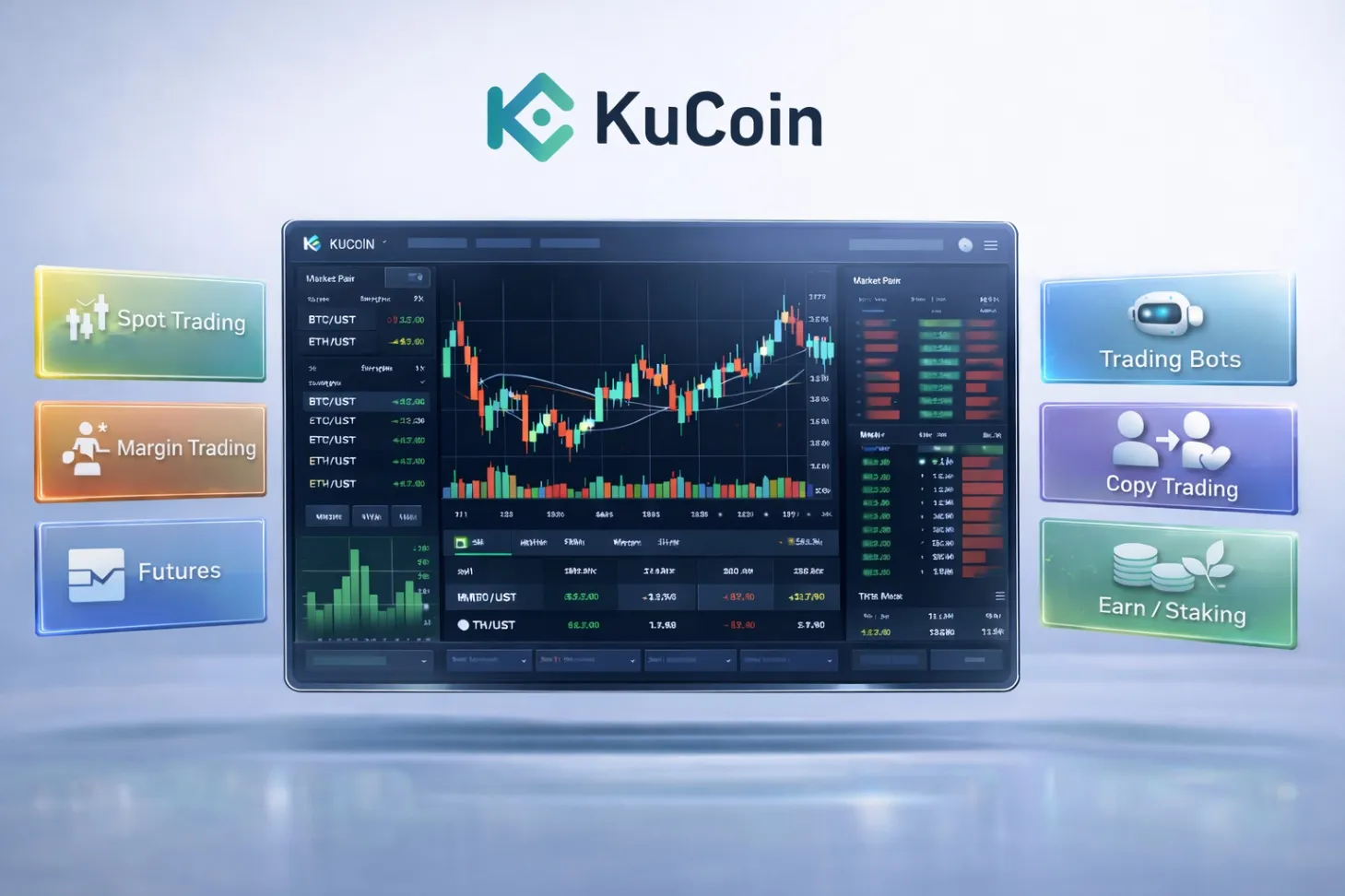
KuCoin brings together spot trading, derivatives, trading bots, sub-accounts, and additional services within a single account. The platform is built not around one tool, but around a broader mix of markets and functions.
KuCoin is a centralized cryptocurrency exchange launched in 2017. According to the platform’s own figures as of March 2026, it serves more than 40 million users across 200+ countries and regions and provides access to 1000+ digital assets and 1300+ trading pairs.
- Spot trading, margin, futures, P2P, and trading bots within one ecosystem
- A broad altcoin lineup, including assets that often appear here earlier than on more conservative platforms
- Tools for different use cases, from simple crypto purchases to automation and multi-account management
KuCoin is most relevant when one account needs spot trading, margin, futures, bots, and operational separation through sub-accounts; the main constraints are tied to KYC, jurisdiction, and uneven liquidity across individual pairs.
KuCoin’s operating model combines broad listings, derivatives, and automation within one account, so spot trades, futures, and algorithmic strategies do not require switching between separate services.
💱 Trading on KuCoin: spot markets, margin, derivatives, and automation
💧 Spot trading
Spot trading is the buying and selling of cryptocurrencies without borrowed leverage. KuCoin uses a maker / taker model. A maker places an order in the order book. A taker executes an existing order.
- Access to 1000+ digital assets and 1300+ trading pairs
- Base fee: 0.10% (maker) and 0.10% (taker)
- The fee may decrease as the VIP level rises, meaning a lower-fee status, or when fees are paid with the exchange token KCS
- For selected tokens and promotional pairs, the rate may differ from the standard level
Limit, market, and stop orders are available in the terminal. The interface also includes charts and indicators for technical analysis.
📊 Margin trading
Margin trading means trading with borrowed funds. KuCoin offers both isolated margin and cross margin.
- With isolated margin, risk is limited to a single position
- With cross margin, the collateral is the total balance of the margin account
- On some isolated pairs, KuCoin has indicated leverage of up to 10x
- Margin parameters depend on the specific pair and the platform’s risk model
A position is liquidated when the collateral is no longer sufficient to cover the debt and maintain the position.
📈 Futures and perpetual contracts
Futures are derivative contracts based on the price of an asset. On KuCoin, the main role is played by perpetual contracts, which have no expiration date.
- Base fee: 0.02% (maker) and 0.06% (taker)
- On some perpetual contracts, KuCoin indicates leverage of up to 125x
- Funding rate is a periodic payment between long positions that bet on price growth and short positions that bet on price decline, usually calculated every 8 hours
- Position results are affected not only by fees, but also by funding payments
Periodic funding payments change the economics of holding a position, so the final result depends not only on the entry price and the trading fee.
🤖 Copy Trading and trading bots
Copy Trading mirrors the trades of a selected trader according to predefined risk parameters. Trading bots automate strategy execution based on preset settings.
- Spot Grid is a grid of buy and sell orders within a defined range
- Futures Grid applies the same logic to derivatives with the added risk of leverage
- DCA means regular purchases at equal time intervals
- Smart Rebalance returns the portfolio to pre-set asset allocations
- Infinity Grid is a grid strategy without a rigid upper range ceiling
The outcome depends not on the bot itself, but on the strategy settings. Automation speeds up execution, but it does not remove market risk.
🧮 Options: as of March 2026, KuCoin no longer treats this area as one of its core products. In December 2025, the exchange announced the end of new options series launches with expiries in January 2026 and later, while funds from the options account, a separate account for options, were transferred back to the funding account, meaning the main account for deposits and fund storage.
👥 KuCoin sub-accounts: separating strategies, teams, and risk
What sub-accounts are: they are not separate independent exchanges inside one profile, but child accounts under one main account (master account). They are used to separate strategies, API, meaning programmatic access to the account through keys, and operations without mixing all trades in one space.
📌 Standard sub-accounts
- The number of sub-accounts depends on the trading level of the main account and can range from 5 to 50
- Sub-accounts inherit the main account’s KYC level and trading fee tier, meaning the fee level
- Sub-account trading volumes are aggregated at the main account level
- Sub-accounts are suitable for separating strategies, API trading, and position control
💼 Managed sub-accounts
- This model is designed for managed trading within the KuCoin infrastructure
- The manager operates on a dedicated account rather than inside the investor’s main account
- The investor keeps the right to fund the account, withdraw funds, and terminate the management arrangement
- This mode is used to separate roles and control access
Sub-accounts are most useful when strategies, teams, capital, and API keys need to be kept separate in practice.
🛡️ Verification on KuCoin: where limited access ends and full access begins
KYC is identity verification through documents and a selfie. Without it, KuCoin does not provide full access to platform functions. The help center still shows limits for unverified accounts, but materials from early 2026 state that identification is required for deposits, trading, and withdrawals.
- After completed verification, the full product set and higher withdrawal limits become available
- For fully verified users, KuCoin states a withdrawal limit of up to 999,999 USDT per day
- Without completed KYC, strict limits may apply to withdrawals, deposits, P2P, crypto purchases with fiat, and access to certain products
KuCoin can no longer be treated as an exchange for full-scale trading without documents. Even if some functions still appear for certain accounts, the workable setup is still built around completed verification.
After verification, limits increase and products such as Spotlight, P2P, and fiat gateways become available.
As of early 2026, identification already determines access to deposits, trading, withdrawals, and part of the product line, so KYC affects not only limits, but also the actual set of available functions.
🎁 KuCoin bonuses for beginners: what promotions offer and where restrictions begin
Welcome offers on KuCoin are tied not to registration itself, but to specific actions. The exchange uses tasks, coupons, and time-limited campaigns. Because of this, the bonus path usually consists of several steps rather than one automatic credit.
- Some rewards unlock only after completed verification
- Conditions are often tied to a deposit, first trade, activation of specific products, or participation in promotional campaigns
- The reward’s validity period affects its value no less than its nominal size
The key issue is not the mere existence of a bonus, but how easily it can be turned into a real trading benefit. If a promotion requires a long chain of actions, its practical value declines.
KuCoin’s bonus model is built around tasks, expiration periods, and product conditions rather than unconditional rewards immediately after registration.
💧 Liquidity on KuCoin: where market depth holds and where slippage rises
Liquidity is the depth of the order book, the volume of matching orders, and the size of slippage when entering and exiting a position. On KuCoin, high liquidity is usually concentrated in major pairs and large perpetual contracts. On smaller altcoins, it is noticeably weaker.
- On major pairs such as BTC/USDT and ETH/USDT, spreads are usually tighter and the execution of large orders is more stable
- On small tokens and recent listings, the order book is thinner, so one large market action can shift the price noticeably
- A large asset list does not make all markets equally liquid
Broad listings can create the impression that all markets within the exchange are equally accessible. In practice, execution quality differs sharply between major pairs and small tokens.
When a strategy is sensitive to slippage, the decisive factors are not the total number of listings, but the depth of a specific pair and trading volume during the relevant hours.
Execution is usually more stable on major markets, while liquidity on smaller altcoins requires a separate check for each individual pair.
🖥️ KuCoin interface: how Lite and Pro modes divide the trading experience
KuCoin is available through a web terminal, iOS and Android mobile apps, as well as Lite and Pro modes inside the app. Lite simplifies purchases and basic actions. Pro restores the full trading interface with charts, orders, and work panels.
- Users can switch between Lite and Pro inside the app
- For futures, KuCoin keeps paper trading, meaning simulated trading without real capital
- The interface is designed not only for one-time purchases, but also for regular trading activity across multiple scenarios
The split between Lite and Pro is visible directly in the interface. One mode covers basic entry, while the other provides the full trading terminal.
🛡️ KuCoin security and regulation: account safeguards and legal access
Account and reserve protection
- Proof of Reserves shows that the exchange publishes reserve data and provides a way to verify asset backing
- The platform states SOC 2 Type II and ISO 27001:2022 certifications
- The account supports 2FA, meaning two-factor authentication, an anti-phishing code, a trading password, and a withdrawal address whitelist
- Protection is built not on one password, but on several layers of confirmation
Regulatory status and geographic restrictions
- In November 2025, the European entity KuCoin EU Exchange GmbH announced that it had obtained a MiCAR license in Austria to operate across 29 EEA countries, where EEA means the European Economic Area; MiCAR is the pan-European regulatory regime for crypto-assets
- Access to KuCoin products depends on jurisdiction, and the platform updates its list of restricted locations in the Terms of Use
- The United States and several other regions are not part of the free-access zones for full platform use
🧩 Additional KuCoin services: what extends the ecosystem beyond trading
💰 Earn and yield products
- KuCoin Earn combines products designed to generate yield on deposited assets
- Different mechanisms are available: fixed-term products, flexible products, staking, and structured products
- Each product type differs in risk level and income predictability
🤝 P2P market
- P2P means direct transactions between users without the participation of an order book
- The exchange holds the cryptocurrency in escrow until payment is confirmed
- Escrow means that the asset is temporarily locked until the transaction is completed
💳 KuCard
- KuCard is a VISA card that converts cryptocurrency into fiat at the moment of payment
- Support is available for Apple Pay and Google Pay
- A separate issuance fee applies to the physical card
🎓 Education and infrastructure
- KuCoin develops educational materials and learning sections
- Solutions are available for institutional clients
- The platform is expanding its Web3 direction, meaning tools for working with blockchain applications and onchain assets, meaning assets and operations recorded directly on the blockchain, as well as payment services inside the ecosystem
- Service availability depends on the region and the specific product
🚀 KuCoin Spotlight: how early token sale access works
KuCoin Spotlight is a launchpad, meaning a platform for initial access to the tokens of new projects before their regular circulation on the spot market. The product provides early entry under the rules of a specific campaign. It does not provide guaranteed profit.
- Completed KYC verification is required for participation
- The exchange states that participation must go through the main account, meaning the primary account, not through a sub-account
- Regional restrictions apply separately to each campaign and depend on compliance rules
- The allocation mechanism depends on the specific token sale: it may be a subscription, a lottery, or another allocation model
Mistakes in evaluating Spotlight usually appear when attention is focused only on past successful launches. Demand, participation terms, and post-listing price behavior differ across projects.
Early entry provides a price advantage only if the project maintains demand after listing. Participation in a launchpad does not guarantee that outcome.
Spotlight changes only the entry point into a token sale, while the final result still depends on the allocation structure, post-listing demand, and price behavior on the spot market.
🤝 KuCoin versus competitors: differences in markets, infrastructure, and limits
KuCoin is usually compared with Binance, OKX, and Bybit. The differences between these platforms come down to their mix of markets, products, and restrictions.
| Exchange | Features of the KuCoin model | Restrictions compared with competitors |
|---|---|---|
| Binance | Broad altcoin listings and access to early tokens | Fewer regulated services and less infrastructure |
| OKX | Strong trading toolkit within one classic exchange | Less developed Web3 infrastructure |
| Bybit | Broader selection of spot assets and built-in trading bots | More complex product structure and more jurisdictional restrictions |
KuCoin is usually chosen for specific tasks: broad listings, futures, automation, and work with multiple trading setups inside one account.
When the priority is broad listings, futures, automation, and sub-accounts, KuCoin covers more scenarios within a single account. When the priority is a simpler interface and a more predictable regulatory structure, the differences from competitors become more noticeable.
🛠️ Operational checkpoints before active trading on KuCoin
- KYC status. Identity verification before transferring large amounts determines access to withdrawals, P2P, and part of the product line.
- Exact fee rate by market. The base 0.10% spot fee does not mean identical conditions for all tokens and promotional pairs.
- Withdrawal network. Transfer cost depends both on the exchange policy and on the selected blockchain.
- Funding rate in futures. The economics of a position depend not only on the trading fee, but also on periodic settlements between long and short positions.
- Order book depth on small tokens. Slippage risk is determined not by the number of listings, but by the liquidity of a specific pair.
- Separation of strategies and API access. Sub-accounts reduce the mixing of positions and keys inside one master account.
- Account protection layers. 2FA, a trading password, an anti-phishing code, and address whitelisting work as one control system for account access and withdrawals.
- P2P counterparty checks. Transaction risk depends on the history of operations, rating, and payment terms of the specific participant.
The core checkpoints on KuCoin are KYC, funding rate, pair liquidity, the withdrawal network, and P2P counterparty risk.
❓ FAQ about KuCoin
What is KuCoin typically used for?
Is KYC required to use KuCoin fully?
How do KuCoin sub-accounts work?
What are KuCoin’s base fees for spot and futures?
Where is slippage risk higher on KuCoin?
What does KuCoin Spotlight do?
🧾 KuCoin: use cases, strengths, and platform limits
The KuCoin model is built for scenarios where one account needs access to a large number of assets, futures, bots, sub-accounts, and additional services.
Its limitations become more visible when the priority is the simplest possible product, full regulatory accessibility, or equally stable execution across the entire altcoin list. That is also shaped by the uneven pace of development across different parts of the ecosystem.
Relevant scenario: working with