📘 BloFin review: exchange overview, core features, fees, and security
The project was founded by entrepreneur Matt Hu in 2019. The exchange’s public launch is stated as January 2023.
The name BloFin comes from the words Blockchain and Finance.
The service description says the platform is available to users in 100+ countries and focuses on perpetual futures trading (futures contracts with no expiration date). The exchange’s materials use the motto “Where whales are made”.
Available products: spot trading, perpetual futures, copy trading (Copy Trading — automatic copying of trades from a selected trader), trading bots, Earn products (placing assets to earn interest), demo mode, and fiat gateways (channels for buying cryptocurrency with bank cards and payment providers).
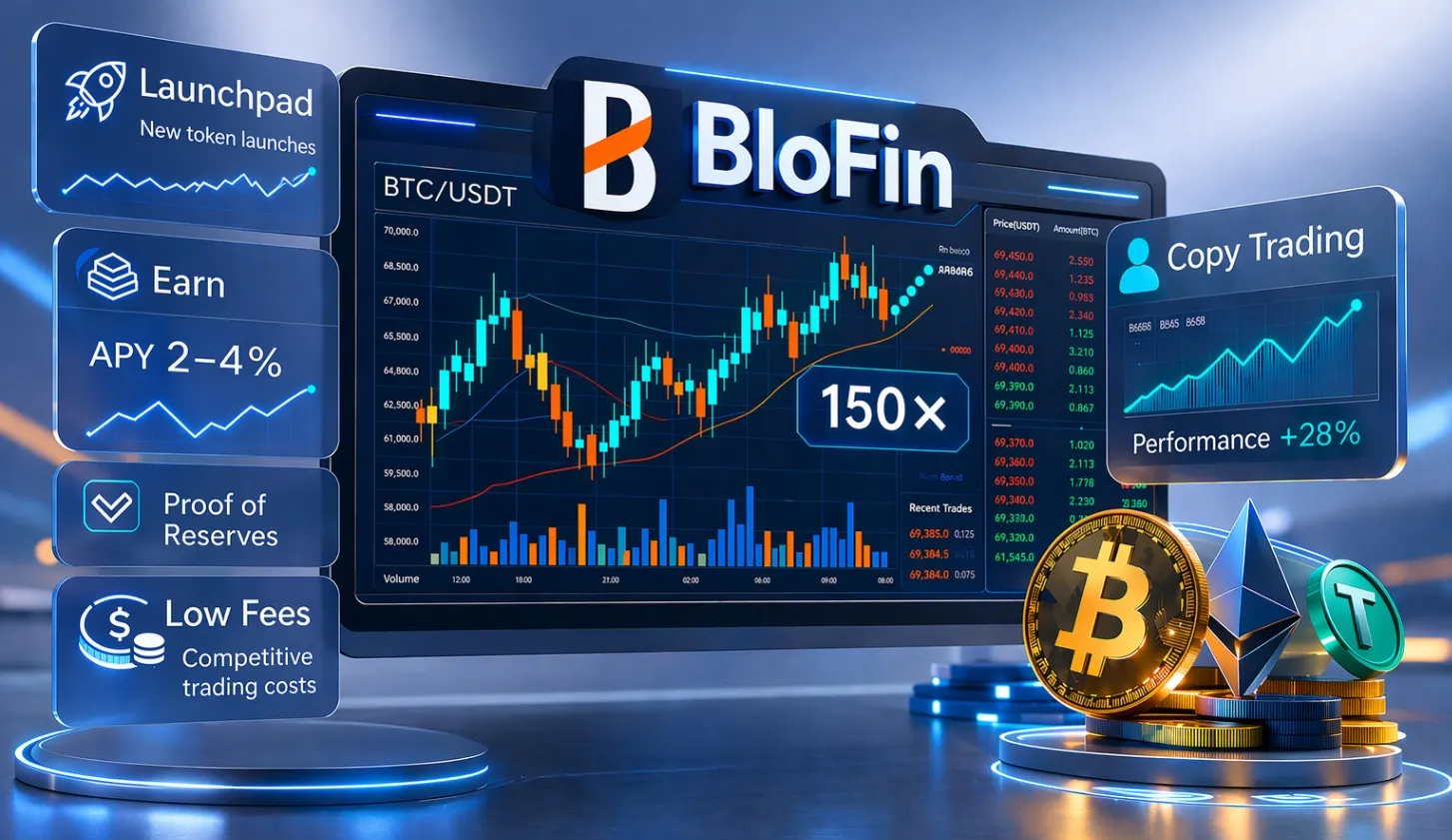
- Focus: perpetual futures with leverage of up to 150×. Leverage increases position size relative to collateral. Copy Trading and trading bots are also listed.
- Market range: 400+ cryptocurrencies on spot and 350+ futures contracts, including BTC, ETH, SOL, XRP, and other altcoins.
- Security: cold storage, Fireblocks custody, 1:1 Merkle proof of reserves, 2FA (two-factor authentication)/Passkeys (Passkeys — login through a device key instead of a password), and an ISO 27001 certificate.
- Fees: spot — 0.10% maker/taker; futures — 0.02%/0.06%. Fee reductions are listed for VIP tiers (VIP tiers — account fee levels based on trading volume and/or asset balance).
Trading volumes on aggregators: BloFin is listed with daily turnover in the hundreds of millions of dollars. Aggregator pages show volume by trading pair; the highest volume usually comes from several of the most actively traded pairs.
💰 BloFin Earn products: interest accrual on placed assets
Flexible placements allow users to add and withdraw funds without a fixed term. Interest accrual is stated as daily.
Fixed placements lock funds for 7/30/90 days. In the fixed placement card, APY (APY — annual percentage yield) is higher than in the flexible placement card.
- Flexible placements: for stablecoins (tokens pegged to the value of a fiat currency), the interface shows a range of about ~2–3% annually; the current APY value is displayed next to the product.
- Fixed terms: for USDT, the interface shows a rate of up to ~4% annually for a longer term.
- Yield tracking: accruals and the unlock date are displayed in the Earn area.
- Product terms: the rate and term are set by the specific Earn product and displayed before funds are placed.
Use case: Earn applies when assets remain on the exchange and interest accrues without opening a spot or futures position.
💱 BloFin spot trading: markets, orders, and fees
Spot trading uses the maker/taker model. Maker is a limit order that adds an order to the order book. Taker is an order that executes against existing orders in the order book.
Spot fee: the base fee is listed as 0.10% for maker and taker. As the VIP tier increases, the fee decreases.
The spot terminal includes:
- TradingView charts, order book, trade feed, limit, market, and stop orders.
- Convert: conversion of one asset into another without manually placing an order in the order book.
- Fiat gateways: buying BTC/ETH/USDT with bank cards and through providers. Fees and payment methods are set by the partner.
- Spot trading in the mobile app (iOS/Android).
BloFin regularly adds new assets. During 2023–2024, the spot list expanded to ~100+ coins. As of 2025, the list is stated as 400+ coins.
📈 BloFin futures and derivatives: leverage, margin, and funding
The terminal includes isolated and cross margin modes. Isolated margin is assigned to a single position. Cross margin is shared across positions on the account.
Hedge mode is also available. In hedge mode, a user can hold a long (a position that benefits from price growth) and a short (a position that benefits from price decline) on the same instrument at the same time.
- Position management: margin selection (isolated/cross) and leverage adjustment for each position.
- Fees: the base rate is 0.02% maker / 0.06% taker. At higher VIP tiers, the fee decreases. Promotional terms may include 0% for maker and about 0.03% for taker.
- Funding rate: a periodic payment between long and short holders. On BloFin, recalculation is stated every 8 hours. The current rate is displayed in the contract interface.
- ADL and insurance fund: ADL (auto-deleveraging) is the forced reduction of a position on the other side of the trade when there is insufficient opposing volume after liquidations. The insurance fund is a reserve used to cover part of the loss during liquidations.
Contract scope: only perpetual contracts are listed. Traditional futures with an expiration date and options are not stated.
The futures terminal displays margin, leverage, estimated PnL (profit and loss), and liquidation price.
🤖 Copy Trading and trading bots on BloFin
The trader card displays return, number of subscribers, Risk Level label, and maximum drawdown.
The master trader’s reward is set as a share of the subscriber’s profit. Copy Trading descriptions show a range of 10–20% when the result is positive.
Copy Trading and bots include:
- Copy settings: fixed amount, share of capital, or Smart Copy mode (the parameter is set in the Copy Trading interface).
- Signal Bot: connection of TradingView signals through webhooks. A webhook is a URL to which TradingView sends a signal.
- Grid Bot: a series of orders across a price grid on futures.
- Demo mode: launching strategies on a virtual balance without real funds.
🚀 BloFin Launchpad status and new token listings
The exchange adds new tokens through spot listing. If a futures contract is available, the token is also added to the futures list.
- Listings: adding new assets to the spot market.
- Token Splash: reward tasks for assets after listing.
- Risk asset labeling: a separate category with warnings for highly volatile tokens.
Hedging: if a token trades on spot and a futures contract is available at the same time, a user can open a spot position and an opposite futures position. This setup is used to reduce price risk during market fluctuations.
🛡️ BloFin security and regulation: custody, reserves, and KYC
🔐 Asset storage and technical protection
- Cold storage: most assets are managed through Fireblocks (MPC — multi-party computation, distributed signing of operations by several participants).
- Proof-of-Reserves: the exchange publishes 1:1 Merkle proof of reserves. This allows users to verify that their balance is included in the general list of client liabilities and included in the reserve calculation.
- AML monitoring: integrations with Chainalysis/AnChain.AI and KYT checks (KYT — know your transaction, checking the source and route of a transaction). Suspicious transactions may be blocked.
- Account protection: 2FA through Google Authenticator, SMS codes, an anti-phishing code for emails, and login with Passkeys (login through a device key instead of a password).
⚖️ Regulation and KYC requirements
The restriction description states that the service is unavailable in several countries, including the United States, Canada, China, Singapore, and other jurisdictions.
- Without KYC: registration, deposit, and trading are available. Withdrawals are limited to about 20,000 USDT per day. KYC means identity verification.
- After completing KYC: withdrawal limits increase. Access to fiat gateways and some promotional campaigns becomes available. The process description states a completion time of 5–10 minutes.
When assets are stored on the exchange, withdrawal keys are controlled by the exchange. When assets are stored in a self-custody wallet, withdrawal keys are held by the user.
💸 BloFin fees: trading costs, deposits, and withdrawals
Cost structure: trading fees, network withdrawal fees, and costs visible in order execution and futures calculations.
📈 Trading fees
- Spot: 0.10% maker/taker.
- Futures: 0.02% maker / 0.06% taker.
- VIP tiers: the fee decreases as 30-day trading volume and/or asset balance increases. Higher tiers list rates down to 0% maker / 0.035% taker for futures and down to 0.01% maker / 0.0325% taker for spot.
💳 Deposits and withdrawals
- Crypto deposits: no exchange-side fee is stated; the network fee is paid.
- Fiat deposits/withdrawals: processed through third-party providers; the typical fee range is listed as 1–5% and depends on the partner.
- Crypto withdrawals: the fee is set by the selected network and displayed when choosing the withdrawal network (for example, USDT on TRC20 and ERC20). The value changes with network conditions.
🖥️ BloFin interface and ease of use
Access channels: web platform and iOS/Android apps with the main trading sections.
- Web platform: trading terminal, sections for spot, futures, Earn, Copy Trading, and bots.
- Mobile apps: trading, deposits/withdrawals, notifications, and bot management.
- Demo mode: testing spot, futures, and strategies on a virtual balance.
- Sub-accounts and access rights: sub-accounts are additional accounts inside the main profile; they are used to separate access and API permissions for algorithmic trading.
- Themes and materials: light/dark themes, BloFin Academy reference materials, and BloFin Research.
🎁 BloFin bonuses, promotions, and referral program
Rewards Hub: BloFin’s promotional activity area, where bonuses and campaigns are described.
The Rewards Hub describes a set of welcome rewards totaling up to 5,000 USDT. Rewards are listed as bonuses and vouchers for futures trading.
Reward conditions: the description lists registration, KYC completion, Passkey/2FA setup, first deposit, and first trade.
Promotional activity formats: beyond welcome rewards, the Rewards Hub publishes other campaign types.
- Welcome missions: Mystery Box (a promotional box with a predefined reward type) for registration, security setup, and first account actions.
- Deposit bonuses: bonus accrual when funding a futures account from a specified amount.
- Referral program: up to 30% of trading fees from invited users; descriptions for major partners mention up to 50%.
- Tournaments and Trade-to-Earn: fee cashback and prizes for trading volume; Trade-to-Earn means campaigns with rewards for trading volume. Some campaigns may include airdrops (token distributions to campaign participants).
🗣️ BloFin user reviews and reputation
Review pattern: both positive and negative ratings appear.
In negative cases, users most often describe deductions caused by funding payments and futures liquidations. Reports also mention sharp price spikes on individual trading pairs, bonus accrual delays, and slow support replies by email.
Typical points from reviews:
- Positive: fees, access to derivatives with leverage of up to 150×, Copy Trading and bots, demo mode.
- Negative: claims about futures calculations during high volatility, bonus delays, and support quality in individual cases.
⚖️ BloFin compared with major competitors
| Platform | What is stated by the competitor | How BloFin’s product set is described alongside it |
|---|---|---|
| Binance | Launchpad, NFT, P2P, own exchange token. | BloFin does not state an exchange token; its core products focus on spot, perpetual futures, Copy Trading, and bots. |
| Bybit | Positioning as an exchange focused on derivatives. | In product comparison, perpetual futures, maker/taker fees, Copy Trading, and bots are listed. |
| BingX / Bitget / Gate | Descriptions often emphasize Copy Trading and IEO/Launchpad programs. | BloFin’s description lists Fireblocks and 1:1 Proof-of-Reserves as operational security elements. |
🔖 BloFin advantages and limitations
Pros
- Perpetual futures with leverage of up to 150×.
- 400+ spot assets and 350+ futures contracts.
- Copy Trading and trading bots.
- Spot fees of 0.10% and futures fees of 0.02%/0.06%, with reductions at VIP tiers.
- Fireblocks, 1:1 Proof-of-Reserves, 2FA/Passkeys, and an ISO 27001 certificate.
Cons
- BloFin does not have its own exchange token; fee reductions are tied to VIP tiers and promotional conditions.
- The service description does not state licenses from major regulators (SEC, FCA, and others).
- A proprietary Launchpad (IEO) is not stated in the interface.
- Review descriptions include claims about futures calculations, bonuses, and support performance in individual cases.
- The restriction description states that the service is unavailable in several countries.
✅ BloFin review summary
BloFin is a centralized crypto exchange. BloFin’s description highlights perpetual futures, Copy Trading, and trading bots. The stated terms include 0.10% spot fees and 0.02%/0.06% futures fees. Leverage of up to 150× is listed for some contracts. 1:1 Proof-of-Reserves through a Merkle proof is also stated.
BloFin’s limitations are linked to the absence of stated licenses from major regulators and to futures trading risks. Funding payments and liquidations are recorded in position history and may lead to losses during short-term price movements.