📘 BitMart Exchange Overview: Core Facts and Product Scope
BitMart is a centralized crypto exchange with offshore registration. The platform focuses on a broad range of tokens, derivatives (trading instruments whose price depends on an underlying asset), and multiple products within a single account.
BitMart is strongest where broad token access and futures trading matter most. Its main limitations are tied to reserve transparency and its regulatory setup.
This review explains where BitMart works well for trading, where its limitations appear, and what risks come with this operating model.
BitMart was founded in 2017 and launched in 2018. The exchange is registered in the Cayman Islands and says it serves users in more than 180 countries.
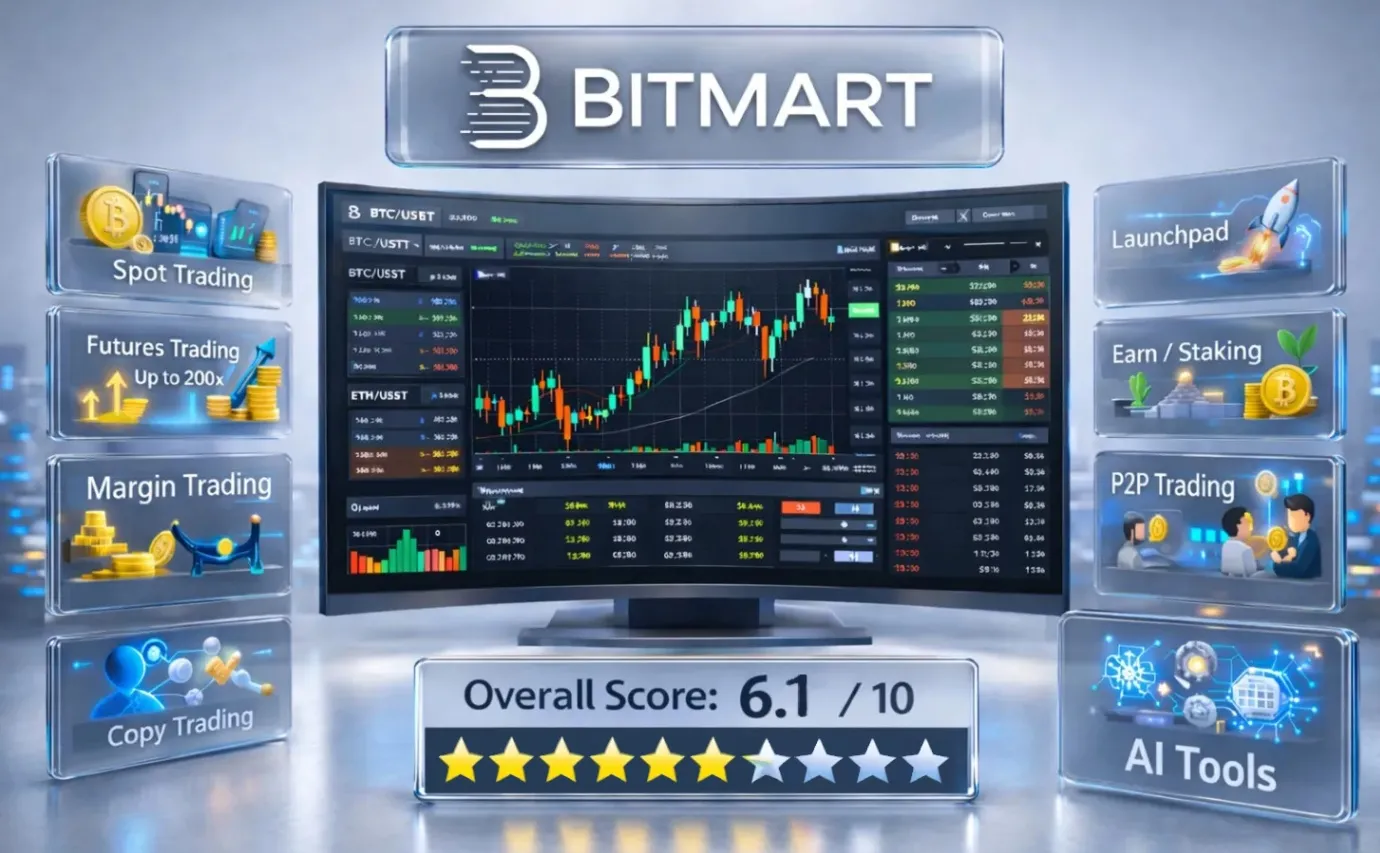
Within one account, users can access spot trading, margin trading, futures with leverage up to 200×, Earn products, new token launches, P2P (trades between users), an NFT section (a section for non-fungible tokens), educational materials, AI tools (tools based on artificial intelligence), and the BMX token. The BMX token is used for fee discounts and access to selected platform privileges.
- 🌍 The exchange says it serves users in more than 180 countries
- 💰 1,700+ cryptocurrencies and around 1,500 trading pairs
- 📈 USDⓈ-M (stablecoin-settled futures) and COIN-M (crypto-settled futures) are available with leverage up to 200×
- 🧾 The BMX token provides a 25% discount when used to pay trading fees
- 🚀 The exchange regularly adds new tokens, including high-risk altcoins and meme coins
BitMart is often chosen for access to a large number of tokens and multiple trading modes within one account. Maximum legal transparency is not one of the platform’s strongest points.
🏆 BitMart Awards and Recognition: What External Acknowledgment Shows
| Year | Award / achievement | Comment |
|---|---|---|
| 2019 | BrandLaureate Tech Award | The award recognized the product’s technology side and the exchange’s contribution to blockchain development. |
| 2024 | “Best Exchange for Altcoins” | The award is tied to the breadth of listings and the regular addition of new tokens. |
📖 Core Crypto Exchange Terms: Short Glossary and Key Concepts
📉 Liquidation
The automatic closure of a position by the exchange when the loss on a trade approaches the size of the collateral.
📚 Order Book
A list of all active buy and sell orders in the market.
🧾 Maker and Taker
Maker is an order that adds liquidity to the order book. Taker is an order executed against an existing order and removes liquidity from the market.
🤝 P2P Trading
A format for buying and selling cryptocurrency directly between users. The exchange acts as an intermediary and helps ensure the trade is completed.
🔒 Escrow
A transaction protection mechanism used in P2P trading. During the trade, the exchange temporarily locks the seller’s cryptocurrency. The asset is released to the buyer only after payment is confirmed.
📈 Funding Rate
A periodic payment between participants in the futures market. It helps keep the futures contract price close to the asset’s spot price.
💱 BitMart Trading Products: Spot, Margin, and Derivatives
📈 Spot Trading
Buying and selling cryptocurrencies without leverage through the order book.
On spot markets, both major coins and low-liquidity altcoins are available. Most trading volume is concentrated in pairs with USDT and USDC, which are stablecoins pegged to the US dollar. For fiat deposits, BitMart uses two channels. The first is P2P, where users buy cryptocurrency from each other. The second is partner payment gateways, which allow purchases by card or other electronic payment methods.
- More than 1,700 coins, including a dedicated Innovation Zone for new projects
- Fees: 0.15% maker and 0.25% taker
- Terminal with TradingView charts, an order book, and market depth
- Cryptocurrency purchases through P2P or payment partners
- Mobile apps mirror the core functions of the web terminal
Most BitMart trading volume is concentrated in BTC/USDT and ETH/USDT pairs. For low-liquidity tokens, checking order book depth matters, otherwise a large order can move the price noticeably.
📊 Futures (Perpetuals)
Perpetual futures contracts with leverage and a funding mechanism.
BitMart offers perpetual futures in two formats. USDⓈ-M uses stablecoin settlement. COIN-M uses settlement and collateral in the cryptocurrency itself. Maximum leverage on major markets reaches 200×. For many altcoins, leverage is lower and more often falls in the 20–50× range.
- Fees: 0.02% maker and 0.04% taker
- Funding is charged every 8 hours between longs and shorts
- Support for cross margin and isolated margin modes
- Stop orders, trailing stops, and hedge mode
- Copy trading and trading bots
High leverage of 100×–200× increases profit potential but sharply raises liquidation risk. Even a small price move can close the position.
💳 Margin Trading
Spot trading with borrowed funds and leverage.
Margin trading on spot markets offers leverage of up to 5×. The user borrows an asset from the exchange and opens a position on the spot market. In addition to the trading fee, loan interest is charged. Its size depends on the specific asset.
- Fees match spot fees, but borrowing costs are added
- If collateral value drops, the exchange first issues a margin call
- If value falls further, the position is liquidated
Margin trading plays a secondary role on BitMart. Most user activity is concentrated in spot and futures markets.
🚀 Launchpad and 💰 Earn: Where BitMart Offers Yield and Where Risk Rises
Launchpad and the LaunchPrime format provide access to early token offerings before they reach open trading. Participation terms depend on the campaign. In one case, a subscription is required; in another, a lottery; and in a third, the user must hold BMX or lock USDT during the selection period. The main risk appears after listing. The price of a new token can rise sharply and then fall just as quickly.
Earn: Savings, Staking, and Loans
- 💹 Savings: flexible and fixed products are available. Yield is shown as APY, meaning the estimated annual percentage yield. For some top assets, the exchange states yields of up to about 15% annually, but this rate usually applies only to a limited amount. Above that threshold, the rate declines
- 🔒 Staking: allows users to allocate assets like ETH and SOL without running their own node or configuring a validator
- 🏦 Crypto Loans: the user receives a loan secured by cryptocurrency collateral. The maximum loan-to-value ratio (LTV) reaches about 65%. The borrowing cost depends on which asset is borrowed
A high percentage does not mean the same level of risk across all products. Flexible savings, fixed deposits, staking, and crypto loans all operate under different models.
BitMart’s strength in this area is the breadth of its product lineup. Its weaker side is the standard CEX risk: the user hands assets over to the exchange and depends on its solvency, internal processes, and withdrawal rules.
🤝 P2P and Fiat Gateways: How Fiat On-Ramps and Off-Ramps Work
P2P on BitMart allows users to buy and sell cryptocurrency directly with other users through an escrow mechanism. The exchange temporarily holds the cryptocurrency until payment is confirmed. The P2P fee is 0.1% from each side of the trade. The total cost on turnover is about 0.2%.
The second option is buying through payment partners. In this case, the user does not choose the counterparty manually. The fee for this type of purchase is higher. The final markup usually falls in the 3–5% range above the market rate.
P2P requires users to verify payment details and the counterparty. A payment gateway removes that part of the process, but increases the cost of the purchase.
BitMart Card is presented as a debit card in partnership with Visa for spending from a crypto balance. Card availability depends on the region and the rollout stage.
BitMart has two working channels for moving in and out of fiat: P2P and partner payment gateways. Compared with the largest exchanges, this model usually means fewer banking integrations and greater dependence on third-party payment partners.
🧩 Additional BitMart Services: What Meaningfully Extends the Platform
- 🖼 NFT marketplace: allows users to mint and trade NFTs through integration with the exchange account; the stated fee is around 1%
- 📚 BitMart Academy: includes reference materials, basic terms, and educational articles
- 🤖 AI Hub: combines AI-based tools, including the Beacon assistant, the Top KOL section (a selection of market opinion leaders), and market sentiment analytics
- 👥 Sub-accounts and VIP: allow users to separate access rights, assets, and workflows within one management structure; VIP refers to privilege tiers for clients with higher trading volume
- 🪙 Web3 wallet and on-chain DEX: provide a separate mode for self-custody and decentralized exchange; a Web3 wallet means a wallet where the user controls the keys, and an on-chain DEX means trading through the blockchain without a centralized operator
BitMart’s additional services are centered around the trading account. The NFT section, AI Hub, sub-accounts, and Web3 mode expand the range of use cases within the exchange ecosystem, but they do not replace separate specialized products for custody, analytics, or decentralized trading.
💸 BitMart Fees: Where Costs Are Clear and Where Separate Calculation Matters
| Operation type | Rate | Note |
|---|---|---|
| Spot | maker 0.15% / taker 0.25% | The rate declines as volume increases and when fees are paid with the BMX token. |
| Futures | maker 0.02% / taker 0.04% | Futures fees are noticeably lower than spot fees; additional discount tiers apply to VIP users. |
| P2P | ~0.1% from each side | The fee is charged only after the trade is completed. |
| Cryptocurrency deposit | 0% | The exchange does not charge deposit fees, but some tokens may have a built-in tax or deflationary mechanism. |
| Cryptocurrency withdrawal | Fixed network fee | The fee depends on the selected network and the specific asset. |
The final cost on BitMart includes the base fee, the BMX discount, the selected withdrawal network, and, in margin and lending products, the borrowing cost as well.
In fee terms, BitMart looks stronger in derivatives than in spot trading. The most noticeable savings appear with active trading and when fees are paid with the BMX token.
⚖️ Regulation and Restrictions: How BitMart Is Structured Legally
The legal status of an exchange affects regional availability, the KYC procedure, the risk of account restrictions, and the legal protection available in a dispute.
BitMart operates as an offshore crypto exchange. The platform is not among exchanges licensed by major Western regulators such as the SEC (the U.S. Securities and Exchange Commission) and the FCA (the UK Financial Conduct Authority).
Its European entity is registered in Lithuania as a VASP, meaning a virtual asset service provider. This status helps meet AML (anti-money laundering) requirements, but it does not make BitMart an exchange with strict supervision across all parts of its business.
Regional restrictions include:
- 🚫 Access is restricted for residents of the United States, the United Kingdom, a number of sanctioned countries, and certain territories
- 🏦 In some regions, trading is available but banking infrastructure works in a limited way, so users rely on P2P or partner gateways
🛡️ BitMart Security and Technical Reliability: Protection, Incidents, and Reserves
BitMart’s security profile should be viewed on three levels. The first level is account protection. The second is incident history. The third is transparency in reserve verification.
🔐 Account Protection and Asset Storage
BitMart uses standard account security mechanisms and withdrawal control procedures.
- 2FA (two-factor authentication), an anti-phishing code, and a withdrawal address whitelist are available
- The exchange uses a combination of hot and cold wallets
- Multisignature is used for some operations
- Large withdrawals go through additional review
- Suspicious activity is monitored by internal systems
Account protection is built around standard security tools and additional withdrawal controls.
⚠️ The 2021 Incident and Its Aftermath
In December 2021, two BitMart hot wallets were compromised.
- Losses were estimated at around $150–200 million
- After the incident, the exchange temporarily suspended withdrawals
- BitMart conducted an internal investigation
- Users were promised compensation from the company’s own funds
This episode shows that BitMart has a history of a serious security incident. Holding large sums on the exchange should be assessed with that case in mind.
📊 Proof of Reserves and Performance
PoR (Proof of Reserves) shows whether an exchange can prove it holds the assets needed to cover user balances.
- BitMart reported work on a PoR system based on a Merkle tree (a cryptographic hash tree)
- The exchange partially disclosed hot wallet addresses
- A full public PoR report is not yet available
- Separately, the exchange said it introduced a third-generation matching engine with performance of up to ~80 thousand orders per second
- This figure refers to system performance during periods of sharp volatility
Based on public information, BitMart describes standard account protection tools and reports matching-engine performance of up to ~80 thousand orders per second, but a full public PoR report is still unavailable.
👤 BitMart Verification: Which KYC Levels Unlock Key Features
| Level | What is required | Access and limits |
|---|---|---|
| Level 1 (Starter) | Basic information: name, country, and date of birth. | Withdrawals up to ~0.06 BTC per day; spot and P2P are available, while futures and margin are unavailable. |
| Level 2 (Advanced) | ID document and selfie for biometric verification. | Withdrawals up to ~100 BTC per day and access to all major products, including futures, margin, Launchpad, and Earn. |
Verification impact: on BitMart, this is not just a formality before withdrawals. Full verification unlocks access to a large share of the platform’s functionality. Without it, the account remains in a limited mode.
🖥️ Interface and Apps: How Comfortable BitMart Is in Daily Use
- 🌐 The web interface is built around clear navigation between spot, derivatives, Earn, and P2P
- 📈 The terminal includes TradingView charts, advanced order types, and separate modes by difficulty level
- 📱 iOS and Android apps cover trading, KYC, Earn, Launchpad, and P2P
- 🔌 There is a trading API (an interface for connecting external programs) and WebSocket (a real-time market data channel) for algorithmic strategies and external automation
- 🆘 Support works through chat and tickets, but response speed depends on workload
The BitMart interface does not change the security level or reduce fees by itself. It provides a practical trading environment across a large number of markets, including markets beyond the usual list of top coins.
🎁 Bonuses, Promotions, and Referral Program: Where the Value Is and Where the Conditions Matter
Promotions on an exchange should be assessed through the conditions for receiving and using the bonus. Without that context, the reward size alone says very little.
- 🎉 Welcome Rewards: a set of starter bonuses for registration, KYC, deposit, and first trades
- 👥 Referral program: the invited user receives a fee discount, while the referrer receives a reward that can reach around 40%
- 🏁 Trading competitions: the exchange regularly launches campaigns with prize pools based on trading volume or PNL (profit and loss on trades)
- 💳 Fee holidays and cashback: fees on selected pairs may be temporarily reduced to zero or partially refunded
- 🪙 BMX loyalty: token holders receive additional privilege tiers and access to selected activities
- 🎁 PowerDrop: token distributions for completing a set of actions within the exchange ecosystem
🗣️ BitMart Reputation and User Reviews: What Gets Praise and What Draws Criticism
Exchange reviews are most useful where they show real experience with withdrawals, KYC verification, and communication with support in disputed situations.
Reviews of BitMart are polarized. Positive feedback is usually tied to the broad altcoin selection, bonuses, and access to multiple trading modes from one account. Negative feedback is more often linked to withdrawal delays in specific cases, unexpected requests for additional KYC, and slow support during periods of heavy workload.
Operational account control includes:
- 🔐 The use of 2FA, an anti-phishing code, and a withdrawal address whitelist
- 💼 Avoiding long-term storage of capital that is not used for trading or allocation
- 🧾 Completing KYC before any disputed withdrawal situation arises
- 📊 Checking market depth before placing a large trade in rare tokens
Positive reviews are more often tied to access to a broad listing and multiple trading modes within one account. Harsher feedback appears in cases where support response speed, withdrawal stability, and the transparency of the legal structure become critical.
🔄 BitMart vs Other Exchanges: Where It Stands Out and Where It Falls Short
It is easier to compare BitMart not with the whole market at once, but across three groups: altcoin exchanges, large universal platforms, and more strictly regulated exchanges.
| Exchange group | Examples | Where BitMart is stronger | Where it is weaker |
|---|---|---|---|
| Altcoin exchanges | KuCoin, Gate.io, MEXC, LBank | Broad token listings and a developed derivatives market | No clear advantage in reserve transparency or legal structure |
| Large universal exchanges | Binance, OKX, Bybit | Access to less-known tokens and new listings | Lower liquidity on core pairs, weaker fiat infrastructure, and weaker reserve transparency |
| Regulated exchanges | Coinbase, Kraken | A broader asset list and a more aggressive altcoin offering | A weaker regulatory base and weaker legal protection for users |
❓ FAQ About BitMart: Fees, KYC, Futures, and Security
Do you need KYC verification to trade on BitMart?
What trading fees does BitMart charge?
Does BitMart offer futures trading with leverage?
How can you buy cryptocurrency with fiat on BitMart?
How secure is the BitMart exchange?
What bonuses and promotions does BitMart offer?
Does BitMart have a mobile app for trading?
In which countries is BitMart unavailable?
🧾 BitMart Overview: Core Strengths and Limitations
BitMart combines spot, margin, futures, Earn, Launchpad, P2P, and supporting products within one account. The platform’s main strength lies in its broad listings, access to new tokens, and a functional derivatives lineup with relatively low futures fees.
The main limitations sit elsewhere in the model. They include the offshore structure, the history of a serious hack, incomplete public Proof of Reserves, and a support reputation that can be less predictable in difficult cases. BitMart is geared more toward active trading than toward long-term storage of a significant share of capital.
BitMart is more often used in scenarios involving